Home
Department Of Physics text logo
  • Research
    • Our research
    • Our research groups
    • Our research in action
    • Research funding support
    • Summer internships for undergraduates
  • Study
    • Undergraduates
    • Postgraduates
  • Engage
    • For alumni
    • For business
    • For schools
    • For the public
  • Support
Menu
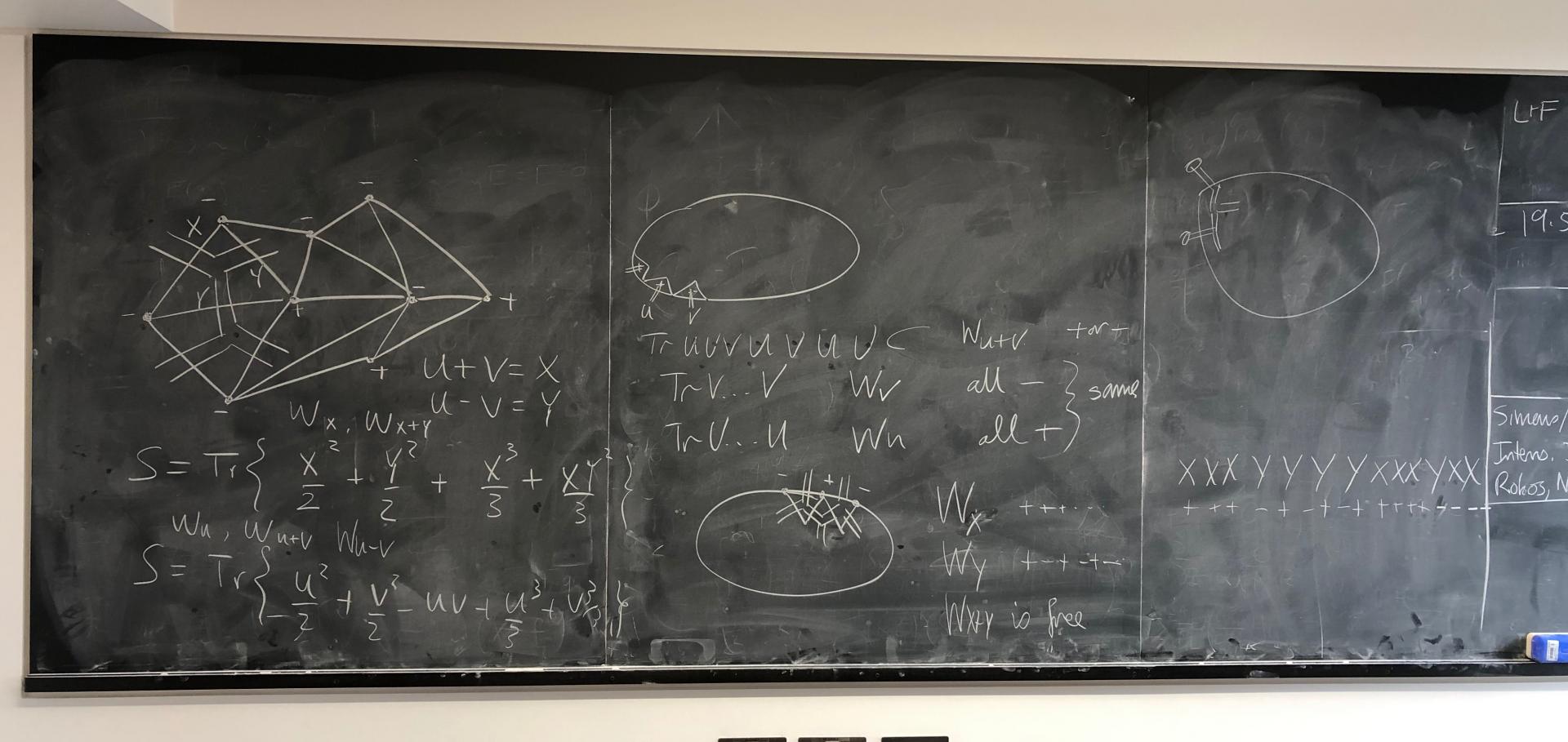
A blackboard in my office

John Wheater

Professor of Physics, Head of Particle Theory Group

Research theme

  • Fundamental particles and interactions
  • Fields, strings, and quantum dynamics

Sub department

  • Rudolf Peierls Centre for Theoretical Physics

Research groups

  • Particle theory
John.Wheater@physics.ox.ac.uk
Telephone: 01865 (2)73961
Rudolf Peierls Centre for Theoretical Physics, room 60.06
  • About
  • Research
  • Teaching
  • Publications

Three-State Complex Valued Spins Coupled to Binary Branched Polymers in Two-Dimensional Quantum Gravity

(1997)

Authors:

Joao D Correia, John F Wheater
More details from the publisher

Branched polymers, complex spins and the freezing transition

ArXiv hep-lat/9708027 (1997)

Authors:

Joao D Correia, Behrouz Mirza, John F Wheater

Abstract:

We show that by coupling complex three-state systems to branched-polymer like ensembles we can obtain models with gamma-string different from one half. It is also possible to study the interpolation between dynamical and crystalline graphs for these models; we find that only when geometry fluctuations are completely forbidden is there a crystalline phase.
Details from ArXiV
More details from the publisher

Branched polymers, complex spins and the freezing transition

(1997)

Authors:

Joao D Correia, Behrouz Mirza, John F Wheater
More details from the publisher

ND Tadpoles as New String States and Quantum Mechanical Particle-Wave Duality from World-Sheet T-Duality

ArXiv hep-th/9703141 (1997)

Authors:

Ian I Kogan, John F Wheater

Abstract:

We consider new objects in bosonic open string theory -- ND tadpoles, which have N(euman) boundary conditions at one end of the world-sheet and D(irichlet) at the other, must exist due to s-t duality in a string theory with both NN strings and D-branes. We demonstrate how to interpolate between N and D boundary conditions. In the case of mixed boundary conditions the action for a quantum particle is induced on the boundary. Quantum-mechanical particle-wave duality, a dual description of a quantum particle in either the coordinate or the momentum representation, is induced by world-sheet T-duality. The famous relation between compactification radii is equivalent to the quantization of the phase space area of a Planck cell. We also introduce a boundary operator - a ``Zipper'' which changes the boundary condition from N into D and vice versa.
Details from ArXiV
More details from the publisher

ND Tadpoles as New String States and Quantum Mechanical Particle-Wave Duality from World-Sheet T-Duality

(1997)

Authors:

Ian I Kogan, John F Wheater
More details from the publisher

Pagination

  • First page First
  • Previous page Prev
  • …
  • Page 15
  • Page 16
  • Page 17
  • Page 18
  • Current page 19
  • Page 20
  • Page 21
  • Page 22
  • Page 23
  • …
  • Next page Next
  • Last page Last

Footer Menu

  • Contact us
  • Giving to the Dept of Physics
  • Work with us
  • Media

User account menu

  • Log in

Follow us

FIND US

Clarendon Laboratory,

Parks Road,

Oxford,

OX1 3PU

CONTACT US

Tel: +44(0)1865272200

University of Oxfrod logo Department Of Physics text logo
IOP Juno Champion logo Athena Swan Silver Award logo

© University of Oxford - Department of Physics

Cookies | Privacy policy | Accessibility statement

Built by: Versantus

  • Home
  • Research
  • Study
  • Engage
  • Our people
  • News & Comment
  • Events
  • Our facilities & services
  • About us
  • Giving to Physics
  • Current students
  • Staff intranet