Home
Department Of Physics text logo
  • Research
    • Our research
    • Our research groups
    • Our research in action
    • Research funding support
    • Summer internships for undergraduates
  • Study
    • Undergraduates
    • Postgraduates
  • Engage
    • For alumni
    • For business
    • For schools
    • For the public
  • Support
Menu
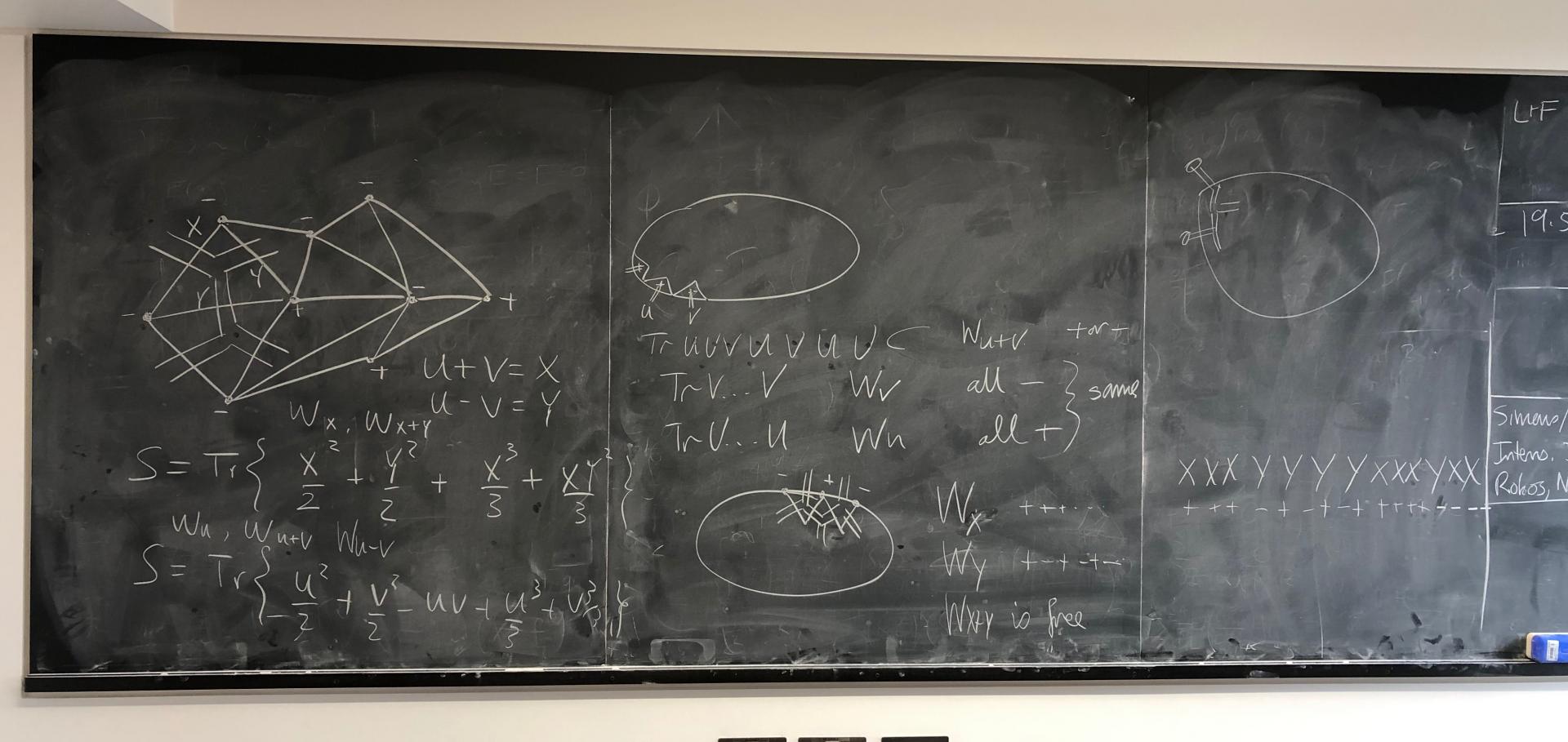
A blackboard in my office

John Wheater

Professor of Physics, Head of Particle Theory Group

Research theme

  • Fundamental particles and interactions
  • Fields, strings, and quantum dynamics

Sub department

  • Rudolf Peierls Centre for Theoretical Physics

Research groups

  • Particle theory
John.Wheater@physics.ox.ac.uk
Telephone: 01865 (2)73961
Rudolf Peierls Centre for Theoretical Physics, room 60.06
  • About
  • Research
  • Teaching
  • Publications

High-Temperature Properties of the Z(3) Interface in (2+1)-D SU(3) Gauge Theory

(1996)

Authors:

ST West, JF Wheater
More details from the publisher

Properties of the Z(3) interface in (2+1)-D SU(3) gauge theory

NUCL PHYS B (1996) 535-538

Authors:

ST West, JF Wheater

Abstract:

A study is made of some properties of this interface in the SU(3) pure gauge theory in 2+1 dimensions. At high temperatures, the interface tension is measured and shows agreement with the perturbative prediction. Near the critical temperature, the behaviour of the interface is examined, and its fluctuations compared to a scalar field theory model.
More details from the publisher
Details from ArXiV

Properties of the Z(3) Interface in (2+1)-D SU(3) Gauge Theory

(1995)

Authors:

ST West, JF Wheater
More details from the publisher

The Critical Exponents of Crystalline Random Surfaces

ArXiv hep-lat/9503008 (1995)

Abstract:

We report on a high statistics numerical study of the crystalline random surface model with extrinsic curvature on lattices of up to $64^2$ points. The critical exponents at the crumpling transition are determined by a number of methods all of which are shown to agree within estimated errors. The correlation length exponent is found to be $\nu=0.71(5)$ from the tangent-tangent correlation function whereas we find $\nu=0.73(6)$ by assuming finite size scaling of the specific heat peak and hyperscaling. These results imply a specific heat exponent $\alpha=0.58(10)$; this is a good fit to the specific heat on a $64^2$ lattice with a $\chi^2$ per degree of freedom of 1.7 although the best direct fit to the specific heat data yields a much lower value of $\alpha$. Our measurements of the normal-normal correlation functions suggest that the model in the crumpled phase is described by an effective field theory which deviates from a free field theory only by super-renormalizable interactions.
Details from ArXiV
More details from the publisher

The Critical Exponents of Crystalline Random Surfaces

(1995)
More details from the publisher

Pagination

  • First page First
  • Previous page Prev
  • …
  • Page 18
  • Page 19
  • Page 20
  • Page 21
  • Current page 22
  • Page 23
  • Page 24
  • Page 25
  • Page 26
  • …
  • Next page Next
  • Last page Last

Footer Menu

  • Contact us
  • Giving to the Dept of Physics
  • Work with us
  • Media

User account menu

  • Log in

Follow us

FIND US

Clarendon Laboratory,

Parks Road,

Oxford,

OX1 3PU

CONTACT US

Tel: +44(0)1865272200

University of Oxfrod logo Department Of Physics text logo
IOP Juno Champion logo Athena Swan Silver Award logo

© University of Oxford - Department of Physics

Cookies | Privacy policy | Accessibility statement

Built by: Versantus

  • Home
  • Research
  • Study
  • Engage
  • Our people
  • News & Comment
  • Events
  • Our facilities & services
  • About us
  • Giving to Physics
  • Current students
  • Staff intranet