QED-enhanced PDF implications for the Higgs sector

(2025)

Authors:

Amanda M Cooper-Sarkar, Thomas Cridge, TJ Hobbs, Joey Huston, Pavel Nadolsky, Maximiliano Ponce-Chavez, Keping Xie

Searches for direct slepton production in the compressed-mass corridor in sqrt(๐’”) = 13 TeV ๐’‘ ๐’‘ collisions with the ATLAS detector

Journal of High Energy Physics Springer 2025:8 (2025) 53

Abstract:

This paper presents searches for the direct pair production of charged light-flavour sleptons, each decaying into a stable neutralino and an associated Standard Model lepton. The analyses focus on the challenging โ€œcorridorโ€ region, where the mass difference, ฮ”๐‘š, between the slepton (๐‘’หœ or ๐œ‡หœ) and the lightest neutralino (๐œ’หœ 0 1 ) is less or similar to the mass of the ๐‘Š boson, ๐‘š(๐‘Š), with the aim to close a persistent gap in sensitivity to models with ฮ”๐‘š โ‰ฒ ๐‘š(๐‘Š). Events are required to contain a high-energy jet, significant missing transverse momentum, and two same-flavour opposite-sign leptons (๐‘’ or ๐œ‡). The analysis uses ๐‘ ๐‘ collision data at โˆš ๐‘  = 13 TeV recorded by the ATLAS detector, corresponding to an integrated luminosity of 140 fbโˆ’1 . Several kinematic selections are applied, including a set of boosted decision trees. These are each optimised for different ฮ”๐‘š to provide expected sensitivity for the first time across the full ฮ”๐‘š corridor. The results are generally consistent with the Standard Model, with the most significant deviations observed with a local significance of 2.0 ๐œŽ in the selectron search, and 2.4 ๐œŽ in the smuon search. While these deviations weaken the observed exclusion reach in some parts of the signal parameter space, the previously present sensitivity gap to this corridor is largely reduced. Constraints at the 95% confidence level are set on simplified models of selectron and smuon pair production, where selectrons (smuons) with masses up to 300 (350) GeV can be excluded for ฮ”๐‘š between 2 GeV and 100 GeV.

AION-10: Technical Design Report for a 10m Atom Interferometer in Oxford

(2025)

Authors:

K Bongs, A Brzakalik, U Chauhan, S Dey, O Ennis, S Hedges, T Hird, M Holynski, S Lellouch, M Langlois, B Stray, B Bostwick, J Chen, Z Eyler, V Gibson, TL Harte, CC Hsu, M Karzazi, C Lu, B Millward, J Mitchell, N Mouelle, B Panchumarthi, J Scheper, U Schneider, X Su, Y Tang, K Tkalร„ยec, M Zeuner, S Zhang, Y Zhi, K Clarke, A Vick, CFA Baynham, O Buchmรƒยผller, D Evans, L Hawkins, R Hobson, L Iannizzotto-Venezze, A Josset, D Lee, E Pasatembou, BE Sauer, MR Tarbutt, T Walker, L Badurina, A Beniwal, D Blas, J Carlton, J Ellis, C McCabe, G Parish, D Pathak Govardhan, V Vaskonen, T Bowcock, K Bridges, A Carroll, J Coleman, G Elertas, S Hindley, C Metelko, H Throssell, JN Tinsley, E Bentine, M Booth, D Bortoletto, C Foot, N Callaghan, C Gomez-Monedero, K Hughes, A James, T Leese, A Lowe, J March-Russell, J Sander, J Schelfhout, I Shipsey, D Weatherill, D Wood, SN Balashov, MG Bason, K Hussain, H Labiad, P Majewski, AL Marchant, D Newbold, Z Pan, Z Tam, TC Thornton, T Valenzuela, MGD van der Grinten, I Wilmut

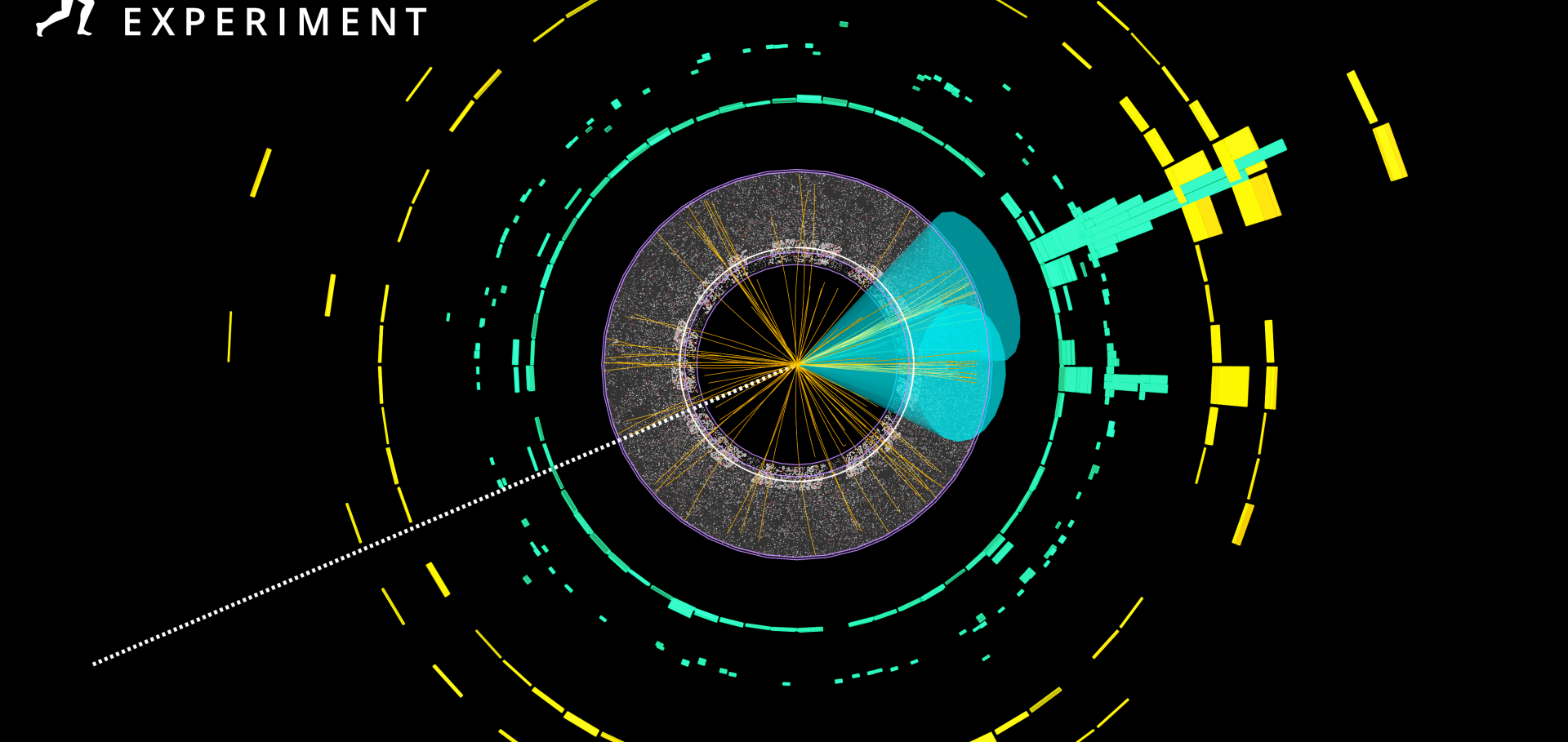
Measurements of the production cross-sections of a Higgs boson in association with a vector boson and decaying into WW * with the ATLAS detector at s = 13 TeV

Journal of High Energy Physics Springer 2025:8 (2025) 34

Authors:

G Aad, E Aakvaag, B Abbott, S Abdelhameed, K Abeling, NJ Abicht, SH Abidi, M Aboelela, A Aboulhorma, H Abramowicz, H Abreu, Y Abulaiti, BS Acharya, A Ackermann, C Adam Bourdarios, L Adamczyk, SV Addepalli, MJ Addison, J Adelman, A Adiguzel, T Adye, AA Affolder, Y Afik, MN Agaras

Abstract:

Measurements of the total and differential Higgs boson production cross-sections, via WH and ZH associated production using H โ†’ WW* โ†’ โ„“ฮฝโ„“ฮฝ and H โ†’ WW* โ†’ โ„“ฮฝjj decays, are presented. The analysis uses proton-proton events delivered by the Large Hadron Collider at a centre-of-mass energy of 13 TeV and recorded by the ATLAS detector between 2015 and 2018. The data correspond to an integrated luminosity of 140 fbโˆ’1. The sum of the WH and ZH cross-sections times the H โ†’ WW* branching fraction is measured to be 0.44โˆ’0.09+0.10stat.โˆ’0.05+0.06syst. pb, in agreement with the Standard Model prediction. Higgs boson production is further characterised through measurements of the differential cross-section as a function of the transverse momentum of the vector boson and in the framework of Simplified Template Cross-Sections.

A Morphological Model to Separate Resolvedโ€“Unresolved Sources in the DESI Legacy Surveys: Application in the LS4 Alert Stream

Publications of the Astronomical Society of the Pacific IOP Publishing 137:8 (2025) 084501

Authors:

Chang Liu, Adam A Miller, Joshua S Bloom, Robert A Knop, Peter E Nugent

Abstract:

Separating resolved and unresolved sources in large imaging surveys is a fundamental step to enable downstream science, such as searching for extragalactic transients in wide-field time-domain surveys. Here we present our method to effectively separate point sources from the resolved, extended sources in the Dark Energy Spectroscopic Instrument (DESI) Legacy Surveys (LS). We develop a supervised machine learning model based on the Gradient Boosting algorithm XGBoost. The features input to the model are purely morphological and are derived from the tabulated LS data products. We train the model using โˆผ2 ร— 105 LS sources in the COSMOS field with HST morphological labels and evaluate the model performance on LS sources with spectroscopic classification from the DESI Data Release 1 (โˆผ2 ร— 107 objects) and the Sloan Digital Sky Survey Data Release 17 (โˆผ3 ร— 106 objects), as well as on โˆผ2 ร— 108 Gaia stars. A significant fraction of LS sources are not observed in every LS filter, and we therefore build a โ€œHybridโ€ model as a linear combination of two XGBoost models, each containing features combining aperture flux measurements from the โ€œblueโ€ (gr) and โ€œredโ€ (iz) filters. The Hybrid model shows a reasonable balance between sensitivity and robustness, and achieves higher accuracy and flexibility compared to the LS morphological typing. With the Hybrid model, we provide classification scores for โˆผ3 ร— 109 LS sources, making this the largest ever machine learning catalog separating resolved and unresolved sources. The catalog has been incorporated into the real-time pipeline of the La Silla Schmidt Southern Survey (LS4), enabling the identification of extragalactic transients within the LS4 alert stream.