Titan's atmospheric temperatures, winds, and composition.

Science 308:5724 (2005) 975-978

Authors:

FM Flasar, RK Achterberg, BJ Conrath, PJ Gierasch, VG Kunde, CA Nixon, GL Bjoraker, DE Jennings, PN Romani, AA Simon-Miller, B Bézard, A Coustenis, PGJ Irwin, NA Teanby, J Brasunas, JC Pearl, ME Segura, RC Carlson, A Mamoutkine, PJ Schinder, A Barucci, R Courtin, T Fouchet, D Gautier, E Lellouch, A Marten, R Prangé, S Vinatier, DF Strobel, SB Calcutt, PL Read, FW Taylor, N Bowles, RE Samuelson, GS Orton, LJ Spilker, TC Owen, JR Spencer, MR Showalter, C Ferrari, MM Abbas, F Raulin, S Edgington, P Ade, EH Wishnow

Abstract:

Temperatures obtained from early Cassini infrared observations of Titan show a stratopause at an altitude of 310 kilometers (and 186 kelvin at 15 degrees S). Stratospheric temperatures are coldest in the winter northern hemisphere, with zonal winds reaching 160 meters per second. The concentrations of several stratospheric organic compounds are enhanced at mid- and high northern latitudes, and the strong zonal winds may inhibit mixing between these latitudes and the rest of Titan. Above the south pole, temperatures in the stratosphere are 4 to 5 kelvin cooler than at the equator. The stratospheric mole fractions of methane and carbon monoxide are (1.6 +/- 0.5) x 10(-2) and (4.5 +/- 1.5) x 10(-5), respectively.

Titan's Atmospheric Temperatures, Winds, and Composition.

Science 308 (2005) 975-978

Authors:

FW Taylor, Flasar F.M., Achterberg, R.K., Conrath, B.J.

Temperatures, Winds, and Composition in the Saturnian System

Science 307 (2005) 1247-1251

Authors:

FM Flasar, PGJ Irwin, SB Calcutt, R Achterberg, FW Taylor

Direct imaging searches for planets around white dwarf stars

Proceedings of the International Astronomical Union 1:S232 (2005) 344-349

Authors:

M Burleigh, E Hogan, F Clarke

Abstract:

White dwarfs are excellent targets for direct imaging searches for extra-solar planets, since they are up to 104 times fainter than their main sequence progenitors, providing a huge gain in the contrast problem. In addition, the orbits of planetary companions that lie beyond the maximum extent of the Red Giant envelope are expected to widen considerably, improving resolution and further encouraging direct detection. We discuss current searches for planetary companions to white dwarfs, including our own "DODO" programme. At the time of writing, no planetary companion to a white dwarf has been detected. The most sensitive searches have been capable of detecting companions ≳5MJup, and their non-detection is consistent with the conclusions of McCarthy & Zuckerman (2004), that no more than 3% of stars harbour 5-10MJup planets at orbits between 75-300AU. Extremely Large Telescopes are required to enable deeper searches sensitive to lower mass planets, and to provide larger target samples including more distant and older white dwarfs. ELTs will also enable spectroscopic follow-up for any resolved planets, and follow-up of any planetary companions discovered astrometrically by GAIA and SIM. © 2006 International Astronomical Union.

Exploring the Saturn system in the thermal infrared: The composite infrared spectrometer

Space Science Reviews 115:1-4 (2005) 169-297

Authors:

FM Flasar, VG Kunde, MM Abbas, RK Achterberg, P Ade, A Barucci, B Bézard, GL Bjoraker, JC Brasunas, S Calcutt, R Carlson, CJ Césarsky, BJ Conrath, A Coradini, R Courtin, A Coustenis, S Edberg, S Edgington, C Ferrari, T Fouchet, D Gautier, PJ Gierasch, K Grossman, P Irwin, DE Jennings, E Lellouch, AA Mamoutkine, A Marten, JP Meyer, CA Nixon, GS Orton, TC Owen, JC Pearl, R Prangé, F Raulin, PL Read, PN Romani, RE Samuelson, ME Segura, MR Showalter, AA Simon-Miller, MD Smith, JR Spencer, LJ Spilker, FW Taylor

Abstract:

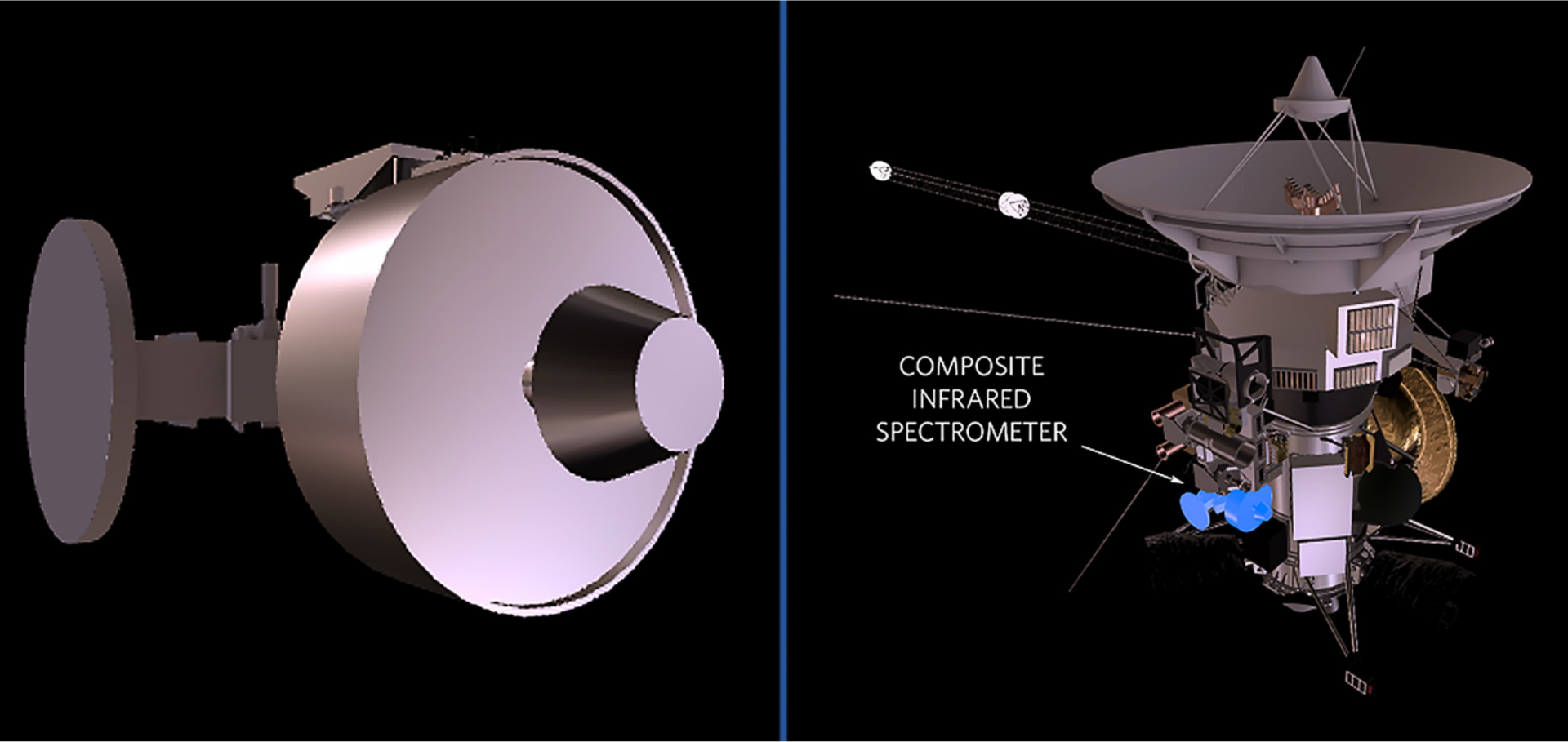
The Composite Infrared Spectrometer (CIRS) is a remote-sensing Fourier Transform Spectrometer (FTS) on the Cassini orbiter that measures thermal radiation over two decades in wavenumber, from 10 to 1400 cm- 1 (1 mm to 7μ m), with a spectral resolution that can be set from 0.5 to 15.5 cm- 1. The far infrared portion of the spectrum (10-600 cm - 1) is measured with a polarizing interferometer having thermopile detectors with a common 4-mrad field of view (FOV). The middle infrared portion is measured with a traditional Michelson interferometer having two focal planes (600-1100 cm- 1, 1100-1400 cm- 1). Each focal plane is composed of a 1× 10 array of HgCdTe detectors, each detector having a 0.3-mrad FOV. CIRS observations will provide three-dimensional maps of temperature, gas composition, and aerosols/condensates of the atmospheres of Titan and Saturn with good vertical and horizontal resolution, from deep in their tropospheres to high in their mesospheres. CIRS's ability to observe atmospheres in the limb-viewing mode (in addition to nadir) offers the opportunity to provide accurate and highly resolved vertical profiles of these atmospheric variables. The ability to observe with high-spectral resolution should facilitate the identification of new constituents. CIRS will also map the thermal and compositional properties of the surfaces of Saturn's icy satellites. It will similarly map Saturn's rings, characterizing their dynamical and spatial structure and constraining theories of their formation and evolution. The combination of broad spectral range, programmable spectral resolution, the small detector fields of view, and an orbiting spacecraft platform will allow CIRS to observe the Saturnian system in the thermal infrared at a level of detail not previously achieved. © 2004 Kluwer Academic Publishers.