

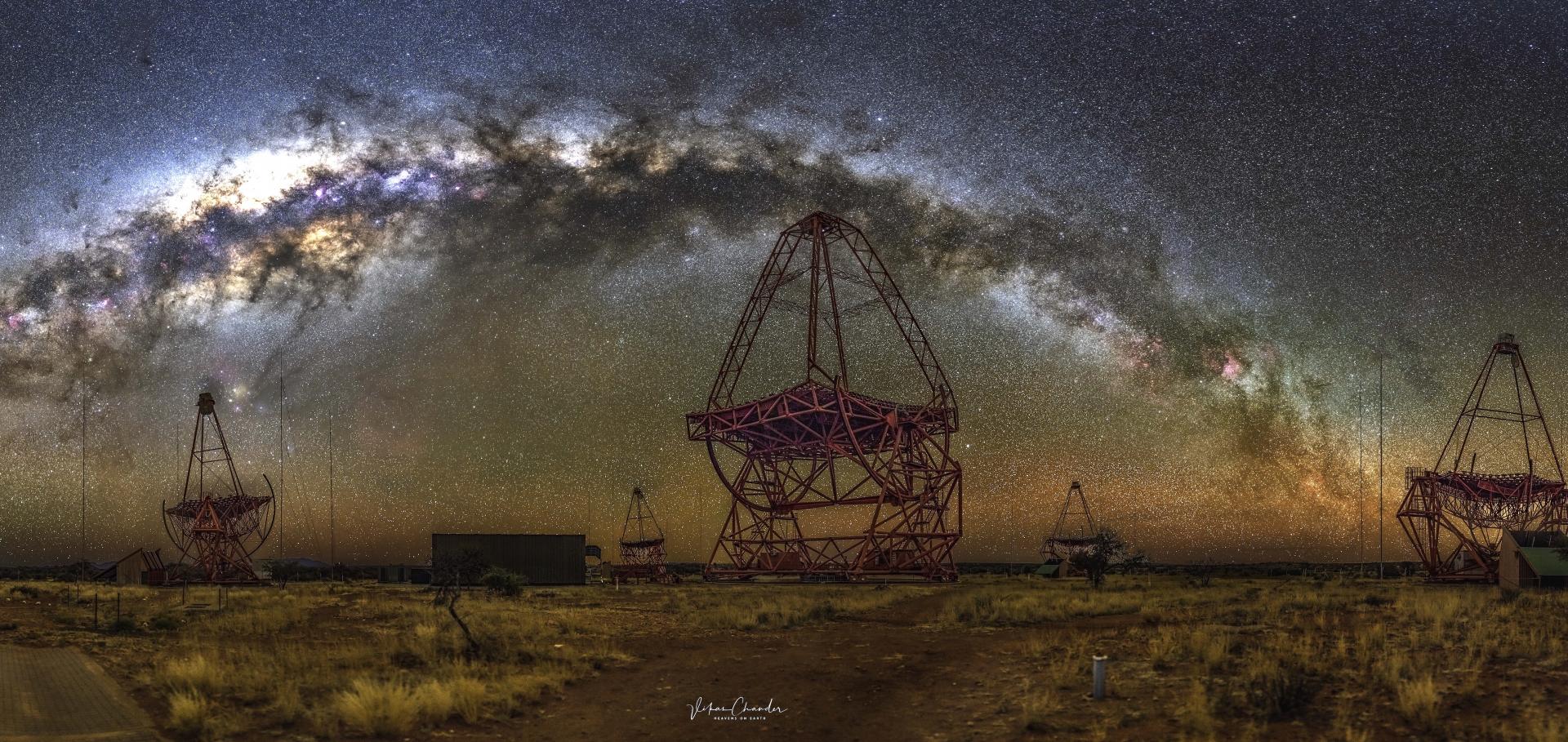
Detectability of Supernova remnants with the Southern Wide-field Gamma-ray Observatory
Journal of Cosmology and Astroparticle Physics IOP Publishing 2025:05 (2025) 096
Abstract:
Supernova remnants (SNRs) are likely sources of hadronic particle acceleration within our galaxy, contributing to the galactic cosmic ray flux. Next-generation instruments, such as the Southern Wide-field Gamma-ray Observatory (SWGO), will be of crucial importance in identifying new candidate SNRs. SWGO will observe two-thirds of the gamma-ray sky, covering the energy range between a few hundreds of GeV and a PeV. In this work, we apply a model of SNR evolution to a catalogue of SNRs in order to predict their gamma-ray spectra, explore the SNR emission phase space, and quantify detection prospects for SWGO. Finally, we validate our model for sources observed with current-generation instruments, fitting it using a Monte-Carlo Markov Chain technique to the observed gamma-ray emission from four SNRs. We anticipate that at least 6, and potentially as many as 11 SNRs will be detected by SWGO within 1 year.Gone with the Wind: JWST-MIRI Unveils a Strong Outflow from the Quiescent Stellar-Mass Black Hole A0620-00
(2025)
Relativistic ejecta from stellar mass black holes: insights from simulations and synthetic radio images
Monthly Notices of the Royal Astronomical Society Oxford University Press 540:1 (2025) 1084-1106
Abstract:
We present numerical simulations of discrete relativistic ejecta from an X-ray binary (XRB) with initial conditions directly informed by observations. XRBs have been observed to launch powerful discrete plasma ejecta during state transitions, which can propagate up to parsec distances. Understanding these ejection events unveils new understanding of jet-launching, jet power, and jet–interstellar medium (ISM) interaction among other implications. Multifrequency quasi-simultaneous radio observations of ejecta from the black hole XRB MAXI J1820+070 produced both size and calorimetry constraints, which we use as initial conditions of a relativistic hydrodynamic simulation. We qualitatively reproduce the observed deceleration of the ejecta in a homogeneous ISM. Our simulations demonstrate that the ejecta must be denser than the ISM, the ISM be significantly low density, and the launch be extremely powerful, in order to propagate to the observed distances. The blob propagates and clears out a high-pressure low-density cavity in its wake, providing an explanation for this pre-existing low-density environment, as well as ‘bubble-like’ environments in the vicinity of XRBs inferred from other studies. As the blob decelerates, we observe the onset of instabilities and a long-lived reverse shock – these mechanisms convert kinetic to internal energy in the blob, responsible for in situ particle acceleration. We transform the outputs of our simulation into pseudo-radio images, incorporating the coverage of the MeerKAT and e-MERLIN telescopes from the original observations with real-sky background. Through this, we maximize the interpretability of the results and provide direct comparison to current data, as well as provide prediction capabilities.The Double Tidal Disruption Event AT 2022dbl Implies That at Least Some "Standard" Optical TDEs are Partial Disruptions
ArXiv 2505.16867 (2025)
MeerKAT discovery of a hyperactive repeating fast radio burst source
Monthly Notices of the Royal Astronomical Society Oxford University Press 540:2 (2025) 1685-1700