

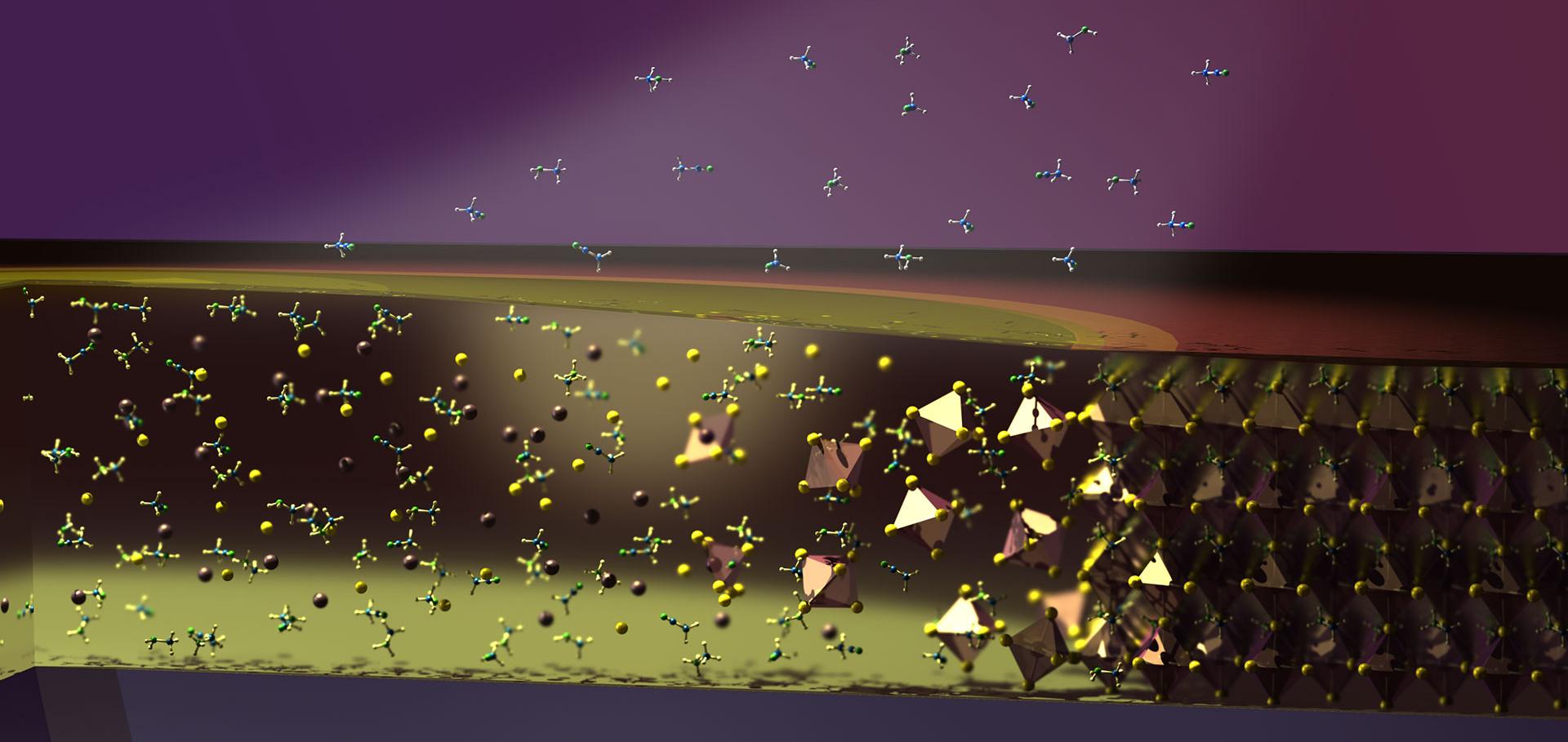
Enhanced photoluminescence and solar cell performance via Lewis base passivation of organic-inorganic lead halide perovskites
ACS Nano American Chemical Society 8:10 (2014) 9815-9821
Abstract:
Organic-inorganic metal halide perovskites have recently emerged as a top contender to be used as an absorber material in highly efficient, low-cost photovoltaic devices. Solution-processed semiconductors tend to have a high density of defect states and exhibit a large degree of electronic disorder. Perovskites appear to go against this trend, and despite relatively little knowledge of the impact of electronic defects, certified solar-to-electrical power conversion efficiencies of up to 17.9% have been achieved. Here, through treatment of the crystal surfaces with the Lewis bases thiophene and pyridine, we demonstrate significantly reduced nonradiative electron-hole recombination within the CH(3)NH(3)PbI(3-x)Cl(x) perovskite, achieving photoluminescence lifetimes which are enhanced by nearly an order of magnitude, up to 2 μs. We propose that this is due to the electronic passivation of under-coordinated Pb atoms within the crystal. Through this method of Lewis base passivation, we achieve power conversion efficiencies for solution-processed planar heterojunction solar cells enhanced from 13% for the untreated solar cells to 15.3% and 16.5% for the thiophene and pyridine-treated solar cells, respectively.Polystyrene Templated Porous Titania Wells for Quantum Dot Heterojunction Solar Cells
ACS Applied Materials & Interfaces American Chemical Society (ACS) 6:16 (2014) 14247-14252
Lessons learned: From dye-sensitized solar cells to all-solid-state hybrid devices
Advanced Materials 26:24 (2014) 4013-4030
Abstract:
The field of solution-processed photovoltaic cells is currently in its second spring. The dye-sensitized solar cell is a widely studied and longstanding candidate for future energy generation. Recently, inorganic absorber-based devices have reached new record efficiencies, with the benefits of all-solid-state devices. In this rapidly changing environment, this review sheds light on recent developments in all-solid-state solar cells in terms of electrode architecture, alternative sensitizers, and hole-transporting materials. These concepts are of general applicability to many next-generation device platforms. The field of solution-processed photovoltaic cells is currently in its second spring, with solid-state devices incorporating novel inorganic absorbers reaching record efficiencies. This review sheds light on recent developments in all-solid-state solar cells in terms of electrode architecture, alternative sensitizers, and hole-transporting materials: concepts applicable to many next-generation device platforms. © 2014 WILEY-VCH Verlag GmbH & Co. KGaA, Weinheim.Lessons Learned: From Dye‐Sensitized Solar Cells to All‐Solid‐State Hybrid Devices
Advanced Materials Wiley 26:24 (2014) 4013-4030
Lead-free organic–inorganic tin halide perovskites for photovoltaic applications
Energy and Environmental Science Royal Society of Chemistry 7:9 (2014) 3061-3068