

A COMPARATIVE RHEOLOGICAL STUDY OF WATERLESS AND CONVENTIONAL OFFSET INKS
JOCCA-SURFACE COATINGS INTERNATIONAL 76:4 (1993) 164-&
A green solvent system for templated sequential deposition of stable formamidinium lead triiodide for perovskite solar cells
Assessing the Opportunities of Spectral Shaping by Quantum Cutting for Perovskite/Silicon Tandem Solar Cells
ACS Energy Letters American Chemical Society
Automation of Simultaneous 4DSTEM-EDX Acquisition and Data Analysis for Beam-sensitive Materials
ScienceOpen
Circumventing the miscibility gap: kinetic pathways to ensure true bandage tunability in metal halide perovskites
Abstract:
Mixed-halide metal halide perovskites offer tunable bandgaps and are promising candidates for photovoltaic applications. However, the practical use of formamidinium (FA)-based mixed-halide perovskites has been limited by the presence of a compositional miscibility gap, which prevents the formation of the photoactive α-phase across a significant portion of the iodide–bromide composition range using conventional processing methods.In this work, the miscibility gap is reproduced experimentally and its origin is investigated using machine-learning interatomic potential (MLIP) modelling. The results show that the miscibility gap arises from a near-degeneracy in the Gibbs free energy of the α- and δ-phases at intermediate bromide compositions, rather than from an intrinsic instability of the α-phase alone. The results also indicate that the presence of the miscibility gap, and the degree of suppression of the α-phase, are dependent on the crystallisation pathway used to process the films.
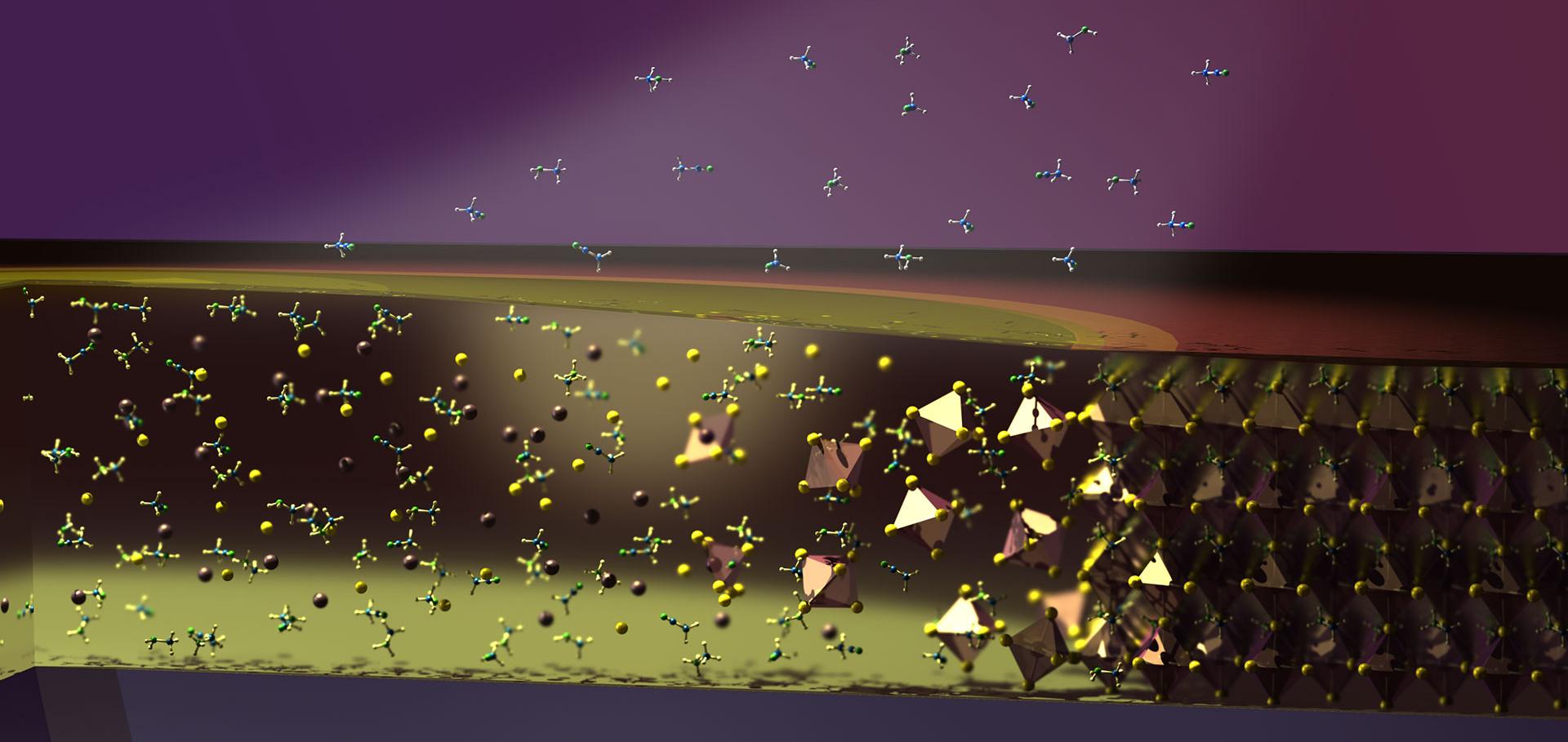
Based on this, a 2D/3D templated crystallisation strategy is developed using butylammoniumbased Ruddlesden–Popper templates. This approach enables phase-pure α-FAPb(I1−xBrx)3 to be obtained across the full composition range. Computational modelling suggests that the 2D template stabilises mixed-halide compositions through site-selective ordering on inequivalent halide sites, while subsequent thermal conversion kinetically preserves the halide framework.The resulting films exhibit favourable optoelectronic properties, including high charge-carrier mobility and long carrier lifetimes. Photovoltaic devices fabricated using the templated films achieve a stabilised power conversion efficiency of 17.1%, demonstrating the viability of this approach for device applications.
The final set of investigations examined whether Cs incorporation or templating plays a more important role in determining film stability. Although Cs was successfully incorporated into the films, they remained metastable and were substantially less stable than conventional FACs films. As a result, this question remains unresolved, as the templated films exhibit a distinct degradation pathway that appears to be independent of Cs content.
Overall, this work provides both a comprehensive understanding of the miscibility gap and a practical strategy for overcoming it, enabling access to FA-based mixed-halide perovskites across the full compositional space.