Modification of the fluorinated tin oxide/electron-transporting material interface by a strong reductant and its effect on perovskite solar cell efficiency

Molecular Systems Design and Engineering Royal Society of Chemistry 3:5 (2018) 741-747

Authors:

F Pulvirenti, B Wegner, Nakita K Noel, Giulio Mazzotta, R Hill, Jay B Patel, Laura M Herz, Michael B Johnston, Moritz K Riede, Henry J Snaith, N Koch, S Barlow

Abstract:

To date, the most efficient hybrid metal halide peroskite solar cells employ TiO2 as electron-transporting material (ETM), making these devices unstable under UV light exposure. Replacing TiO2 with fullerene derivatives has been shown to result in improved electronic contact and increased device lifetime, making it of interest to assess whether similar improvements can be achieved by using other organic semiconductors as ETMs. In this work, we investigate perylene-3,4:9,10-tetracarboxylic bis(benzimidazole) as a vacuum-processable ETM, and we minimize electron-collection losses at the electron-selective contact by depositing pentamethylcyclopentadienyl cyclopentadienyl rhodium dimer, (RhCp*Cp)2, on fluorinated tin oxide. With (RhCp*Cp)2 as an interlayer, ohmic contacts can be formed, there is interfacial doping of the ETM, and stabilized power conversion efficiencies of up to 14.2% are obtained.

Atomic layer deposited electron transport Layers in efficient organometallic halide perovskite devices

MRS Advances Cambridge University Press 3:51 (2018) 3075-3084

Authors:

MM McCarthy, A Walter, S-J Moon, Nakita Noel, S O’Brien, ME Pemble, S Nicolay, Bernard Wenger, Henry Snaith, IM Povey

Abstract:

Amorphous TiO2 and SnO2 electron transport layers (ETLs) were deposited by low-temperature atomic layer deposition (ALD). Surface morphology and x-ray photoelectron spectroscopy (XPS) indicate uniform and pinhole free coverage of these ALD hole blocking layers. Both mesoporous and planar perovskite solar cells were fabricated based on these thin films with aperture areas of 1.04 cm2 for TiO2 and 0.09 cm2 and 0.70 cm2 for SnO2. The resulting cell performance of 18.3 % power conversion efficiency (PCE) using planar SnO2 on 0.09 cm2 and 15.3 % PCE using mesoporous TiO2 on 1.04 cm2 active areas are discussed in conjunction with the significance of growth parameters and ETL composition.

Local structures and temperature-driven polarization rotation in Zr-rich PbZr1-xTixO3

Applied Physics Letters AIP Publishing 113 (2018) 012901

Authors:

Z Wang, N Zhang, H Yokota, Anthony M Glazer, Y Yoneda, W Ren, Z-G Ye

Abstract:

PbZr1-xTixO3, which has abundant structural variations in the corresponding physical properties, has been used in a large variety of applications. To understand the effect of the structure on its high-performance piezoelectric properties, its local and average structures are studied. Total scattering data have been obtained from high-energy synchrotron powder diffraction experiments at 20 K and 300 K. Using the reverse Monte Carlo method, information on cation displacements has been extracted from X-ray Pair Distribution Function data. This suggests that the local disorder of the B cations is mainly driven by thermal motion, while the local disorder of Pb is most likely caused by more complex factors, such as displacive disorder. Both rhombohedral and monoclinic local polarizations are observed in Zr-rich PZT, whose directions depend on temperature.

Monoclinic distortion, polarization rotation and piezoelectricity in the ferroelectric Na0.5Bi0.5TiO3

IUCrJ International Union of Crystallography 5:4 (2018) 417-427

Authors:

H Choe, J Bieker, N Zhang, Anthony M Glazer, PA Thomas, S Gorfman

Abstract:

The relationship between crystal structure and physical properties in the ferroelectric Na0.5Bi0.5TiO3 (NBT) has been of interest for the last two decades. Originally, the average structure was held to be of rhombohedral (R3c) symmetry with a fixed polarization direction. This has undergone a series of revisions, however, based on high-resolution X-ray diffraction, total neutron scattering, and optical and electron microscopy. The recent experimental findings suggest that the true average symmetry is monoclinic (space group Cc), which allows for a rotatable spontaneous polarization. Neither polarization rotation nor its potentially important real role in enhanced piezoelectricity is well understood. The present work describes an in situ investigation of the average monoclinic distortion in NBT by time-resolved single-crystal X-ray diffraction under external electric fields. The study presents a high-resolution inspection of the characteristic diffraction features of the monoclinic distortion – splitting of specific Bragg reflections – and their changes under a cyclic electric field. The results favour a model in which there is direct coupling between the shear monoclinic strain and the polarization rotation. This suggests that the angle of polarization rotation under a sub-coercive electric field could be 30° or more.

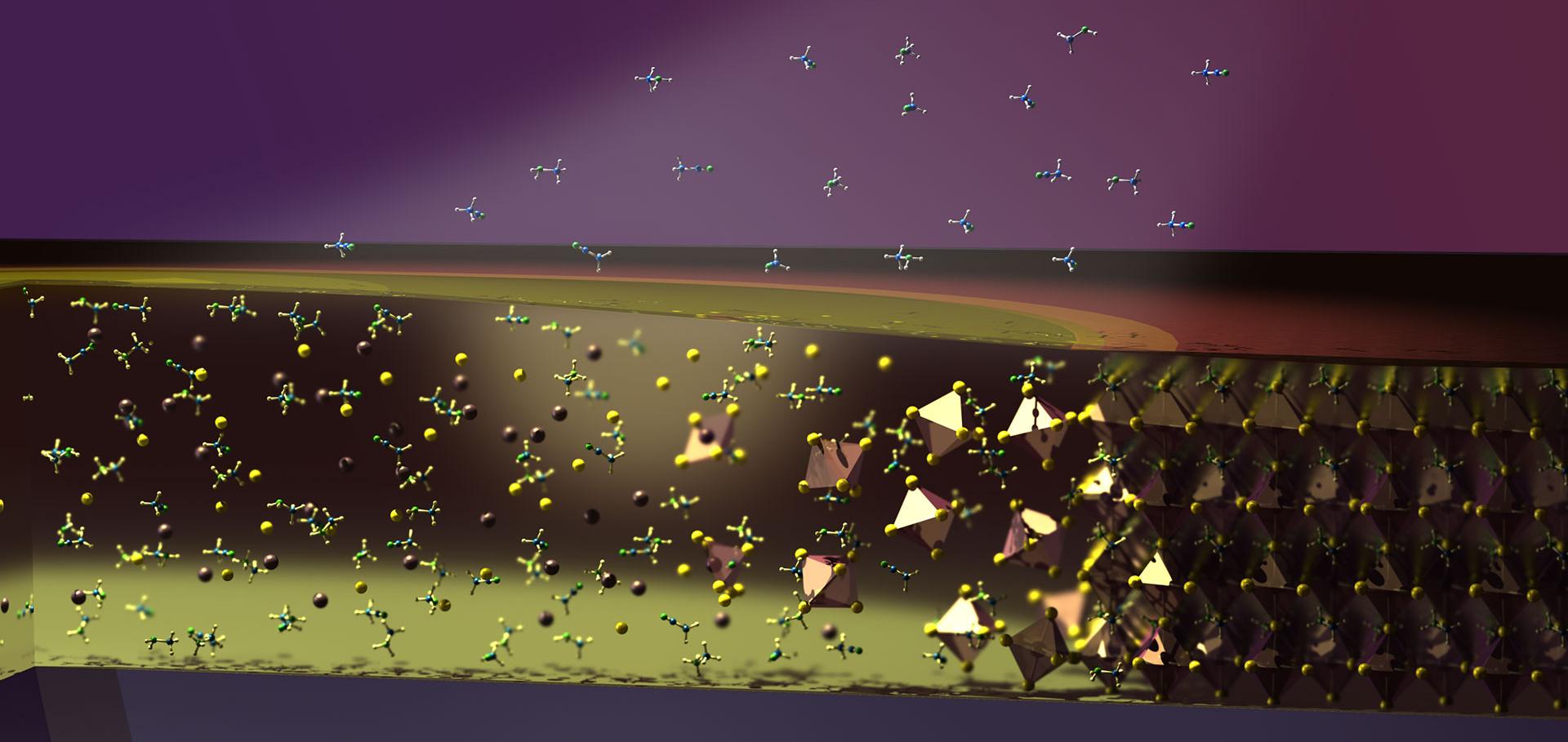
Highly crystalline methylammonium lead tribromide perovskite films for efficient photovoltaic devices

ACS Energy Letters American Chemical Society 3:6 (2018) 1233−1240

Authors:

Nakita Noel, Bernard Wenger, Severin Habisreutinger, Jay Patel, T Crothers, Zhiping Wang, Robin Nicholas, Michael Johnston, Laura Herz, Henry Snaith

Abstract:

The rise of metal-halide perovskite solar cells has captivated the research community, promising to disrupt the current energy landscape. While a sizable percentage of the research done on this class of materials has been focused on the neat and iodide-rich perovskites, bromide-based perovskites can deliver substantially higher voltages because of their relatively wide band gaps of over 2 eV. The potential for efficient, high-voltage devices makes materials such as these incredibly attractive for multijunction photovoltaic applications. Here, we use the acetonitrile/methylamine solvent system to deposit smooth, highly crystalline films of CH3NH3PbBr3. By using choline chloride as a passivating agent for these films, we achieve photoluminescence quantum efficiencies of up to 5.5% and demonstrate charge-carrier mobilities of 17.8 cm2/(V s). Incorporating these films into photovoltaic devices, we achieve scanned power conversion efficiencies of up to 8.9%, with stabilized efficiencies of 7.6%, providing a simple route to realizing efficient, high-voltage CH3NH3PbBr3 planar-heterojunction devices.