

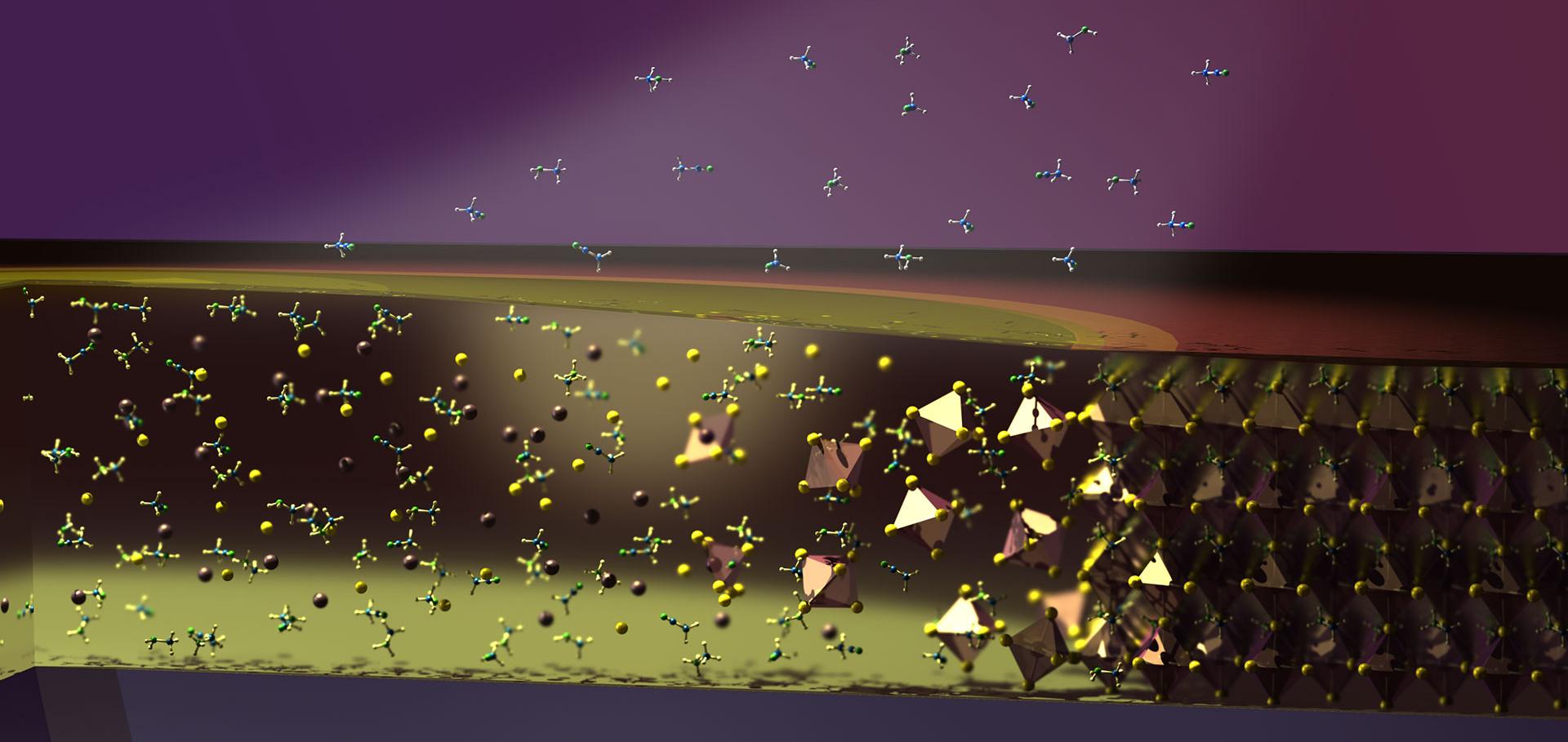
Anomalous hysteresis in perovskite solar cells
journal of physical chemistry letters American Chemical Society 5:9 (2014) 1511-1515
Abstract:
Perovskite solar cells have rapidly risen to the forefront of emerging photovoltaic technologies, exhibiting rapidly rising efficiencies. This is likely to continue to rise, but in the development of these solar cells there are unusual characteristics that have arisen, specifically an anomalous hysteresis in the current-voltage curves. We identify this phenomenon and show some examples of factors that make the hysteresis more or less extreme. We also demonstrate stabilized power output under working conditions and suggest that this is a useful parameter to present, alongside the current-voltage scan derived power conversion efficiency. We hypothesize three possible origins of the effect and discuss its implications on device efficiency and future research directions. Understanding and resolving the hysteresis is essential for further progress and is likely to lead to a further step improvement in performance.Observation of Annealing-Induced Doping in TiO2 Mesoporous Single Crystals for Use in Solid State Dye Sensitized Solar Cells
The Journal of Physical Chemistry C American Chemical Society (ACS) 118:4 (2014) 1821-1827
Performance and stability enhancement of dye-sensitized and perovskite solar cells by Al doping of TiO2
Advanced Functional Materials 24:38 (2014) 6046-6055
Abstract:
© 2014 WILEY-VCH Verlag GmbH & Co. KGaA. Reversible photo-induced performance deterioration is observed in mesoporous TiO2-containing devices in an inert environment. This phenomenon is correlated with the activation of deep trap sites due to astoichiometry of the metal oxide. Interestingly, in air, these defects can be passivated by oxygen adsorption. These results show that the doping of TiO2with aluminium has a striking impact upon the density of sub-gap states and enhances the conductivity by orders of magnitude. Dye-sensitized and perovskite solar cells employing Al-doped TiO2have increased device efficiencies and significantly enhanced operational device stability in inert atmospheres. This performance and stability enhancement is attributed to the substitutional incorporation of Al in the anatase lattice, "permanently" passivating electronic trap sites in the bulk and at the surface of the TiO2.Mesoporous TiO 2 single crystals delivering enhanced mobility and optoelectronic device performance
Nature 495:7440 (2013) 215-219
Abstract:
Mesoporous ceramics and semiconductors enable low-cost solar power, solar fuel, (photo)catalyst and electrical energy storage technologies. State-of-the-art, printable high-surface-area electrodes are fabricated from thermally sintered pre-formed nanocrystals. Mesoporosity provides the desired highly accessible surfaces but many applications also demand long-range electronic connectivity and structural coherence. A mesoporous single-crystal (MSC) semiconductor can meet both criteria. Here we demonstrate a general synthetic method of growing semiconductor MSCs of anatase TiO 2 based on seeded nucleation and growth inside a mesoporous template immersed in a dilute reaction solution. We show that both isolated MSCs and ensembles incorporated into films have substantially higher conductivities and electron mobilities than does nanocrystalline TiO 2. Conventional nanocrystals, unlike MSCs, require in-film thermal sintering to reinforce electronic contact between particles, thus increasing fabrication cost, limiting the use of flexible substrates and precluding, for instance, multijunction solar cell processing. Using MSC films processed entirely below 150C, we have fabricated all-solid-state, low-temperature sensitized solar cells that have 7.3 per cent efficiency, the highest efficiency yet reported. These high-surface-area anatase single crystals will find application in many different technologies, and this generic synthetic strategy extends the possibility of mesoporous single-crystal growth to a range of functional ceramics and semiconductors. © 2013 Macmillan Publishers Limited. All rights reserved.Mesoporous TiO2 single crystals delivering enhanced mobility and optoelectronic device performance
Nature Springer Nature 495:7440 (2013) 215-219