

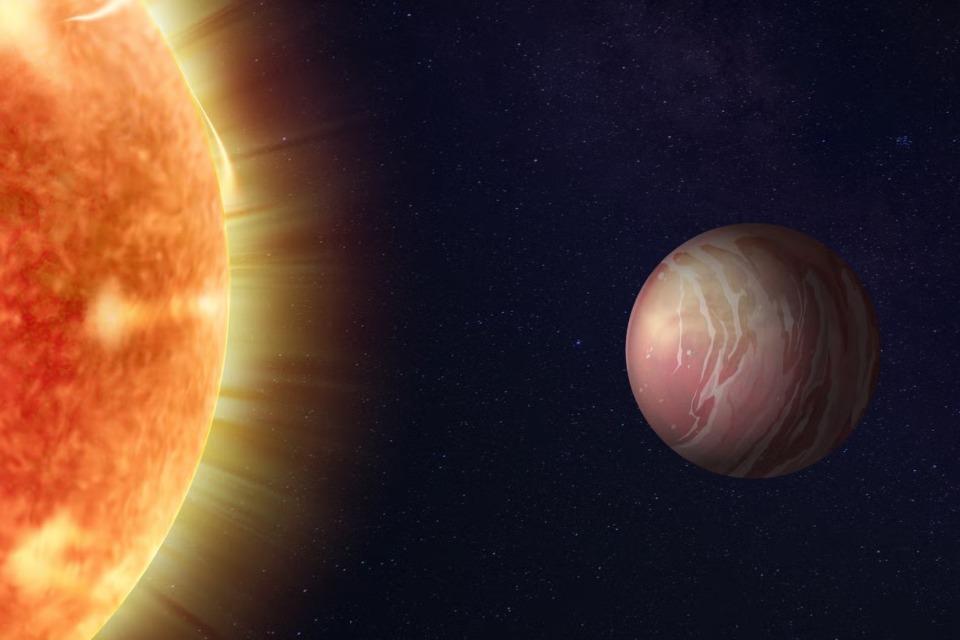
Artist’s concept of the lava world TOI-561 b and its star, whose surface churns with hot, bubbling gas. Webb observations show the planet reflects most of its starlight, and models suggest bright silicate clouds above its magma ocean may be the reason.
A rocky lava planet once thought too extreme to hold an atmosphere appears to be wrapped in one, with a reflective layer of clouds made of silicate minerals, the same family of compounds that makes up quartz and sand.
The international study, led by the University of Waterloo and published in The Astronomical Journal, combined observations from the James Webb Space Telescope (JWST) with simulations of the planet’s climate. The climate modelling was led by Alex McGinty, a third-year DPhil student in the University of Oxford Department of Physics, who works with fellow co-author Professor Raymond Pierrehumbert, Professor of Planetary Physics.
The team used the JWST to observe TOI-561 b for 37 hours, capturing nearly four complete trips of the planet around its star. ‘We measured how the planet’s brightness and heat changed throughout its orbit,’ says University of Waterloo Physics and Astronomy Professor Lisa Dang, who led the project. ‘This technique, known as a phase curve, revealed that the planet reflects a significant amount of light from its star, and that heat is being redistributed around the planet instead of only on the sunlit side. Together, these point to the presence of an atmosphere.’
Earlier work by Dang and collaborators, including McGinty and Professor Pierrehumbert, found that the planet’s dayside was far cooler than expected for a bare, dark rock this close to its star, pointing to a thick atmosphere, likely replenished by gases released from its molten interior. That missing heat could either be carried around to the night side or reflected away before the planet ever absorbed it.
By watching the full orbit, the team got the first look at the night side, which always faces away from the star, and found it was not warm enough to account for the difference. Instead, TOI-561 b must reflect roughly three-quarters of the starlight that hits it, comparable to Venus.
To work out what could make the planet so reflective, McGinty used three-dimensional (3D) general circulation models, which simulate how heat and gases move around a planet’s entire atmosphere, to compare a range of possible atmospheres with the JWST measurements. The simulations showed that carrying heat from the dayside to the night side could not, on its own, explain the observations: the planet also needed to reflect a large share of the starlight reaching it.
‘The benefit of our simulations of the planet’s climate is that we can model the full 3D nature of the planet’s atmosphere,’ says McGinty. ‘This suggests that reflective clouds are the only way to cool the planet down.’
The team’s calculations suggest that clouds made of silicate minerals, including silicon dioxide (SiO2) and magnesium silicate (MgSiO3), could form on the planet’s dayside and act like sunscreen. By reflecting starlight and keeping the planet cooler, the clouds may help the planet hold onto an atmosphere that would otherwise be stripped away.
What that atmosphere is made of remains an open question. It could be a dense blanket of carbon dioxide, like a much hotter version of Venus, or it could be rich in sulfur dioxide, like the atmosphere of Jupiter’s volcanic moon Io. The planet’s surface is covered by an ocean of molten rock, which could act as a planet-wide volcano that is constantly feeding its atmosphere.
‘The next big question we will seek to answer is whether TOI-561 b’s atmosphere resembles Venus or an extreme Io,’ says Dang. ‘Observing the planet at longer wavelengths with JWST could give us insights and help explain how a planet this hot has held on to an atmosphere for billions of years.’
This article is adapted from a University of Waterloo news release.
A Highly Reflective Atmosphere on the Lava World TOI-561 b Revealed by JWST/NIRSpec Phase Curve, S Boucher et al, The Astronomical Journal, 29 September 2026