

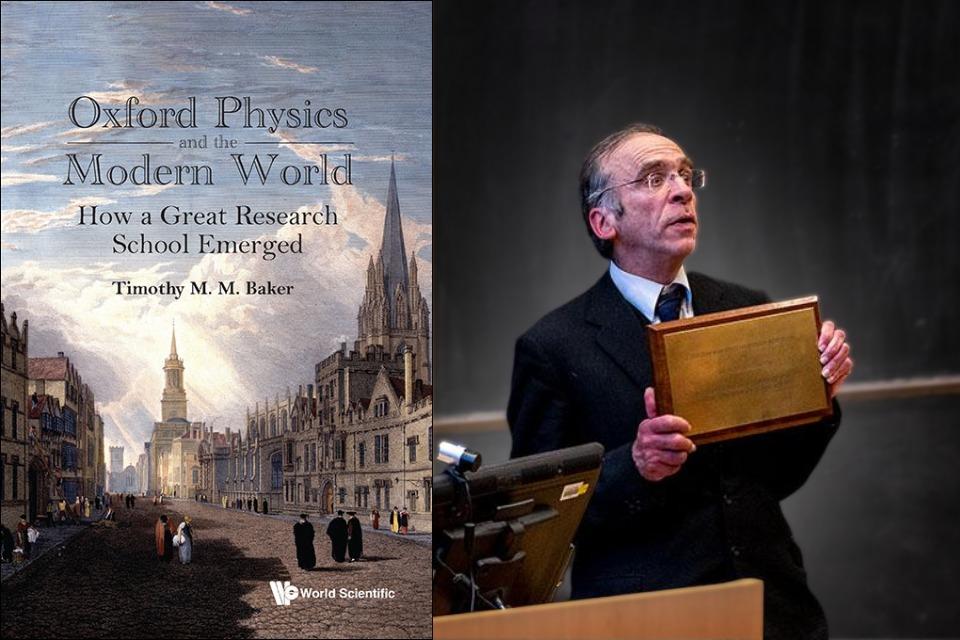
Timothy Baker, son of the late Professor Michael Baker of the Clarendon Laboratory, has published a book on the history of physics at Oxford. Here, he reflects on important insights from his research and how his family connection influenced his appreciation of the department’s history. His book, Oxford Physics and the Modern World: How a Great Research School Emerged was launched at the Department of Physics on 11 November 2026. See below for the event recording and discount code to purchase the book.
The development of physics at Oxford
In the early twentieth century, Oxford physics was still struggling to emerge from its Victorian nadir. Oxford basked in the glory of its pioneering past in mediaeval natural philosophy, in the mid-seventeenth century experimental revolution, and in Georgian positional astronomy. But in the later nineteenth century it had focused on mainstream teaching, and not participated in the dramatic research discoveries of other universities and the private sector. Oxford University, dominated by philosophy and the classics, and still controlled by the colleges, was sceptical or indifferent. Within Oxford itself, rival laboratories and observatories vied for limited funding and influence.
By the early twenty-first century, Oxford physics had become a pillar of the University, well established as a world leader in several branches of the discipline, and the largest physics department in the UK. Now streamlined into a single department, its six sub-departments reflected its particular strengths. In condensed matter physics, atomic and laser physics, and atmospheric physics it had been among the pioneers in the mid-twentieth century. In particle physics and astrophysics, it took a leading role in several of the major international instrumental collaborations of ‘Big Science’ using particle accelerators and telescopes across the spectrum. A distinctive feature of the Oxford department was the close integration of theoretical physics with the experimental sub-departments.
The twentieth century
In this newly published book, I aim to chronicle how and why this transformation took place, and the distinctive personalities who effected it. Frederick Lindemann brought drive from the 1920s. His recruitment of the cream of German low-temperature physics, who were taking refuge from state antisemitism in the 1930s, took Oxford to sustained world status as they trained their British pupils. From the 1940s onwards Oxford’s role in developing war-winning technologies, and new emphasis on government funding of science, enabled rapid expansion and ever-growing influence. Later in the twentieth century, and into the twenty-first, increasing international participation and, building on the Laboratory's Germanic heritage, the recruitment of international talent, reinforced the upward trajectory. Reconsolidation of the constellation of separate departments that had emerged in the diversity of disciplines effected organisational coherence.
The book tells how Oxford became a pioneer and leader in such diverse fields as low-temperature thermodynamics, superconductivity and superfluidity, magnetic resonance, laser physics, the structure of matter, cosmology, and climate science, together with their technological spin-offs, including imaging systems, telescopes, interplanetary satellites, photovoltaics, advanced electronics and magnonics, and quantum computing. All of these developments reflected a distinctive Oxford emphasis on interdisciplinarity. Technological spin-offs, and their potential to solve some of the most pressing problems of modern civilisation, in turn helped to support further research as government funding became more chary.
Family perspective
My father was a pupil of Brebis Bleaney, the pioneer of microwave spectroscopy and electron paramagnetic resonance. He took over Bleaney’s research group, and was a central participant in this ‘golden age’ over most of the second half of the twentieth century. My mother worked as a secretary to Francis Simon and Nicholas Kurti, two of the world leaders among the refugees from Germany, both giants of the physics of temperatures close to Absolute Zero. My grandfather had been one of Frederick Lindemann’s earliest graduate students. This family perspective perhaps initially obscured my ability to appreciate the importance of Oxford’s work.
But with age came perspective, and a perception that Oxford’s role in the development of modern physics was perhaps under-documented in the historical literature, certainly by comparison with the well-researched period up to the Second World War, and its significance underappreciated. It is a good principle that if a book one wants to read does not yet exist, one should write it. This book therefore aims to set the past century in the broader historical context of the centuries that preceded it, stretching right back to the University’s origins in the twelfth. It aims to supplement the physics and the history with anecdotal vignettes of the human aspects of scientific discovery. Inevitably perhaps the most recent and multiplying developments cannot be treated in as quite as much detail. So, I hope that the book, as well as acting as an accessible summary of what has happened so far, will act as a prompt for further scholarship as the achievements of Oxford physics and their impact on the modern world continue to unfold.
Click here to purchase a copy of Oxford Physics and the Modern World: How a Great Research School Emerged. Use code WSBAKER30 before 31 December 2026 to get a 30% discount.