

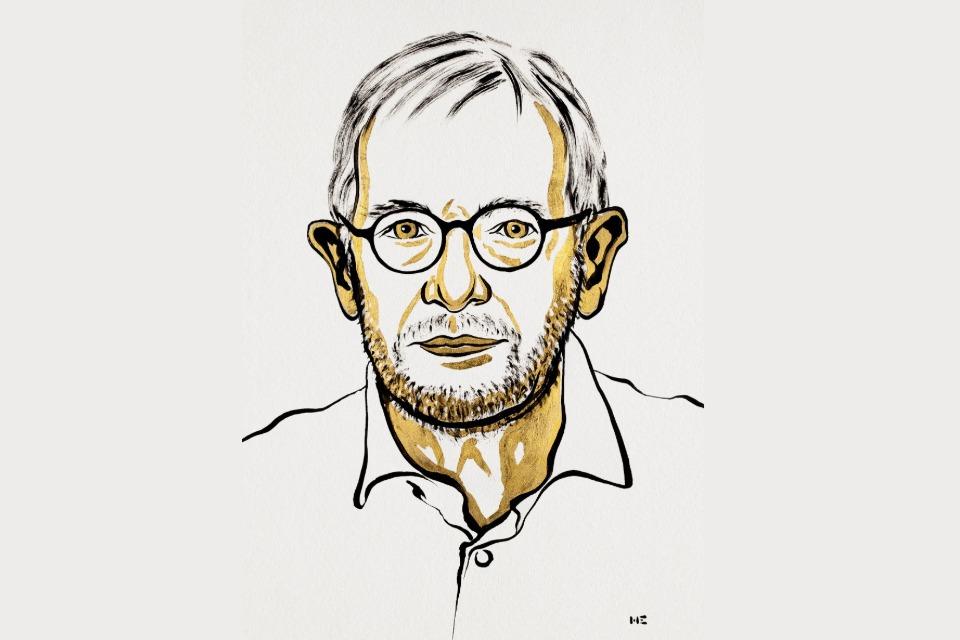
Emeritus Professor Subir Sarkar, who has been part of theIceCube Neutrino Observatory collaboration since its inception, comments on the Nobel prize awarded to its Principal Investigator Francis Halzen.
Along with 450 other ‘IceCubers’ (from 58 institutions in 14 countries), I am delighted that Francis Halzen has been honoured 'for decisive contributions to the IceCube Neutrino Observatory and the discovery of high-energy neutrinos of astrophysical origin.' This is the first solo award of the Nobel Prize in Physics since 1992.
The Oxford Connection
Oxford Physics has been a part of this audacious project since 2004 when the international collaboration was being formed, and I was asked by Francis and the first Spokesperson Per-Olof Hulth if we would like to join. I had worked with Per-Olof at CERN in the 1980’s on the physics implications of a neutrino ‘beam dump’ experiment that he had led, and knew Francis too as a fellow theorist at the University of Wisconsin-Madison, so agreed enthusiastically. Another Oxford member was postdoc Dan Hooper, who is now Director of the Wisconsin IceCube Particle Astrophysics Center at Madison, which operates the Observatory at the South Pole. Later several other postdocs & students worked with me on IceCube physics e.g. Markus Ahlers who now co-leads the IceCube group I set up at the Niels Bohr Institute, Copenhagen, while a visiting Professor there. Regrettably we were never supported by the STFC, presumably because I was unable to persuade our experimental colleagues at Oxford to join IceCube.
An unusual collaboration
At the bi-annual collaboration meetings, I got to meet some of the other remarkable physicists who had conceived of this astounding idea of instrumenting a whole cubic kilometre of ice in the Antarctic to detect the most elusive of particles: neutrinos. Francis, together with John Learned from Hawaii, proposed the concept in 1988 and its boldness attracted adventurous physicists who finally made it a reality, notwithstanding many setbacks along the way and widespread scepticism in the community. There was Buford Price from Berkeley who led the initial attempts to sink sensors in the ice in Greenland. However this did not work too well, and neither did the follow-up Antarctic Muon and Neutrino Detector Array (AMANDA) at the South Pole led by Francis. This deployed 80 photomultiplier tubes on four ‘strings’ at a depth between 810 and 1000 m in the polar ice cap to detect the Cherenkov radiation of high-energy cosmic muons created by neutrino interactions, as they traverse the ice faster than the speed of light. However the light scattering length even at that depth turned out to be inadequate to allow any tracking or useful detection. Undeterred by this, Francis managed to convince the National Science Foundation to continue backing the project, and fund with $246 million the much bigger IceCube, which would deploy 86 strings carrying 5160 Digital Optical Modules (DOMs). When Oxford organised the IceCube Collaboration Workshop in 2005, I recall Francis telling me as we walked back from a memorable workshop dinner that these had been designed by a master instrumentalist Dave Nygren at Berkeley. Indeed over 98% of them are still working, 15-20 years after being buried 1.5 to 2.5 km below the South Pole. There is also IceTop – a km2 surface array which Tom Gaisser from Bartol took charge of. Many IceCubers have worked on other such experiments too – Christian Spiering from DESY Zeuthen had worked on the Lake Baikal array, and Teresa Montaruli from Geneva on ANTARES in the Mediterranean sea. Francis presided over this motley crew – a quiet-spoken theorist who inspired diverse physicists and engineers to somehow overcome the many challenges that we encountered, as well as convincing hard-headed administrators at funding agencies that the risks were well worth taking.
'In the fields of observation, chance favours only the prepared mind.' – Louis Pasteur
And it did pay off spectacularly. In 2013 just as we were beginning to wonder if even 1 km3 was big enough, the first high energy extraterrestrial neutrinos were detected, followed in 2018 by the first source, a supermassive black hole in a blazar about 6 billion light years away. This was a great demonstration of ‘multi-messenger astronomy’, exploiting coincident measurements of neutrinos by IceCube and of gamma-rays by other telescopes. In order to have created neutrinos with the observed energies of several hundred TeV, this active galaxy must be among the long sought accelerators of ultra-high energy cosmic rays. IceCube also detected the quantum mechanical oscillations of neutrinos between different flavours with precision matching that of accelerator experiments, and studied neutrino interactions at energies far exceeding those achieved at CERN’s Large Hadron Collider. IceCube is an experiment that sees the high energy Universe – both ‘inner space and outer space’ – an inspiring example of how a visionary scientific idea, propelled by international collaboration, can yield striking discoveries.
When the BBC asked me to comment after the prize was announced, it seemed appropriate to quote Marcel Proust, who spent most of his life in a darkened room but perhaps saw further than most of us: 'The only true voyage of discovery, the only fountain of Eternal Youth, would be not to visit strange lands but to possess other eyes, to behold the universe through the eyes of another, of a hundred others, to behold the hundred universes that each of them beholds, that each of them is.' Francis has led the IceCube collaboration on just such a voyage of discovery, and opened a new window on to our Universe.
Many new experiments are now being constructed around the world to follow-up on IceCube’s pioneering findings and Francis’s Nobel prize is sure to boost further interest in cosmic neutrino physics – there will surely be other exciting discoveries to follow. This award also highlights how real progress can be made in realising ambitious ideas when the barriers that obstruct close collaboration between theorists and experimentalists are broken down and funding agencies are prepared to take a chance. Most of all it reminds us of just how challenging and hard, but also exciting and fun doing physics can be, if we can see the journey as its own reward.
Further reading: IceCube @ Oxford