

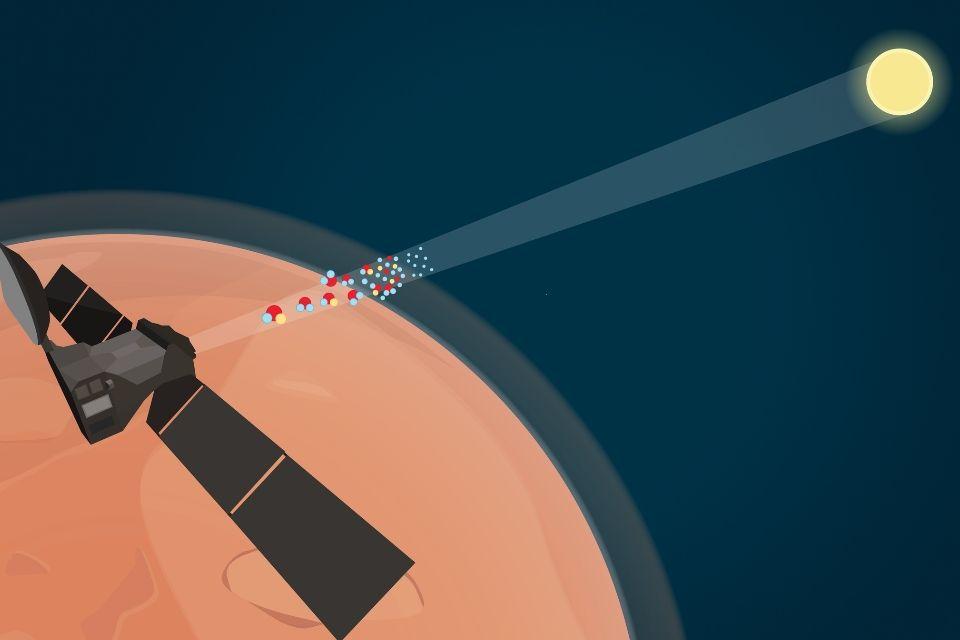
Artist impression of the ExoMars Trace Gas Orbiter (TGO) analysing the Martian atmosphere. The solar occultation method is depicted: the onboard spectrometers – ACS and NOMAD – look at the way sunlight is absorbed in the atmosphere to reveal the chemical fingerprints of its ingredients.
New evidence from gas seeping above the Alba Mons region hint at active spots under the surface, where gases from inside the volcanic rifts suggests Mars is not geologically dead deep inside, but merely sleeping – fresh fissures along the planet may be making their way up to the surface. The findings have been published in Science Advances.
An international research team, led by Alexander Trokhimovskiy from Space Research Institute, Russia and including Dr Kevin Olsen, formerly from the Department of Physics at the University of Oxford, suggests that the release of hydrogen chloride comes from hot magma beneath the surface – a sign of dormant volcanism.
Using data returned by the ExoMars Trace Gas Orbiter (TGO), Dr Olsen made the first reported discovery of hydrogen chloride gas in the Martian atmosphere back in 2021. This gas is commonly found escaping from magmatic vents on Earth, leading researchers to wonder whether the same was happening on Mars.
‘These observations have been puzzling us for a long time,’ comments Dr Olsen, now at the Canadian Space Agency. ‘Ever since first finding HCl in 2020, through a long period of dedicated work to characterise HCl and really understand how it behaves. All this time, these unseasonal detection over Alba Mons have been unique, and difficult to understand. We are finally ready to posit that they may be coming out of the ground. This is exactly the main objective of the ExoMars TGO mission.’
A team of researchers first noticed spikes of hydrogen chloride during early summer in the northern hemisphere of Mars; both the time of year and the location were unexpected and prompted deeper exploration. The gas varies seasonally on Mars, reaching its maximum in northern hemisphere winter, then mostly disappearing in the summer – most of this variability appears to be linked with Mars’ dust and water cycles. These observations were an exception to this pattern, always in the same season and at the same place – above volcanic fissures on the flanks of the Alba Mons volcano, in early summer.
Mars has the largest volcanoes in the Solar System, but it is not known how active they are. Orbital imagery shows that some volcanoes appear to have been active within the last few million years, and seismometers have detected marsquakes – the earthquakes of Mars. Both facts point to the possibility of Mars being volcanically active. However, no new lava flows or eruptions have ever been observed.
Combined atmospheric and geological analysis
The finding is the result of combined atmospheric and geological analysis. Following the detection of the hydrogen chloride, the group turned to the infrared spectrometers from TGO’s Atmospheric Chemistry Suite. A close look at the Alba Mons region using TGO’s CaSSIS camera showed fresh and narrow fissures, in some cases hundreds of metres long, associated with colour changes on the surface.
‘The Trace Gas Orbiter was able to find the smoking gun,’ explains Professor Daniel Mège from the Space Research Centre of the Polish Academy of Sciences and co-lead author of the paper. ‘It was like looking for a needle in a haystack. It’s truly amazing that it spotted a handful of molecules from a perhaps intermittent source, whilst moving continuously along its orbit to monitor the whole Martian atmosphere.’
Scientists suggest magmatic gases might be rising through these fissures, like some fumaroles – volcanic gas vents – on Earth. Blocked by ice during winter’s freezing temperatures, down to -120°C, the fissures would channel the release of chloride as the ice sublimates in early summer. The discolouration around the fissures could come from deposits left behind by gases escaping from Mars’s interior, as around fumaroles on Earth.
The team of researchers relied on geological intuition to make the link between the gas and the rifts. ‘Looking at the spatial distribution of the seeping, it became instantly obvious to me that there was something volcanic behind it, but it had to be demonstrated,’ concedes Professor Mège. ‘A huge part of the work consisted of examining all the possible chemical processes going on in the Martian atmosphere. We needed to be rigorous, critical and creative to explain the presence of hydrogen chloride. The data were complex, but also excellent brain food.’
The team suggests that the seepage is connected to a dormant magma chamber, a sort of volcanic plumbing system under the Martian surface.
Niches for life
Magmatic gases like hydrogen chloride could have been more abundant in the past, contributing to a thicker atmosphere and warmer climate and allowing liquid water to cover much of the Martian surface. If lava rising through the crust meets groundwater, this could lead to warm habitable niches.
‘Looking for Martian life in the seeping fissures of the Alba Mons region would make a lot of sense,’ comments Professor Mège. ‘If hydrothermal systems are active, they could contain the ingredients and energy needed for microorganisms to develop, and shield microorganisms from the hostile and changing environment above the surface.’
‘These findings may prove to be TGO’s greatest success yet,’ concludes Colin Wilson, ESA’s project scientist for the ExoMars Trace Gas Orbiter.
Enigmatic HCl detections as a potential signature of igneous activity on Mars, A Trokhimovskiy et al, Science Advances, 4 November 2026