

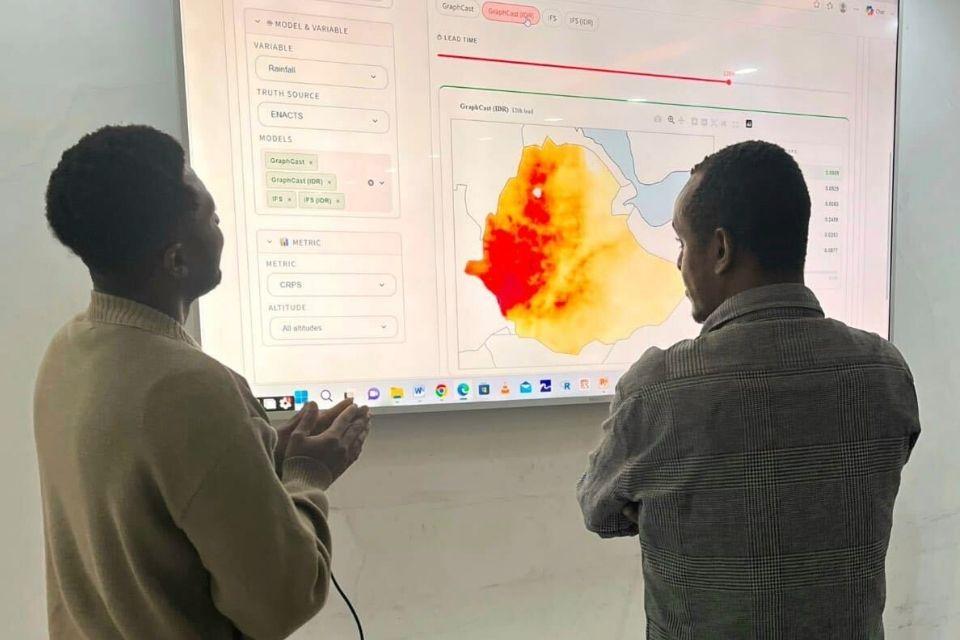
An early storm detection initiative from AfriClimate AI is one of 17 projects to receive funding from the Google.org Impact Challenge: AI for Science. Research at the African community-driven institute is led by Dr Shruti Nath from the Department of Physics.
Across much of Africa, forecasters get just two to three hours’ notice before the most dangerous storms arrive. AfriClimate AI wants to change that with its flagship initiative, ThunderTrace, that aims to push warning time to six hours or more.
Dr Nath, a postdoctoral researcher at Oxford, is part of the AfriClimate AI team behind ThunderTrace: ‘Africa’s most dangerous storms often give us signals before they arrive. ThunderTrace is about learning to recognise those signals and turn them into more time to act. By combining AI with the expertise of African meteorologists, we want to make that extra warning time useful, trusted and available across the continent.’
Cause of sudden flash floods
The storms in question are mesoscale convective systems: vast clusters of thunderstorms that produce 70–90% of the Sahel’s rainfall and cause many of the region’s sudden flash floods. The toll can be enormous: in 2022 alone, floods in Nigeria forced 1.4 million people from their homes.
The project includes a range of partners: the Ghana Meteorological Agency is helping to design the system, and the African Centre of Meteorological Application for Development (ACMAD) will help bring it to weather services across Africa. Asterisk Labs will supply detailed cloud measurements from satellite data through its Clouds Decoded framework, while the Trans-African Hydro-Meteorological Observatory (TAHMO) will use its weather stations to check predictions on the ground.
Custom data for custom systems
‘AfriClimate AI was founded around the idea that Africa should not simply consume AI weather technologies developed elsewhere, but actively shape and localise them,’ says Dr Rendani Mbuvha, Executive Director of AfriClimate AI. ‘ThunderTrace is built with the forecasters who will use it, so they can put it to the test and make it their own.’
Over the next three years, the team hopes to see ThunderTrace in daily use at national weather services across Africa and to train a new generation of African researchers. All code, data and models will be released openly, so researchers and weather services anywhere can build on the work.