

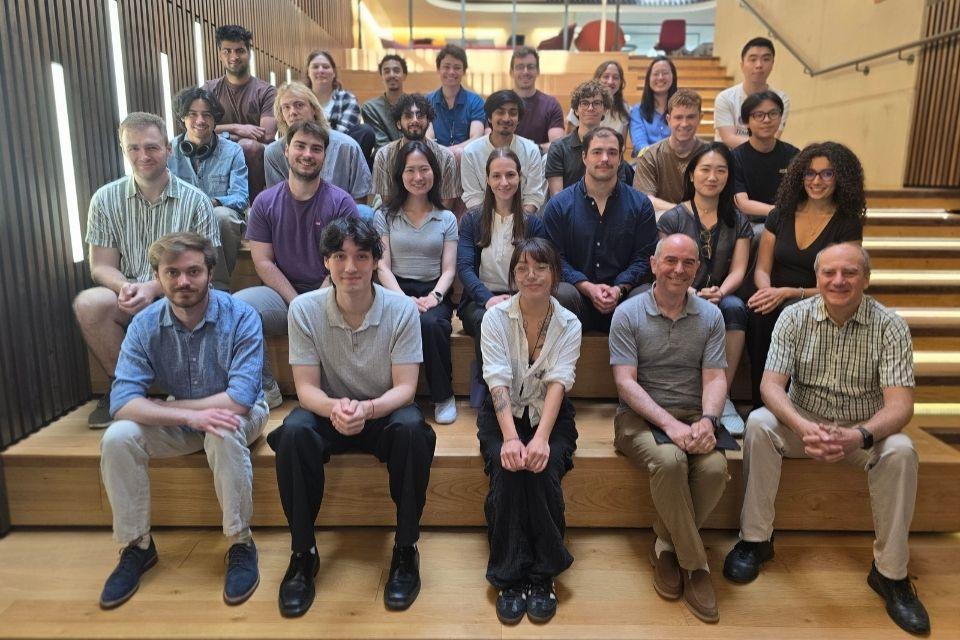
Graduate students at the Department of Physics play a key role in research activity from day one of their doctorate studies. For those who fall under the umbrella of condensed matter physics – looking at the macroscopic and microscopic physical properties of matter that arise from electromagnetic forces between atoms and electrons – they were able to share their work earlier this year at the 2026 Graduate Condensed Matter Physics Conference.
The conference brought together second- and third-year PhD students with 15 oral presentations and 20 research posters spanning three broad scientific themes: quantum materials; semiconductor materials, photovoltaics and nanoscience; and biophysics.
Condensed matter physics is the branch of physics concerned with understanding how matter behaves in order to address why some materials conduct electricity, why others become magnetic or transform light into electrical energy, and how new states of matter emerge in different extreme conditions. The research presented at the graduate conference reflects how this field sits at the heart of some of the most important scientific and technological challenges of our time, from energy and computing to medicine and quantum technology.
Quantum materials for a quantum future
For the students looking at quantum materials, they are probing systems whose properties cannot be explained by classical physics alone, and which often display dramatic and unexpected behaviour when cooled close to absolute zero or subjected to intense magnetic fields or mechanical pressure. One presentation focused on exploring and exploiting iron-based superconductors, a family of materials that lose all electrical resistance below a critical temperature. The students presented new measurements of iron selenide compounds under precisely controlled mechanical strain or pressure, tracking how the magnetic and superconducting behaviour are stabilised. These experiments are technically demanding, often requiring temperatures within a fraction of a degree of absolute zero (−273°C) and magnetic fields tens of thousands of times stronger than that of the Earth.
Other quantum materials presentations explored different remarkable phenomena: students shared progress made in using a material that can perform neuromorphic computation by processing information in a way inspired by the human brain and using waves travelling through a solid. Another presentation introduced a molecule, a single nitrogen atom trapped inside a hollow carbon cage just one nanometre across, as a precision quantum sensor. Another talk examined a triangular magnetic material that may host a “supersolid” a phase of matter that is simultaneously ordered like a crystal and fluid-like breaking translational and rotational symmetries simultaneously, a state long sought in both quantum materials and ultracold atomic gases.
The poster session highlighted atomic-scale images of unconventional superconducting states captured by scanning tunnelling microscopes, acoustic measurements of magnetic order in iron oxide, and upgrades to a custom-built microscope to survey unconventional superconductors at temperatures near absolute zero.
Better, cheaper, more stable solar cells: the future is photovoltaic
A growing strand of the graduate conference addressed photovoltaics which is the science of converting sunlight into electricity. The focus was on perovskites, a class of materials named after their crystal structure that have emerged over the past decade as serious rivals to conventional silicon solar cells. Perovskites can be manufactured at lower cost and tuned to absorb different parts of the solar spectrum by adjusting their chemical composition, but improving their long-term stability remains an active area of research.
Talks addressed how perovskite films are deposited and how their internal structure determines their optical properties. Poster presentations widened the picture further, covering strategies to prevent charge carriers from becoming trapped in defects, new solvent formulations that improve the shelf-life of devices, and computational predictions of optical properties in chemically novel perovskite variants. Taken together, their research highlights a field moving rapidly from laboratory curiosity to practical energy technology.
The physics of medicine
Additional talks brought physics techniques applied to biological questions. One presentation highlighted the use of single-particle tracking by following individual molecules as they move inside a living bacterial cell to watch a virus replicate in real time. Another exploited the optical properties of tiny gold rods to measure rotational motion in two dimensions at high throughput, a technique with applications ranging from molecular motors to drug delivery.
Elsewhere, a presentation highlighted whether small credit-card-sized chips containing a radiation-sensitive amino acid could be used to measure how much ionising radiation a person has been exposed to in an emergency, offering a potentially cheap and widely deployable personal dosimeter.
‘Physicists in the Condensed Matter Physics sub-department at the Department of Physics are working on creative solutions to the climate crisis, driving forward the quantum revolution and applying physics to pave the way to life-changing, equitable healthcare – which means our graduate students are too,’ explains Professor Arzhang Ardavan, head of Condensed Matter Physics. ‘The conference is a fantastic opportunity to share the work they are doing –which is a skill in and of itself – and is a particular highlight of the academic year.’
Best poster (2nd year) winner: Katharina Lasinger
Best poster (2nd year) commended: Soyoung Oh, Wan Fong, Taosha Sheng, Rafee Abedin, and Yang Li
Best talk (3rd year) winner: Thomas Haward
Best talk (3rd year) commended: Sammi Ta, Ioana Paulescu, John Pearce, and Ethan Arnold