

We work among extraordinary people doing extraordinary things; get to know some of them by reading these quick-fire interviews.
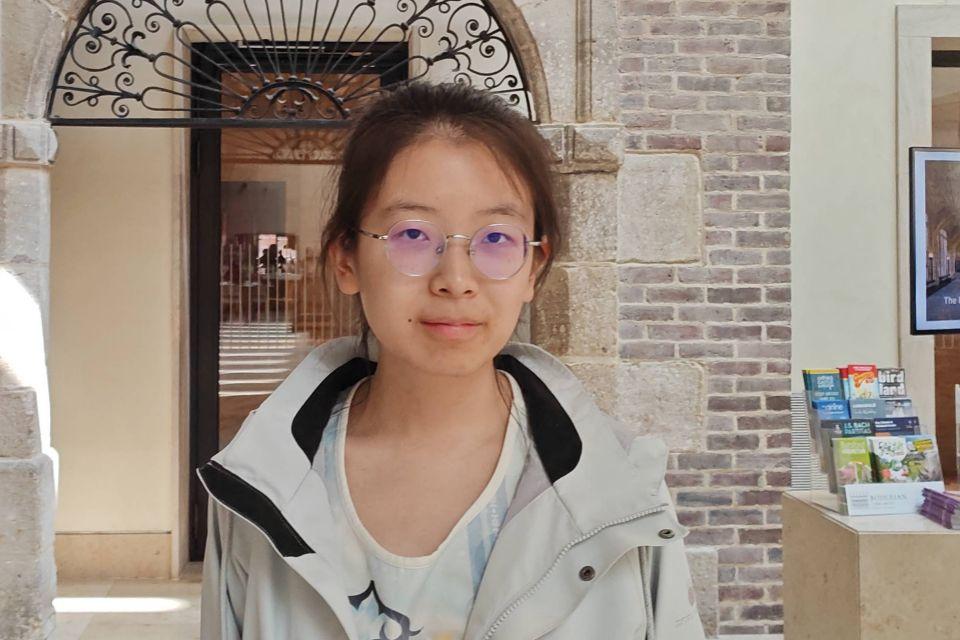
Name: Jiaxuan Zhang
Job title: DPhil student, Atomic and Laser Physics
What are you currently working on?
My current research focuses on quantum foundations, in particular on the derivation of the Born rule. The Born rule is the fundamental mathematical rule connecting quantum mechanics with probability, and plays a central role in the quantum measurement problem. My work aims to identify a minimal set of assumptions from which the Born rule can be derived, helping us understand where probability ultimately comes from in quantum mechanics.
To achieve this, I analyse existing derivations developed within different frameworks. I am also investigating whether some of the usual postulates of quantum mechanics, such as the state postulate, can be eliminated from the derivation. Ultimately, I hope this could contribute to a more fundamental understanding of the axioms of quantum mechanics.
Describe a typical day
My work is theoretical, so mathematics is my most important tool. I often work from home. I usually get up at around 8am, have oats for breakfast, and start working. I like to alternate between reading the literature, thinking about research problems, doing calculations, and writing. Sometimes I go to our office at the Clarendon Laboratory, where I can have scientific or random chats with friends in the group. Then we have lunch together, often at my college, Balliol. Otherwise, I cook for myself.
I usually take a short nap after lunch, a habit I have had since childhood that helps me maintain energy for the rest of the day. I rarely drink coffee or tea. I continue with my work in the afternoon. I prefer to organise my working time around the goals I want to achieve rather than fixed hours. If I get stuck, I may take a break to do something simple, check my emails, do some housework, or just rest for a while before returning to the problem later. If everything goes smoothly, I like to listen to music and read novels before bed. It happens at times that a difficulty in my work appears at night, and it used to make me nervous. I have now learned to press pause and leave it for the next morning. I find that this is often better both for solving the problem and for myself.
What got you into physics?
I was much better at literature than science when I was a kid, and I hadn't thought about working in physics before I was 16. I remember encountering several popular science books and novels about quantum mechanics that year and being deeply enchanted by them. The quantum measurement problem is what attracted me from the beginning. I wanted to know whether our observations really have such seemingly magical effects on reality, and whether the secrets of the quantum world could provide us with more exciting possibilities. I decided that even if it might be very difficult to be the one making a real breakthrough, I wanted to understand the frontier of quantum physics. The journey since then has included plenty of doubts and discouragements, but also a great deal of encouragement, support and kindness. And now I'm here (I still remember saying that I would never take a physics class again when I was 15), happy to be getting closer to my dream each day.
If you had an entire day at your disposal (not at work/studying), what would be your ideal way to spend it?
My favourite personal hobby is the history of science. If I have time, I like to travel to places relevant to it. I'm very interested in exploring lesser-known places that could be important to the history of science or connected to great scientists, and I have made some such small trips. Otherwise, I may stay at home and read about the history of science. I don't take it as work, but as reading a favourite novel or watching an interesting TV series. I like not only the moments of great discoveries, but also the stories of struggle, debates, and even conflicts among scientists before those discoveries. So my ideal day might actually be a bit busy, but this is my favourite way of relaxing and recharging.
What is your favourite place in Oxford?
My current favourite place is the Oxford University Museum of Natural History. I really like the statues of scientists, philosophers and engineers in the main court. They are very beautiful and carefully carved, including details like their equipment. Other specimens and minerals are also beautiful and enlightening. My office is very close to the museum, so I often have the chance to stop by and walk around. Sometimes when I'm stressed or sad, I imagine that even the greatest scientists could have had moments like these. This gives me a lot of relief and confidence to carry on.
Plan B: what would you be if you weren’t doing the job you are currently doing?
I think I would become a writer, which would probably not be a good choice for me. I have loved writing novels since childhood, and dreamed of becoming a great writer before I was 16. But I used to share the stories I wrote with people and get very different reactions, which made me sad and confused. Overall, I realised that I didn't want to choose something without a clear standard of evaluation as my career. So physics is better for me than literature. We can freely disagree about whether a novel is good or bad, but maybe not about a formula or an experiment — well, you can, if you consider philosophy. Anyway, I'm happy I chose physics as my career. Literature remains my hobby, and I still write some pieces about the history of science just for my own entertainment.
What discovery would you like to see in your lifetime?
There are many for me. Generally speaking, I wish to see discoveries that will change the world, or at least change our understanding of the world, as relativity did. From my research interest, of course I hope the resolution of the quantum measurement problem will provide such a revolution. Maybe we would prove one quantum interpretation to be the right one (maybe it will be none of the existing ones), and such a breakthrough might open up possibilities that currently seem almost magical: perhaps new ways of interacting with another parallel world, new forms of interaction between consciousness and physical reality, or the discovery of new physical fields associated with hidden variables. I would also like to see other big discoveries about dark matter or a unified field theory. Although it is not physics, I think we are also witnessing the history of the rise of generative artificial intelligence. We are living in a miraculous era. I really hope to understand these beautiful discoveries as much as I can, and perhaps promote some of them.