

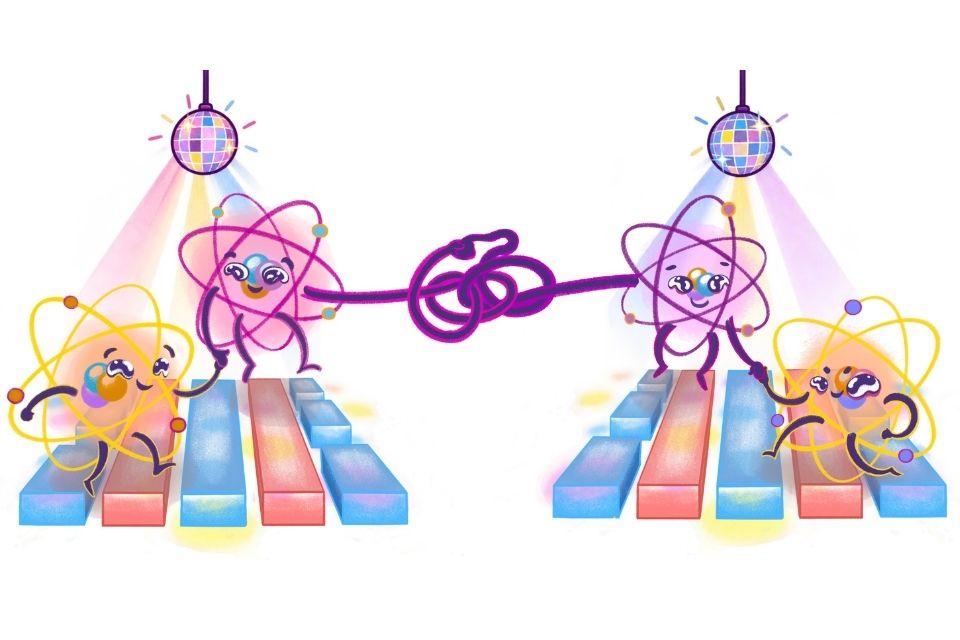
Physicists at the University of Oxford have used a quantum network to entangle several atoms across two separate locations. The atoms are two different elements, strontium and calcium. The team created shared quantum states involving up to four atoms, then used calcium atoms to preserve the entanglement for more than 10 seconds. The research has been published in Physical Review Letters.
Quantum computers use the rules of quantum physics to process information. For some problems, they could solve tasks that would be impractical for conventional computers. A key resource is entanglement, which links quantum particles so that their properties are connected, even when the particles are far apart.
Connecting separate quantum computers through entanglement could allow them to work together as a distributed quantum computer. To do this, a network needs to create entanglement between distant devices, combine it with other quantum operations, and preserve it long enough to be useful.
Different elements can offer different advantages and disadvantages as parts of a quantum computer. In this experiment, the team placed one strontium atom and one calcium atom at each of two locations. Light links the strontium atoms across the network. The researchers then used local operations to extend the entanglement to calcium, creating shared quantum states involving up to four atoms across the two locations.
‘Different types of atoms offer different advantages and disadvantages for quantum applications. Having more than one type in your quantum computer lets you take the best from each,’ says lead author Dr Dougal Main. ‘In this paper, we show for the first time that we can control the entanglement between different types of atoms, even when they are separated across a network.’
The team also used calcium to preserve the entanglement for much longer. Calcium has a pair of quantum states that is less sensitive to magnetic-field noise than the strontium states used to create the network link. By transferring the entanglement to calcium, the researchers extended its lifetime from milliseconds to more than 10 seconds.
‘This could help make future quantum networks useful for tasks that need several distant atoms to share and preserve the same quantum state,’ says co-author Dr Gabriel Araneda. ‘That could include quantum computing, more sensitive measurements made across remote locations, and comparisons between different types of atomic clocks.’
The results bring together the ability to entangle several atoms of different elements across a network with the ability to preserve that entanglement for more than 10 seconds. These capabilities could help future quantum networks connect separate processors and coordinate their operations, while also supporting applications in sensing and precision timekeeping.
Multipartite mixed-species entanglement over a quantum network, D Main et al., Physical Review Letters 137, 160801 (2026), 13 October 2026