

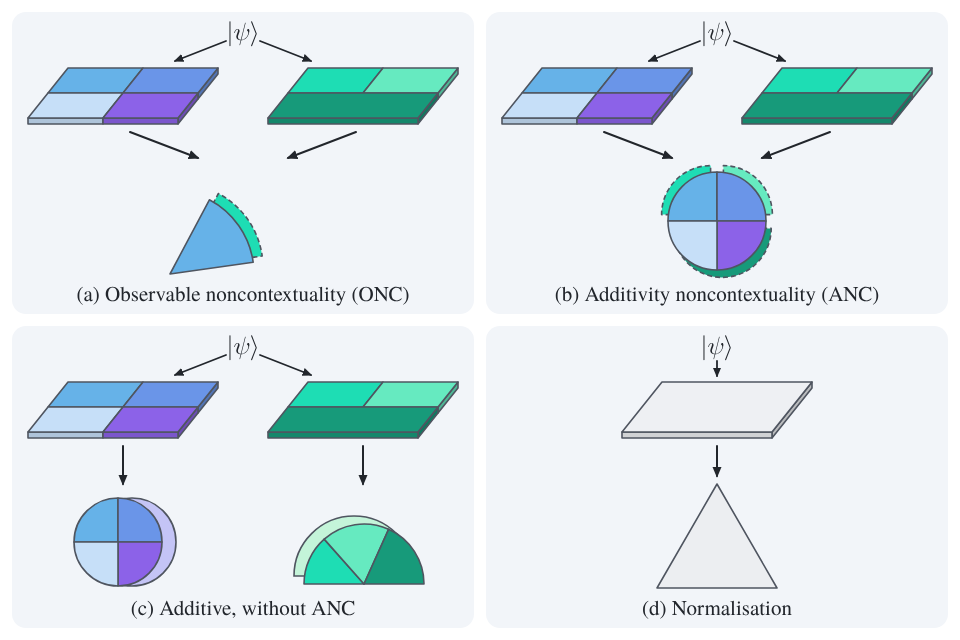
A simplified diagram of the four main postulates discussed in the paper which also demonstrates their inequivalence.
A study by Jiaxuan Zhang, a fourth-year DPhil student in the Department of Physics, has shown that five of the most influential attempts to derive the rule behind quantum probability all depend on the same assumption: that the probabilities of outcomes which do not overlap can be added up. Her study has been published in Physical Review A.
Quantum mechanics has a puzzle at its heart. Left alone, a quantum system changes smoothly and predictably. When it is measured, however, the result is random, and physicists can calculate only the probability of each possible outcome. This contrast, known as the measurement problem, is captured in Schrödinger's famous thought experiment of a cat that is, in a sense, both alive and dead until someone opens the box.
Those probabilities come from the Born rule, proposed by Max Born in 1926, which turns the mathematical description of a quantum system into the chance of each measurement result. It is the only explicitly probabilistic part of standard quantum mechanics, and it is introduced as a postulate – an assumption – rather than derived. For decades, physicists have tried to derive it instead from the theory's other, non-probabilistic principles. The hope has been especially strong among supporters of deterministic interpretations of quantum mechanics, such as the many-worlds interpretation, in which every possible outcome of a measurement occurs in a separate branch of reality.
Zhang examined five of the most influential of these derivations, the earliest dating back to 1957, which between them cover the main approaches to the problem. She focused on one assumption that appears, in different guises, across all of them: additivity, the idea that the probabilities of mutually exclusive outcomes can be summed. When rolling a die, for example, the one-in-six chance of a one and the one-in-six chance of a two add up to a one-in-three chance of rolling either. Additivity is a central defining property of probability, so a derivation that depends on it has, in effect, very likely built probability in from the start.
'Where does quantum probability really come from? Our results suggest that the answer may be related to one of the simplest operations we learn in primary school: addition,' says Zhang.
Some researchers have argued that additivity can be replaced by other assumptions that say nothing about probability, such as the idea that the probability of an outcome should not depend on which other compatible measurements are made alongside it. Zhang proved that these alternatives cannot stand in for additivity, and that earlier claims to the contrary had quietly built additivity into their definitions.
She then showed that all five derivations ultimately require additivity. In some, it is stated openly as a starting assumption; in others, it is hidden within the reasoning. Where a derivation relies on only a weaker version of additivity, or none at all, problems appear: one works only in special cases, while another contains a previously unrecognised inconsistency that adding additivity resolves.
Taken together, the results support the view that the Born rule cannot be derived from the non-probabilistic principles of quantum mechanics alone, and that any successful derivation will need an assumption that is itself probabilistic. This bears on an old question: whether the universe is fundamentally deterministic, as the mathematician Pierre-Simon Laplace suggested in 1814 when he imagined an intellect – later dubbed 'Laplace's demon' – that could predict the future from complete knowledge of the present.
'Our results urge us to reconsider whether probability should be regarded as more fundamental in the physical world,' says Zhang. 'Do we really live in a world ruled by Laplace's demon – or is the opposite true?'
Zhang now plans to examine later refinements of these derivations, as well as derivations proposed within other interpretations of quantum mechanics.
Summing to uncertainty: on the necessity of additivity in deriving the Born rule, J Zhang, Physical Review A, 13 October 2026.