

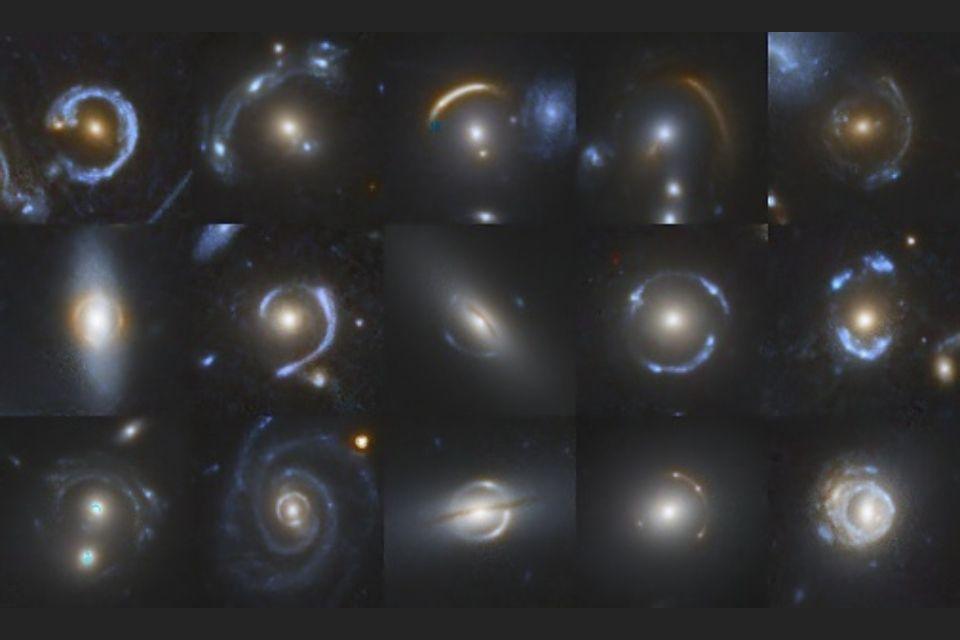
The image shows a montage of galaxy-galaxy strong lensing - two galaxies that are perfectly aligned, and the closest one modifies the image we see of the background one. Euclid’s combination of wide-field coverage and high-resolution imaging will allow it to identify thousands of strong gravitational lenses across the sky. These systems are powerful tools for studying dark matter, as the distorted images of background galaxies reveal the mass distribution of foreground galaxies and clusters. Strong lenses also magnify distant galaxies, giving astronomers a unique window onto the early Universe and galaxy evolution. In addition, large samples of strong lenses can help constrain the geometry and expansion history of the Universe, providing an independent probe of cosmology.
Euclid, a satellite a million miles from Earth, has released the largest map of the sky of its kind ever produced from space. The space telescope’s first major data release covers some 1,900 square degrees of the sky, equivalent to around 14% of the area planned for the 6-year mission and around 5% of the total sky. It is an unprecedented collection of visible and near-infrared observations.
The data combines exceptionally sharp images, and millions of spectra, offering the international astrophysics community an unrivalled wealth of data to explore a wide range of astrophysical questions and drive new discoveries. The pioneering space telescope aims to explore two of astronomy’s biggest mysteries: dark matter and dark energy.
In March 2025, almost two years after Euclid’s launch into space in July 2023, the consortium gave a taster of what was to come when it released a sneak preview of some early data – just 0.5 per cent of the complete area Euclid will map. And if that was the appetiser, today’s release is the first half of the starter: approximately 10,000 science images have been obtained by the satellite’s two instrument VIS (Visible instrument) and NISP (Near-Infrared Spectrometer and Photometer).
In just over a year, Euclid has catalogued more than 900 million galaxies across the released area. In addition, several regions were observed repeatedly over extended periods, known as the Euclid Deep Fields, allowing astronomers to probe galaxies dating back to 10 billion years. The release also includes the first tranche of spectroscopic data; more than 160 million spectra are available that can provide crucial information on each celestial object. Combined with Euclid’s high-resolution imaging, properties like how distant the objects are, what their chemical make-up is, what types of stars dominate their light, if they contain (supermassive) black holes and even how the stars and gas move within galaxies can all be determined. This rich dataset over such a large area is unprecedented.
Astrophysicists at the University of Oxford are key members of the Euclid consortium and are involved in various aspects of the mission. Dr Louis Gabarra is lead author of one of eight papers to have been selected as foundation papers to show just what Euclid is capable of.
His study demonstrates Euclid’s powerful spectroscopic capabilities. He extracted emission-line maps from the complex NISP spectroscopic data that traces the gas in galaxies. From this, he was able to obtain detailed information of how stars and gas move within galaxies, providing new insights into galaxy evolution.
‘Understanding dark energy requires measuring how the Universe has expanded over cosmic time, using an enormous amount of spectroscopic data from tens of millions of galaxies,’ explains Dr Gabarra. ‘To achieve this, Euclid's spectroscopic data-processing pipeline was designed to measure galaxy distances accurately and efficiently. It does this by measuring how emission lines, particularly the H-alpha line emitted by hydrogen, are shifted towards longer wavelengths as the Universe expands. The greater the redshift, the farther away the galaxy is.
'But these observations contain much more than information about galaxy distances. The H-alpha emission line also traces where new stars are forming within galaxies. We were able to unlock Euclid's ability to recover this spatial information, transforming its spectroscopic observations into detailed maps of star formation — almost turning Euclid's spectrometer into an imager!’
The study demonstrates this capability – to recover emission-line maps of galaxies across a wide range of distances – for the first time with Euclid. With the potential to produce around a million such maps, this breakthrough opens the door to studying where and how stars have formed within galaxies across billions of years of cosmic history, on an unprecedented scale.
Associate Professor Aprajita Verma, also from the Department of Physics at the University of Oxford and her group are part of the international team that has worked on mining the data to find rare strong gravitational lenses. She has co-authored three of the foundation papers borne out of the study of Euclid’s data. Access to the ‘taster’ data last year gave the team an exciting glimpse of all the strongly lensed systems that were out there, but the 30-times-larger area of data release today has surpassed these.
Methods to find the lenses remain largely the same as those used with the taster dataset; galaxies were shown to trained machine learning lens finders and these results were then inspected visually through the citizen science project Space Warps and by the Euclid strong lensing team. What changed however is that the machine learning models were retrained with the strong lenses discovered in the taster data which improved their performance significantly. Some 68 million images have been classified to date in this latest tranche of data revealing an astounding 15,000 high-quality strong lenses.
‘Citizen scientists have played a central role in delivering what is the largest set of strong lenses known to date,’ explains Professor Verma, who is also one of the leads of the Space Warps.citizen science project. ‘Tantalisingly, we also know we haven't found everything and there's yet much more Euclid data to come. This is a true pivotal moment for strong lensing science, one that we have been waiting for almost 50 years since the first strongly lensed system was observationally discovered. Thanks to Euclid, and our awe-inspiring cohort of citizen inspectors, we have finally arrived at this incredible era, we cannot wait to see the scientific advances this sample of new strong lenses will bring.’
‘It is extraordinary to see these data from Euclid on this scale,’ concludes Professor Lance Miller from Oxford’s Department of Physics; he has worked on Euclid since the mission was selected for implementation in 2011 and has played a key role in optimising Euclid’s image quality; he is patiently waiting for the next tranche of data that will come out in June – the weak lensing results. ‘The first round of papers is just the start and this is an incredibly exciting time to be an astrophysicist.’
Space telescopes: the big three
Euclid is optimised for mapping large swathes of the sky much like the Rubin Legacy Survey of Space and Time (LSST) – the latter being a ground-based telescope in Chile. Whereas, the Hubble space telescope, a household name since the 90s, and the James Webb Space Telescope, the largest and most powerful infrared space observatory launched at the end of 2021, both have smaller fields of view and are for detailed observation of individual objects or small fields.
In visible light, Euclid can see about 5 times greater detail than ground-based telescopes, Hubble is about twice better than that and JWST is about 2.5 times better than Hubble. JWST is optimised for observing in the infrared, longer wavelength than the visible while Euclid and Hubble have visible to near-infrared capability. There is some complementarity between all three facilities.
About the instruments on board Euclid
The Visible instrument (VIS)
As the name suggests, VIS collects visible light. It is sensitive to wavelengths from green (550 nanometres) up to near-infrared (900 nm). takes very sharp images of galaxies over a much larger fraction of sky than would be possible from the ground. These observations will be used to measure the shapes of over a billion galaxies. Because the trajectory of light is affected by gravity, the shapes of galaxies is also, subtly, affected by the gravity field. By combining this information with accurate estimates of the distance of tens of millions of these objects, scientists will chart the 3-dimensional distribution of matter in the Universe and study how cosmic acceleration modifies its expansion history.
Near-Infrared Spectrometer and Photometer (NISP)
NISP is dedicated to making spectroscopic measurements of galaxies, which involves determining how much light they emit per wavelength. This is useful for measuring the galaxies’ redshift, which cosmologists can use to estimate the distance to each galaxy.
With this information, Euclid’s data will be turned into the largest, most accurate 3D survey of the Universe ever conducted. How galaxies are distributed over the Universe, and how this distribution changes over time, teaches us about dark matter (which affects gravity) and dark energy (which affects the expansion of the Universe).