

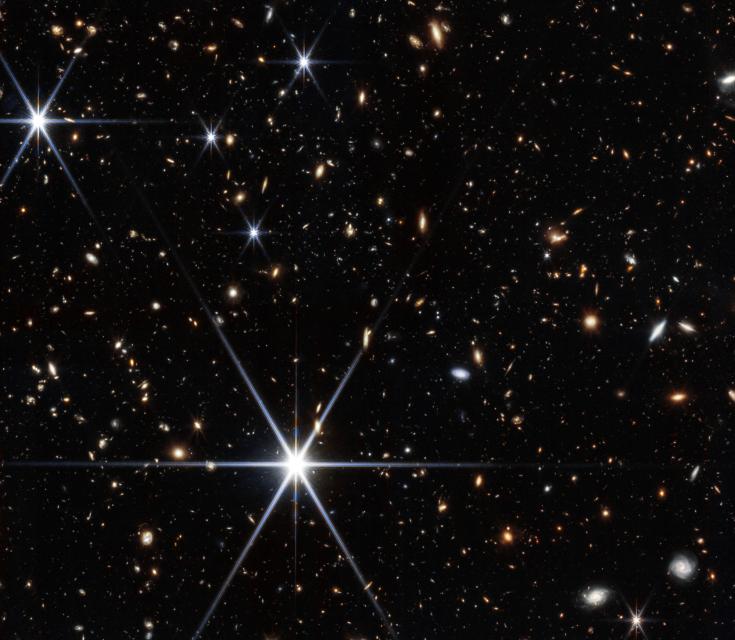
NASA’s James Webb Space Telescope’s NIRCam (Near-Infrared Camera) was able to detect the host galaxy of the fast radio burst called FRB 20240304B, whose location is shown by the white cross. They found it is a small dwarf galaxy actively forming stars.
An international team of astronomers, including researchers from the Universities of Manchester and Oxford, have used a combination of the MeerKAT telescope and the James Webb Space Telescope to identify the most distant fast radio burst (FRB) seen to date.
Published today in Science, the new findings show that the host galaxy of the FRB is surprisingly small and young which suggests that there is little delay between when galaxies form stars and when they become capable of generating FRBs.
The record breaker dates back to just 3 billion years after the big bang though the origin of such events, remains uncertain. First discovered in 2007, FRBs are enigmatic, millisecond-long flashes of radio emission from the distant universe. Their finding has implications for what kind of energetic event creates these bursts.
The MeerTRAP team, led by Professor Ben Stappers at the Jodrell Bank Centre for Astrophysics at The University of Manchester, used the MeerKAT telescope in South Africa to detect the burst on 4 March 2024, leading to its designation as FRB 20240304B. The radio emission from this burst suggested that it was extremely distant, possibly the most distant one seen to date.
'The host sticks out in the whole galaxy sample that we have. And it was not what we were expecting,' said Professor Stappers, a co-author on the paper. 'This combination of using the MeerTRAP project on the MeerKAT telescope to discover and localise these distant bursts and Webb to study their hosts is very exciting.'
Webb’s NIRCam (Near-Infrared Camera) instrument detected a galaxy in the right location, and found that the FRB corresponded to a time just 3 billion years after the big bang. The vast majority of FRBs detected to date occurred billions of years later in cosmic history.
A fast radio burst at redshift 2, three billion years after the Big Bang, M Caleb et al, Science, 8 October 2026
'What makes fast radio bursts interesting is that we don't know what generates them,' adds Dr Manisha Caleb of the University of Sydney, lead author on the study. 'We have theories for what objects produce them, but we don't have conclusive proof.'
The team discovered that the host galaxy of FRB 20240304B was not typical of other galaxies with FRBs. Most FRB galaxies are massive star-forming galaxies, but the galaxy they found was 1,000 times less massive than they expected.
'We thought it would be a big, nicely formed galaxy with lots of stars, and instead it was a little dwarf galaxy, although it was actively forming stars,' said Dr Caleb.
The galaxy existed at the height of 'cosmic noon' – a period in the history of the universe when star formation was at its peak. The galaxy’s rate of star formation suggested that the majority of its stars may have formed within just 30 million years.
This has important implications for the origin of fast radio bursts. One theory suggests that FRBs may originate from the merger of two neutron stars, while a second theory proposes that an FRB can originate from a single, young, highly magnetic neutron star known as a magnetar through a mechanism like starquakes.
'Our work suggests that it’s very unlikely that this FRB was produced by a merger,' said Dr Caleb.
In addition to being a record-holder, the new FRB enabled the team to learn more about the billions of light-years of apparently empty space between the burst and Earth. Dr Kaustubh Rajwade from the Department of Physics at the University of Oxford and co-author of the study led the software development that enabled localising the FRB: 'MeerKAT is uniquely placed to find FRBs at such distances and it’s one of the few telescopes that can find FRBs from the early days of the Universe and probe important epochs in our Cosmic history.'
In the future, the team is excited about the potential to discover more distant FRBs. They estimate that the MeerKAT telescope may be able to detect and localize several FRBs per year potentially dating more than halfway back to the start of the universe. As other new radio telescope facilities and instruments come online, that discovery pace may grow. The Webb telescope will be essential for characterising those distant host galaxies.