

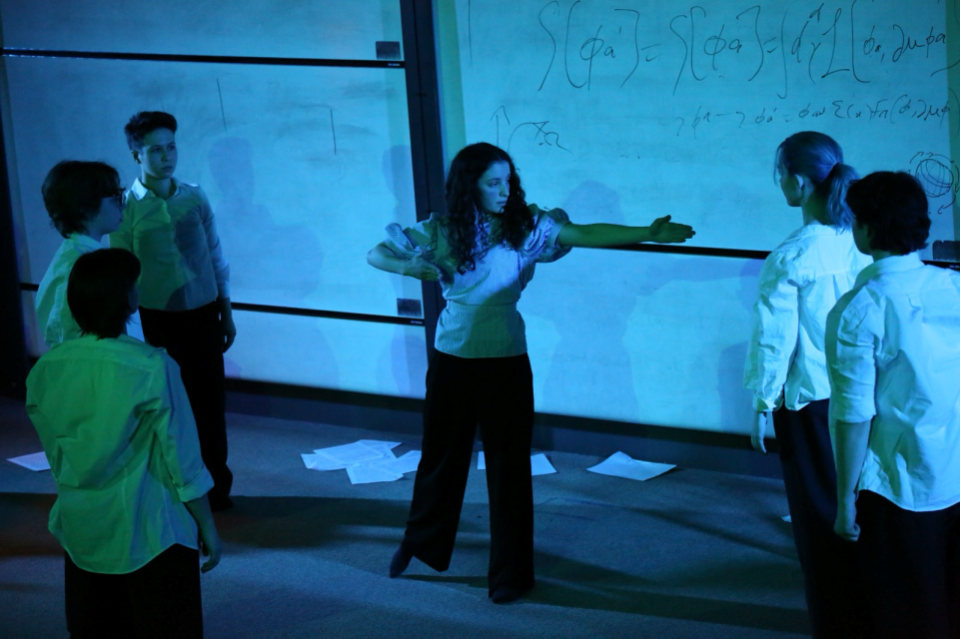
In February 2026, Oxford students performed a new play at the Mathematical Institute celebrating the life and work of German mathematician Emmy Noether (1882-1925). The play, Noether, was written and directed by third-year physics student Esme Somerside Gregory.
Albert Einstein described Noether as ‘the most significant creative mathematical genius produced since the higher education of women began.’ Noether’s mathematics are foundational to mathematical physics, especially Noether’s theorem that explains the connection between symmetry and conservation laws.
Esme was first drawn to Noether's story during her first-year physics lectures, where she encountered Noether's theorem. After a year of historical research, drawing on letters, memoirs and primary documents, she devised the production collaboratively with a cast of seven actors over six weeks, weaving verbatim source material into a dramatic narrative.
The play explores Noether’s life and early career at the University of Göttingen where she faced significant discrimination as a German-Jewish woman in mathematics. Despite this adversity, ‘Noether made huge contributions to mathematics and physics that still impact current research,' comments Esme. 'It felt important to highlight her story as it is often not heard, and many of the themes feel ever more relevant now.'
The production, presented by Oxford student theatre company Cartesian Productions, ran for four nights at the Mathematical Institute. The final performance was followed by an academic panel discussion and drinks reception hosted by the Oxford Physics Gender Equity Network.