

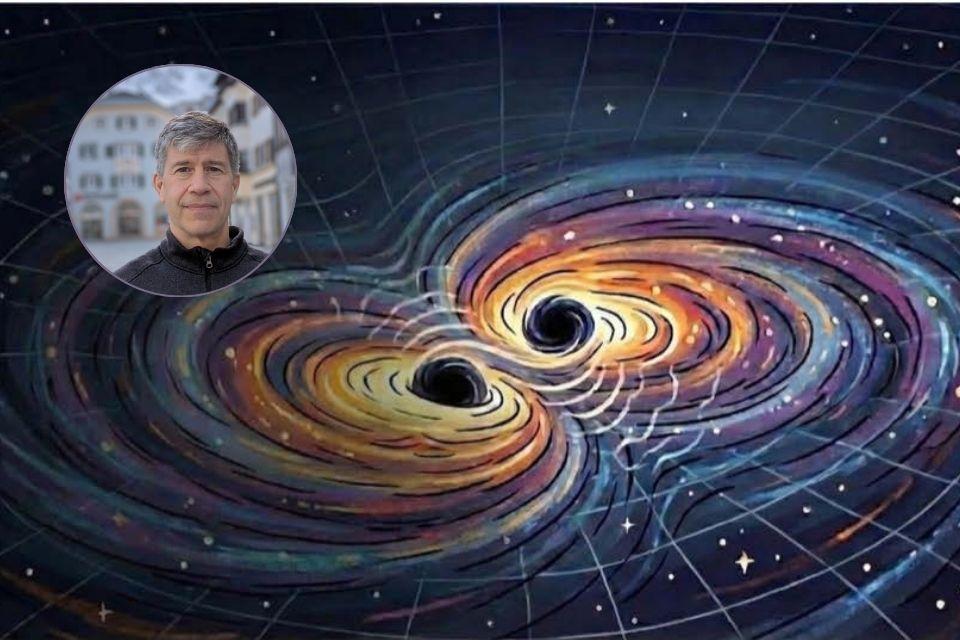
Professor Matias Zaldarriaga, IAS/Princeton University
Black holes we didn't expect: puzzles from gravitational wave observations
This year's Halley Lecture will be delivered by Professor Matias Zaldarriaga from the Institute for Advanced Study, USA. The public lecture will be hosted in person at the Martin Wood Complex, and streamed online via Zoom (link below). For those attending in person, the talk will be followed by a drinks reception. No registration is required, please be seated by 16:55hs.
Abstract:
Gravitational waves have opened entirely new windows onto the universe. Ground-based detectors have now observed hundreds of mergers of stellar-mass black holes, revealing a population that is heavier and more diverse than anticipated. Meanwhile, pulsar timing arrays have recently claimed the detection of a low-frequency gravitational wave background, most likely produced by merging supermassive black holes in the centres of galaxies – and its strength appears surprisingly large compared to what we would predict from the known
population of these objects. The origin of the heaviest stellar-mass black holes and of the supermassive black holes that inhabit the centres of galaxies remain among the great open questions in astrophysics. As has happened so often in the history of astronomy, new ways of observing the universe have given us not the answers we expected, but new puzzles to marvel at and exercise our imagination.