

Martin Wood Complex, Department of Physics, University of Oxford, Parks Road, Oxford, OX1 3PU
Leanne O'Donnell (Leanne.odonnell@physics.ox.ac.uk)
Abstract
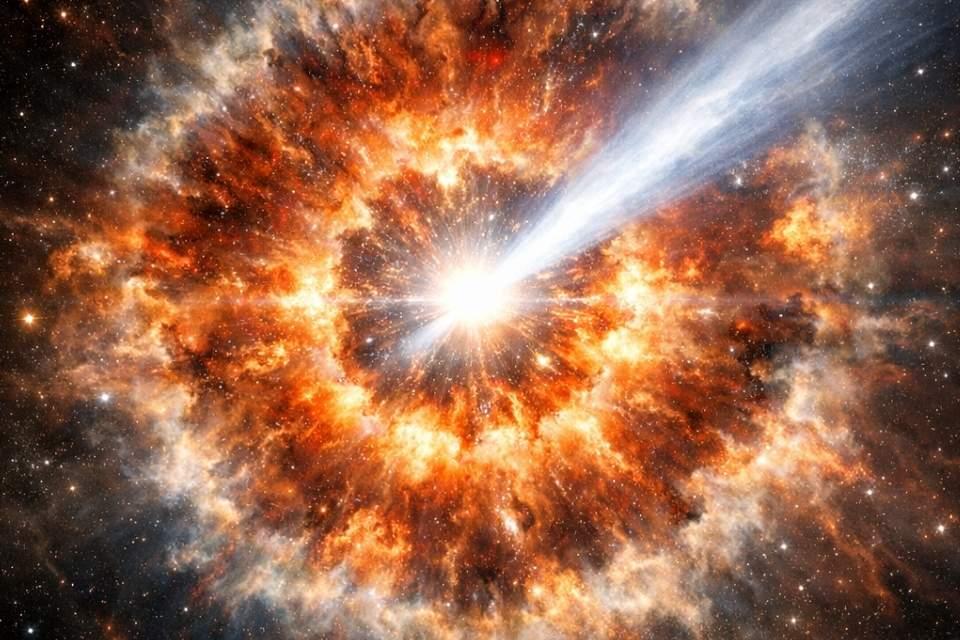
The Universe is a violent and dynamic environment, in which the explosions of massive stars can outshine an entire galaxy, supermassive black holes swallow stars whole, merging neutron stars cause ripples in the fabric of spacetime, and particles are accelerated to energies far surpassing anything possible in laboratories on the Earth. The extremes of physics – density, temperature, pressure, velocity, gravitational and magnetic fields – experienced in these environments provide a unique glimpse at the laws of physics operating in extraordinary regimes. Such ‘extreme astrophysics’, is a high priority for global research in the 21st century, and Oxford is leading the way, chasing these elusive and transient phenomena.
Professor Rob Fender will introduce the subject of astrophysical transients. Following this Wetton Professor Stephen Smartt will discuss how we study supernovae, the extraordinarily luminous explosions that mark the death throes of massive stars, and furthermore how he and his group have chased and identified the optical counterpart to the first gravitational wave burst associated with the merging of two neutron stars. Dr Katie Savard will show how we can simulate these relativistic astrophysical transients, involving huge masses moving at large fractions of the speed of light, in powerful computers, to gain insights into the physics taking place.
Following these presentations, we will have a panel discussion on astrophysical transients, the most extreme physics in our universe since the big bang.
This event is for alumni and invited guests.