

Abstract
Detecting the fractionalized Fermi liquid in the cuprate superconductors
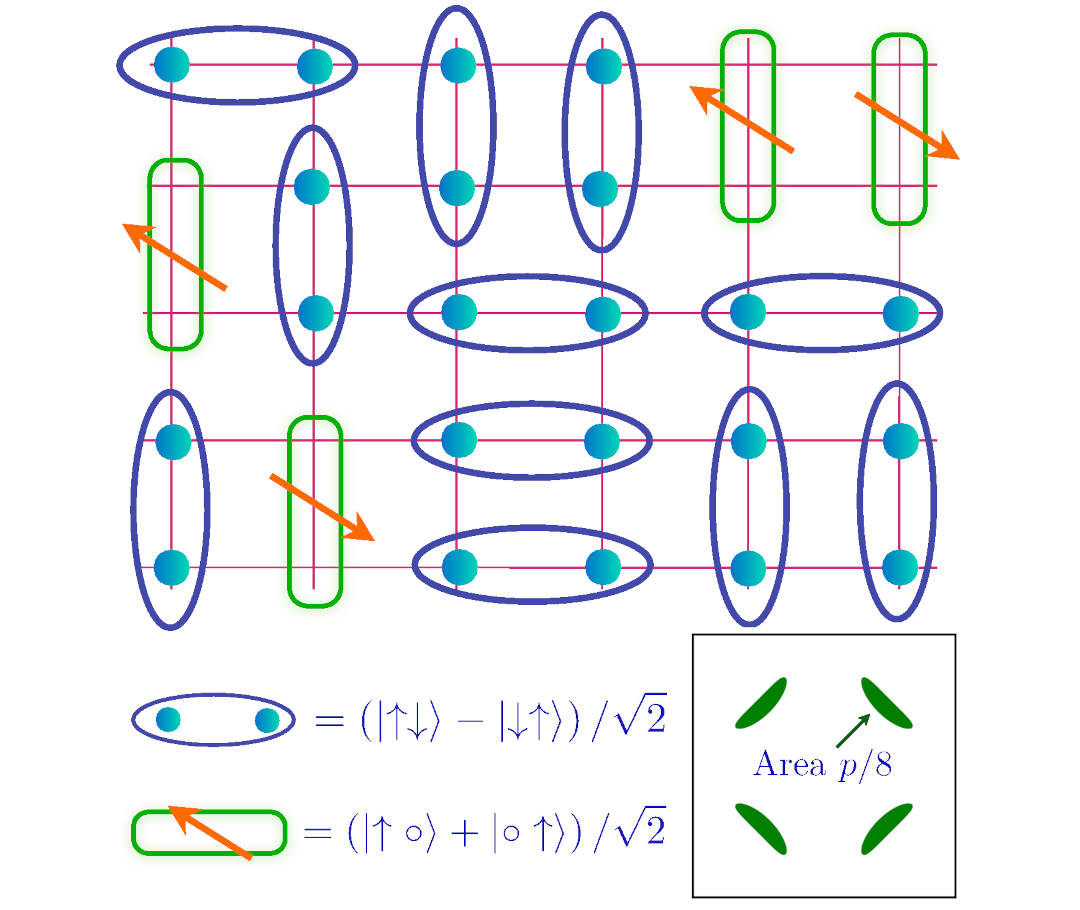
Soon after the discovery of the cuprate high-temperature superconductors, P. W. Anderson presciently suggested in 1987 that their physics is connected to highly entangled many-body states now known as quantum spin liquids. However, the development of this idea over subsequent decades encountered significant tensions with experimental observations. I address these difficulties using the fractionalized Fermi liquid (FL*) state, proposed in 2002, which describes the doping of a quantum spin liquid with electron-like quasiparticles.
Recent angle-dependent magnetoresistance measurements in lightly hole-doped cuprates are consistent with key predictions of the FL* theory. The non-symmetry-breaking quantum phase transition between the FL* state and a conventional Fermi liquid, in the presence of impurities, can be described by a two-spatial-dimensional extension of the Sachdev–Ye–Kitaev (SYK) model. This framework is then applied to the strange-metal regime at intermediate temperatures and dopings. I will also briefly mention how the SYK model has led to recent progress in understanding the density of quantum states of charged black holes.