

Martin Wood Complex, Department of Physics, University of Oxford, Parks Road, Oxford, OX1 3PU
Professor Sir Chris Lewellyn-Smith, FRS, Physics Department, University of Oxford
Abstract
Electricity will meet an increasing fraction of the world’s growing energy needs as fossil fuels are phased out. In many countries, including GB, most will be provided by wind. Wind varies by large amounts on a decadal time scale. To match wind and solar with demand, which is also variable, they must therefore be complemented by adding other controllable low carbon sources, and/or using wind and solar energy that has been stored when there is an excess. Following some general remarks on the world energy outlook, I will describe the conclusion of the Royal Society’s 2023 study of Large-scale Electricity Storage, and further work that builds on, extends and further quantifies its conclusions. The new elements include the use of 45 years of weather data, systematic inclusion of correlations between demand and the weather, and modelling of a range of types of store and other sources. For given input costs, the model automatically chooses the solution that leads to the lowest average cost of electricity, and the corresponding level of wind and solar supply. In all cases long-duration storage that could meet at least 15 days of demand is required: in GB this would best be provided by hydrogen generated by excess wind and solar power stored in solution-mined salt caverns. The average cost of electricity is minimised by including some medium-duration store. Depending on the future cost of gas, this average cost could be lowered by using unabated gas fired generation but this would lead to unacceptable CO2 and upstream methane emissions, while using gas equipped with carbon capture and storage would increase the cost. The average cost of electricity is found to be higher than in the last decade, but no higher than in recent years. The biggest uncertainty is in the cost of wind power. In order for GB to reach net-zero in 2050, construction of salt-caverns should start now, market conditions that would allow them to attract private funding should be introduced, and all possible steps to drive down the cost of wind power should be taken.
References: royalsociety.org/electricity-storage (September 2023) and subsequent work in collaboration with Seamus Garvey and Iain Staffell.
See the attachment for the slides that accompanied the talk.
Biography
Chris Llewellyn Smith, who is a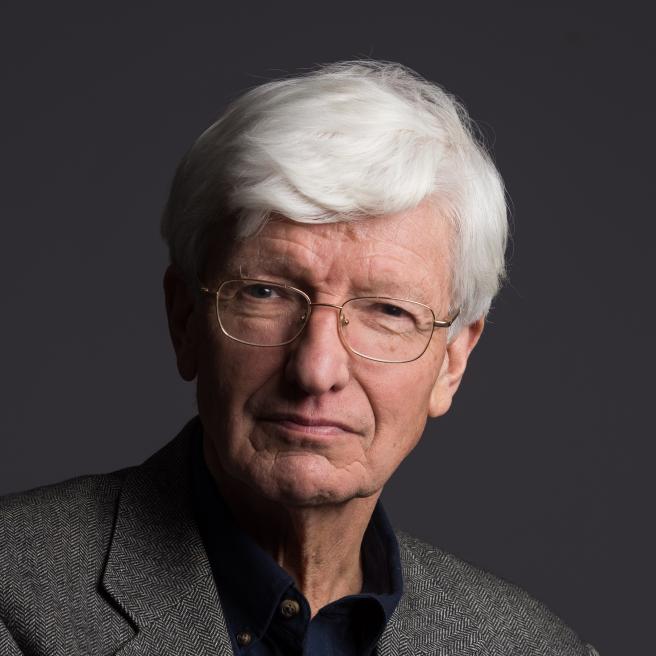 theoretical physicist, is currently interested in all aspects of energy supply and demand. He led the Royal Society’s study large-scale electricity storage, published in September 2023. Chris has inter alia served as Director of Energy Research, University of Oxford (2011-17); President of the Council of Synchrotron-light for Experimental Science and Applications in the Middle East (2008-17); and Director General of CERN (1994-1998), when the Large Hadron Collider was approved and construction started. He has written and spoken widely on science funding, international scientific collaboration and energy issues, and served on many advisory bodies nationally and internationally, including the UK Prime Minister’s Advisory Council on Science and Technology (1989-92). His contributions to theoretical particle physics and leadership have been recognised by awards and honours world-wide, including election to the Royal Society (1984), which awarded him a Royal Medal in 2015. Chris studied in Oxford, where took a degree in physics (1964) and a DPhil (1967) in theoretical particle physics. After periods in Moscow, at CERN and at SLAC, he was based in Oxford from 1974 until he returned to CERN as Director General. As Chairman of Physics (1987-92) he led the unification of Oxford’s then separate four physics departments and astronomy. As a theoretical physicist, Chris showed that SLAC’s deep inelastic electron scattering data when combined with CERN’s neutrino data imply that partons have non-integral charge and baryon number one-third (i.e. they are quarks), and that gluons carry around half a nucleon’s momentum. Using methods that imply an upper bound on its mass, in reach of the LHC, he showed that there must be a Higgs boson, or bosons, in well-behaved theories of the electroweak force. In the 1980s and 1990s he was involved in many studies of future accelerators, including LEP, HERA and the LHC
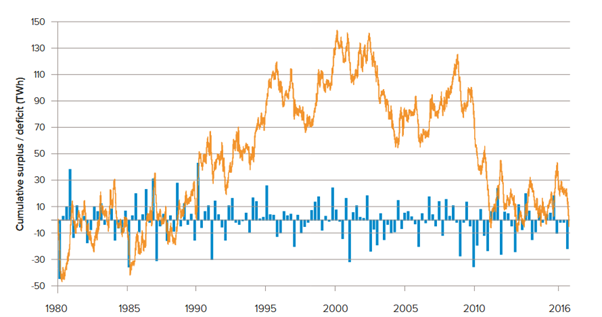
Differences between electricity supply and demand in each quarter ( blue) and cumulative ( orange) 1980 to
2018, with an AFRY model of 570 TWh/year of demand in each year and Ninja-Renewables model of wind
and solar supply (mixed 80%/20%), based on real historical weather data, scaled to average 570 TWh/year.
This figure (taken from the 2023 Royal Society Report on Large-Scale Electricity Storage) shows that wind
availability varies on very long (decadal) time scales. This has important implications for the need for largescale
long-duration storage in countries (such as GB) that are committed to large-scale wind supply.
Hybrid Meeting
If you are unable to attend in person, you can join online.