

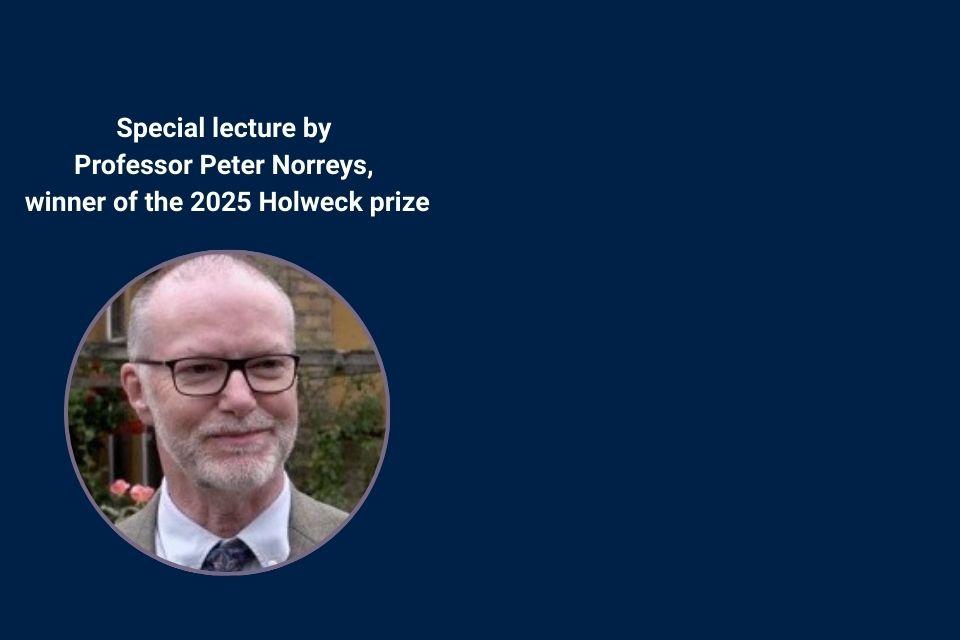
Professor Peter Norreys, University of Oxford
Foam properties under extreme pressures for fusion energy studies
Professor Peter Norreys has been awarded the Société Française de Physics and Institute of Physics Fernand Holweck Prize. The gold medal recognises his outstanding contributions to fundamental studies of high energy density plasmas using high power petawatt-class lasers, including fast ignition inertial fusion, particle acceleration and ultra-bright X-ray sources.
The celebratory lecture will be followed by a small reception.
No registration required; please be seated by 2.25pm
Abstract
The recent progress at the National Ignition Facility (NIF) has sparked fresh excitement around the topic of inertial fusion energy (IFE). However, significant advances are still required before the goal of practical fusion energy can be realised. In particular, while the recently achieved gain of 4 represents an unprecedented milestone, it is still short of the minimum value of > 50 likely to be required for a viable fusion reactor. In addition, current target designs are expensive and time-consuming to produce, while cost estimates for future inertial fusion reactors require low cost and high repetition rates. Wetted-foam capsules are seen as promising solutions for future IFE reactor targets, with the potential to enable high gain performance at low cost. The CH foams, used to contain the DT liquid fuel, can potentially be 3D printed, which could significantly improve the production rates and costs compared to conventional DT-ice targets. A variety of designs based on this technology have been proposed, ranging from more conventional designs (where the wetted-foam layer replaces a DT ice layer) to novel dynamic-shell approaches. Despite their potential, the shock response of low-density foams remains poorly characterised, limiting the accuracy of hydrodynamic simulations. Here, I will review experimental measurements of the equation of state (EOS) for silica (SiO2) aerogel and plastic (TMPTA) foams under laser-driven shock compression, conducted recently by my team over the past few years at the Vulcan, GEKKO XII and LULI2000 laser facilities with colleagues from the UK, France, the EU, the USA and Japan. Shock pressures between 50 and 160 GPa were achieved, and the corresponding states were determined using established impedance matching techniques with a quartz reference material. Towards the end, I will also touch upon promising AI simulation approaches to target and laser beam optimisation of wetted foam implosions, novel approaches to parametric instability suppression using broad-bandwidth laser pulses, heat flows in burning plasmas and (very briefly) ultra-bright X-ray source generation.