

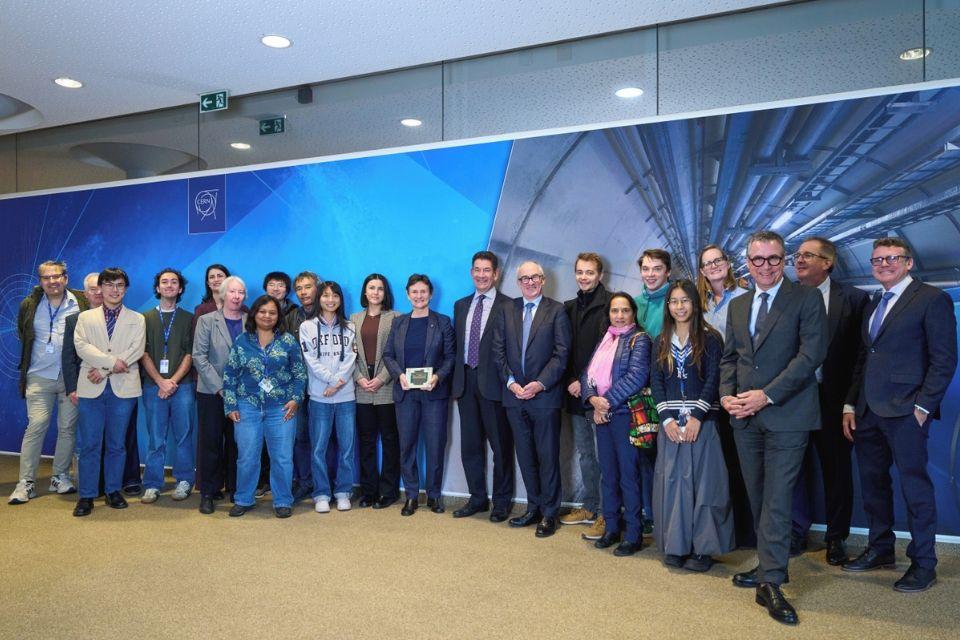
Visiting CERN during an extended shutdown period gives unprecedented access to the world’s best known particle physics playground and when teams from Oxford welcomed the University of Oxford’s Vice Chancellor Professor Irene Tracey, they demonstrated there was just as much going on as when the experiments are all in full swing. CERN’s accelerator complex and experiment facilities are undergoing major maintenance and upgrade work. Referred to as Long Shutdown 3, thousands of experts from around the world – including many from the University of Oxford’s Department of Physics – are focussing on transforming the Large Hadron Collider (LHC) as well as upgrading most of the other accelerators and experimental facilities. It is an excellent opportunity to take stock of Oxford’s longstanding involvement and to find out more about all the hard work that is going on behind the scenes.
The LHCb experiment
Professor Tracey’s tour included an underground visit to the Large Hadron Collider beauty (LHCb) experiment, one of the four large detectors on the LHC. This experiment, of which Oxford is a founding and leading member, is the world’s foremost facility for the study of the CP violation (the difference in behaviour between matter and anti-matter) and other rare processes in the decays of mesons containing a beauty quark. It has also discovered more new hadrons than any other experiment in the history of physics. Professor Guy Wilkinson, a previous Spokesperson (principal investigator) of LHCb, remarked: ‘It was a pleasure to show Professor Tracey our detector, and to introduce her to some of the wonderful Oxford students and postdocs who are so central to its success. It was also a timely opportunity to discuss our future plans and how to realise our goals in a challenging funding environment.’
Accelerator excellence at CERN
Since its foundation in 2004 the John Adams Institute (JAI) centre of excellence based in the Department of Physics at Oxford, has played key roles in supporting and advancing the accelerator complex at CERN. These include understanding the dynamics of intense subatomic particle beams travelling at almost the speed of light, as well as measuring and controlling their trajectories so as to ensure optimal data delivery to the experiments. So far 25 JAI early-career researchers have completed CERN Doctoral Studentships and 27 of JAI’s graduates have gone on to win CERN fellowships or staff positions.
The highest-priority current activity is the upgrade of the LHC – the High-Luminosity LHC – which aims to increase the data delivered to the major experiments by at least a factor of 5. Professor Philip Burrows, who chaired the Collaboration Board of this 1.2 billion Swiss francs international project between 2022 and 2026, commented: ‘It was an honour to accompany Professor Tracey on her tour of the impressive magnet test facility, and of the LHC tunnel 100m below ground. I am proud of the close partnership we have with CERN for advancing accelerator science and technology. This delivers both world-leading developments in particle physics and technologies with huge societal applications in medicine, industry and other scientific fields.’
Advancing ATLAS
During her visit, Professor Tracey also met with Oxford researchers working on ATLAS, one of the largest and most ambitious particle physics experiments ever built. Oxford plays a leading role in analysing the vast amounts of data collected by ATLAS, particularly in studies of the Higgs boson and searches for new particles that could help explain the mysterious dark matter making up much of the matter in the Universe.
Oxford is also making major contributions to the next generation of the experiment. As the LHC prepares for a major increase in the intensity of its collisions, the heart of the ATLAS detector will be replaced with a new, ultra-precise silicon tracking system (ITk), capable of reconstructing particle trajectories in an exceptionally challenging environment. Oxford researchers and engineers are playing a key role in its design and construction, drawing on specialist expertise and facilities within the Department of Physics.
‘ATLAS brings together some of the most extraordinary scientific and technological challenges of our time,’ explains Professor Daniela Bortoletto, Head of Particle Physics. ‘At Oxford, we have the privilege of contributing both to the instruments that make discoveries possible and to the science that follows. With the upgraded LHC, we will be able to explore the Higgs boson with unprecedented precision and push further into the unknown in our search for new physics. What excites me most is that the next great discovery may be something we have not yet imagined.’