Home
Department Of Physics text logo
  • Research
    • Our research
    • Our research groups
    • Our research in action
    • Research funding support
    • Summer internships for undergraduates
  • Study
    • Undergraduates
    • Postgraduates
  • Engage
    • For young people
    • For teachers
    • For the public
    • For alumni
    • For business
  • Support
Menu
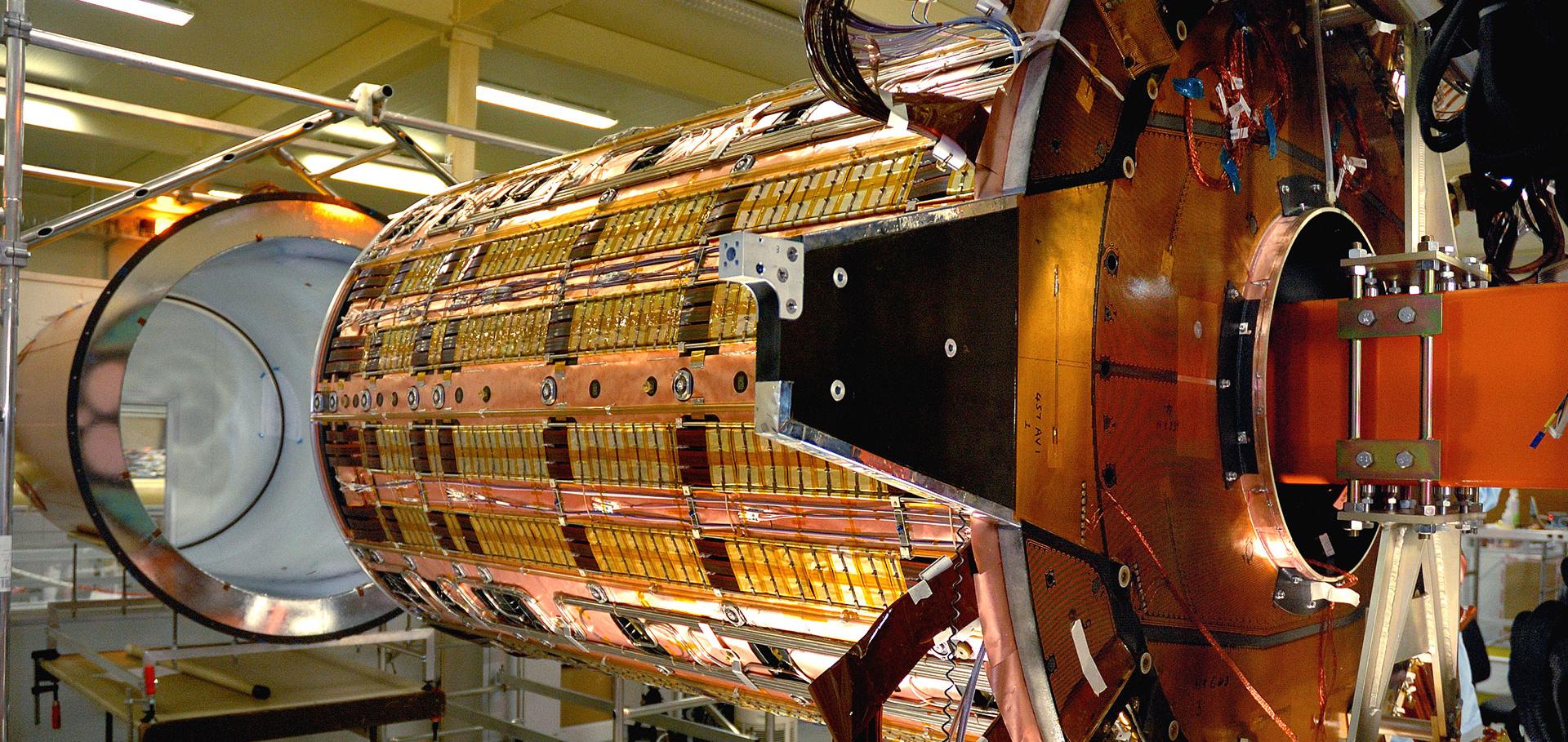
Insertion of STC into TRT at the Department of Physics, Oxford
Credit: CERN

Professor Daniela Bortoletto

Professor and Head of Particle Physics

Research theme

  • Instrumentation
  • Fundamental particles and interactions

Sub department

  • Particle Physics

Research groups

  • AION/Magis
  • ATLAS
  • Future Colliders
  • Mu3e
  • OPMD
daniela.bortoletto@physics.ox.ac.uk
Telephone: 01865 (2)73635
Denys Wilkinson Building, room 608c1
  • About
  • Students
  • Research
  • Teaching
  • Publications

In situ calibration of large-$R$ jet energy and mass in 13 TeV proton-proton collisions with the ATLAS detector

ArXiv 1807.09477 (2018)
Details from ArXiV

Charge collection in irradiated HV-CMOS detectors

Nuclear Instruments and Methods in Physics Research, Section A: Accelerators, Spectrometers, Detectors and Associated Equipment (2018)

Authors:

B Hiti, A Affolder, K Arndt, R Bates, M Benoit, FD Bello, A Blue, D Bortoletto, M Buckland, C Buttar, P Caragiulo, D Das, D Doering, J Dopke, A Dragone, F Ehrler, V Fadeyev, W Fedorko, Z Galloway, C Gay, H Grabas, IM Gregor, P Grenier, A Grillo, Y Han, M Hoeferkamp, LBA Hommels, T Huffman, J John, K Kanisauskas, C Kenney, G Kramberger, Z Liang, I Mandić, D Maneuski, F Martinez-Mckinney, S McMahon, L Meng, M Mikuž, D Muenstermann, R Nickerson, I Peric, P Phillips, R Plackett, F Rubbo, L Ruckman, J Segal, S Seidel, A Seiden, I Shipsey, W Song, M Stanitzki, D Su, C Tamma, R Turchetta, L Vigani, J Volk, R Wang, M Warren, F Wilson, S Worm, Q Xiu, J Zhang, H Zhu

Abstract:

© 2018 Elsevier B.V. Active silicon detectors built on p-type substrate are a promising technological solution for large area silicon trackers such as those at the High Luminosity LHC, but the radiation hardness of this novel approach has to be evaluated. Active n-in-p strip detector prototypes CHESS2 for ATLAS with different substrate resistivities in the range of 20–1000 Ωcm were irradiated with neutrons and protons up to a fluence of 2×10 15 n eq cm −2 and 3.6×10 15 n eq cm −2 . Charge collection in passive test structures on the chip was evaluated using Edge-TCT and minimum ionising electrons from 90 Sr. Results were used to assess radiation hardness of the detector in the given fluence range and to determine parameters of initial acceptor removal in different substrates.
More details from the publisher
Details from ORA
More details

Search for Higgs boson pair production in the $γγWW^{*}$ channel using $pp$ collision data recorded at $\sqrt{s} = 13$ TeV with the ATLAS detector

ArXiv 1807.08567 (2018)
Details from ArXiV

Search for Higgs bosons produced via vector-boson fusion and decaying into bottom quark pairs in $\sqrt{s} = 13$ $\mathrm{TeV}$ $pp$ collisions with the ATLAS detector

ArXiv 1807.08639 (2018)
Details from ArXiV

Search for charged Higgs bosons decaying via $H^{\pm} \to τ^{\pm}ν_τ$ in the $τ$+jets and $τ$+lepton final states with 36 fb$^{-1}$ of $pp$ collision data recorded at $\sqrt{s} = 13$ TeV with the ATLAS experiment

ArXiv 1807.07915 (2018)
Details from ArXiV

Pagination

  • First page First
  • Previous page Prev
  • …
  • Page 323
  • Page 324
  • Page 325
  • Page 326
  • Current page 327
  • Page 328
  • Page 329
  • Page 330
  • Page 331
  • …
  • Next page Next
  • Last page Last

Footer Menu

  • Contact us
  • Giving to the Dept of Physics
  • Work with us
  • Media

User account menu

  • Log in

Follow us

FIND US

Clarendon Laboratory,

Parks Road,

Oxford,

OX1 3PU

CONTACT US

Tel: +44(0)1865272200

University of Oxfrod logo Department Of Physics text logo
IOP Juno Champion logo Athena Swan Silver Award logo

© University of Oxford - Department of Physics

Cookies | Privacy policy | Accessibility statement

Built by: Versantus

  • Home
  • Research
  • Study
  • Engage
  • Our people
  • News & Comment
  • Events
  • Our facilities & services
  • About us
  • Giving to Physics
  • Current students
  • Staff intranet