Home
Department Of Physics text logo
  • Research
    • Our research
    • Our research groups
    • Our research in action
    • Research funding support
    • Summer internships for undergraduates
  • Study
    • Undergraduates
    • Postgraduates
  • Engage
    • For young people
    • For teachers
    • For the public
    • For alumni
    • For business
  • Support
Menu
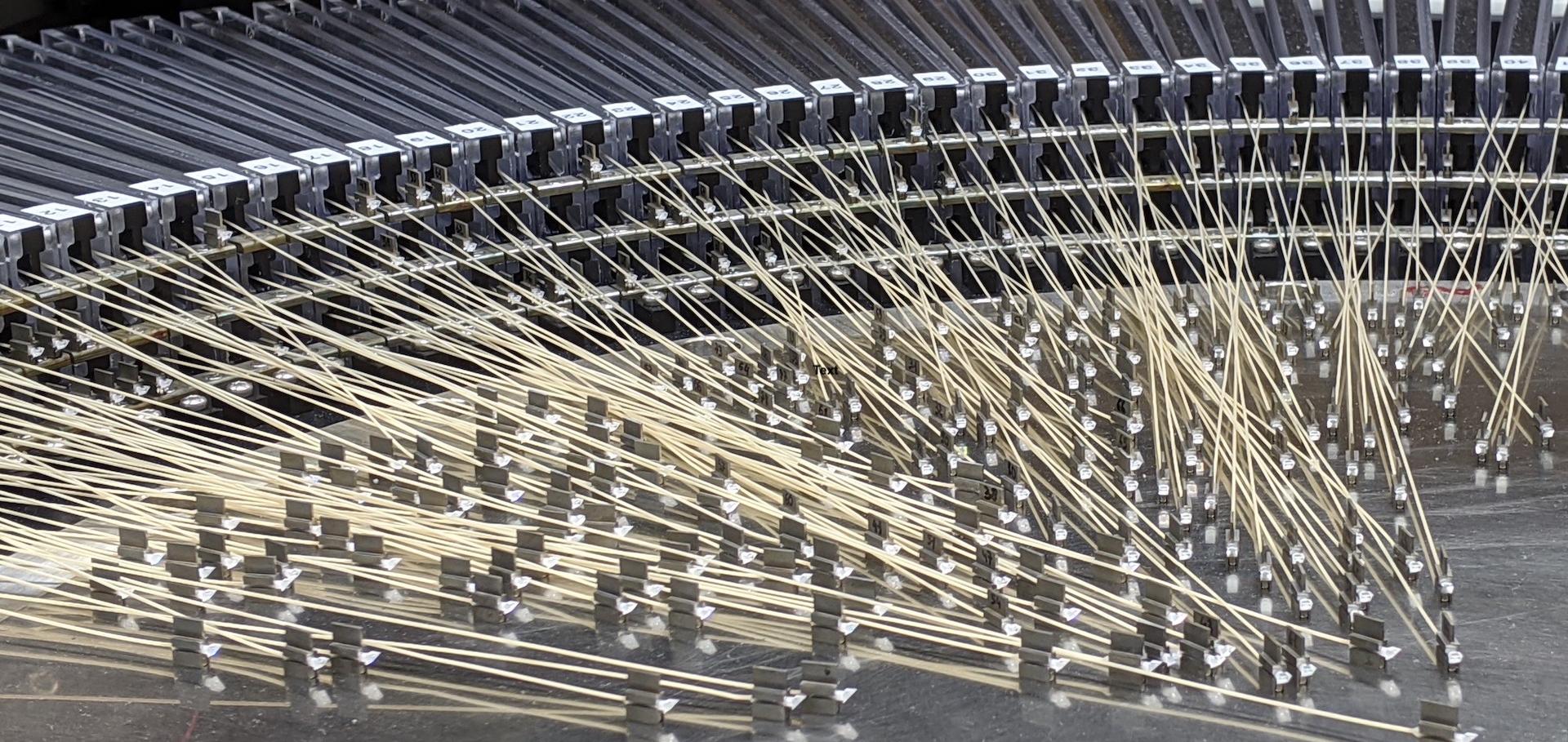
Part of a WEAVE fibre configuration

Part of the WEAVE focal plane showing optical fibres positioned on a set of targets in the telescope focal plane.

Prof Gavin Dalton

Professor of Astrophysics

Research theme

  • Astronomy and astrophysics

Sub department

  • Astrophysics

Research groups

  • Astronomical instrumentation
  • Extremely Large Telescope
Gavin.Dalton@physics.ox.ac.uk
  • About
  • Research
  • Publications

On the CCD Calibration of Zwicky galaxy magnitudes & The Properties of Nearby Field Galaxies

(1999)

Authors:

E Gaztanaga, GB Dalton
More details from the publisher

The APM cluster-galaxy cross-correlation function: Constraints on Ω and galaxy bias

Monthly Notices of the Royal Astronomical Society 305:3 (1999) 547-562

Authors:

RAC Croft, GB Dalton, G Efstathiou

Abstract:

We estimate the cluster-galaxy cross-correlation function (ξcg), from the APM galaxy and galaxy cluster surveys. We obtain estimates both in real space from the inversion of projected statistics and in redshift space using the galaxy and cluster redshift samples. The amplitude of ξcg is found to be almost independent of cluster richness. At large separations, r ≳ 5 h-1 Mpc (h = H0/100 km s-1 Mpc-1, where H0 is the Hubble constant), ξcg has a similar shape to the galaxy-galaxy and cluster-cluster autocorrelation functions. ξcg in redshift space can be related to the real-space ξcg by convolution with an appropriate velocity field model. Here we apply a spherical collapse model, which we have tested against N-body simulations, finding that it provides an accurate description of the averaged infall velocity of matter into galaxy clusters. We use this model to estimate β(β = Ω0.6/b, where b is the linear bias parameter), and find that it tends to overestimate the true result in simulations by only ∼10-30 per cent. Application to the APM results yields β = 0.46 with β < 0.73 at 95 per cent confidence. This measure is complementary to the estimates made of the density parameter from larger scale bulk flows and from the virialized regions of clusters on smaller scales. We also compare the APM ξcg and galaxy autocorrelations directly with the mass correlation and cluster-mass correlations in COBE-normalized simulations of popular cosmological models, and derive two independent estimates of the galaxy biasing expected as a function of scale. This analysis reveals that both low-density and critical-density COBE-normalized cold dark matter (CDM) models require anti-biasing by a factor ∼2 on scales r ≤ 2 h-1 Mpc, and that the mixed dark matter (MDM) model is consistent with a constant biasing factor on all scales. The critical-density CDM model also suffers from the usual deficit of power on large scales (r ≳ 20 h-1 Mpc). We use the velocity fields predicted from the different models to distort the APM real-space cross-correlation function. Comparison with the APM redshift-space ξcg yields an estimate of the value of Ω0.6 needed in each model. We find that only the low-Ω model is fully consistent with observations, with MDM marginally excluded at the ∼2σ level.
More details from the publisher
More details
Details from ArXiV

The 2dF Galaxy Redshift Survey: Spectral Types and Luminosity Functions

(1999)

Authors:

SR Folkes, S Ronen, I Price, O Lahav, M Colless, SJ Maddox, KE Deeley, K Glazebrook, J Bland-Hawthorn, RD Cannon, S Cole, CA Collins, WJ Couch, SP Driver, G Dalton, G Efstathiou, RS Ellis, CS Frenk, N Kaiser, IJ Lewis, SL Lumsden, JA Peacock, BA Peterson, W Sutherland, K Taylor
More details from the publisher

The 2dF Galaxy Redshift Survey: spectral types and luminosity functions

MONTHLY NOTICES OF THE ROYAL ASTRONOMICAL SOCIETY 308:2 (1999) 459-472

Authors:

S Folkes, S Ronen, I Price, O Lahav, M Colless, S Maddox, K Deeley, K Glazebrook, J Bland-Hawthorn, R Cannon, S Cole, C Collins, W Couch, SP Driver, G Dalton, G Efstathiou, RS Ellis, CS Frenk, N Kaiser, I Lewis, S Lumsden, J Peacock, BA Peterson, W Sutherland, K Taylor
More details from the publisher

The power spectrum of rich clusters of galaxies on large spatial scales

Monthly Notices of the Royal Astronomical Society 296:4 (1998) 995-1003

Authors:

H Tadros, G Efstathiou, G Dalton

Abstract:

We present an analysis of the redshift-space power spectrum, P(k), of rich clusters of galaxies based on an automated cluster catalogue selected from the APM Galaxy Survey. We find that P(k) can be approximated by a power law, P(k)∝kn, with n ≈ -1.6 over the wavenumber range 0.04 < k < 0.1 h Mpc-1. Over this range of wavenumbers, the APM cluster power spectrum has the same shape as the power spectra measured for optical and IRAS galaxies. This is consistent with a simple linear bias model in which different tracers have the same power spectrum as that of the mass distribution, but shifted in amplitude by a constant biasing factor. On larger scales, the power spectrum of APM clusters flattens and appears to turn over on a scale k ∼ 0.03 h Mpc-1. We compare the power spectra estimated from simulated APM cluster catalogues with those estimated directly from cubical N-body simulation volumes, and find that the APM cluster survey should give reliable estimates of the true power spectrum at wavenumbers k ≳ 0.02 h Mpc-1. These results suggest that the observed turnover in the power spectrum may be a real feature of the cluster distribution, and that we have detected the transition to a near-scale-invariant power spectrum implied by observations of anisotropies in the cosmic microwave background radiation. The scale of the turnover in the cluster power spectrum is in good agreement with the scale of the turnover observed in the power spectrum of APM galaxies.
More details from the publisher
More details
Details from ArXiV

Pagination

  • First page First
  • Previous page Prev
  • …
  • Page 81
  • Page 82
  • Page 83
  • Page 84
  • Current page 85
  • Page 86
  • Page 87
  • Page 88
  • Page 89
  • …
  • Next page Next
  • Last page Last

Footer Menu

  • Contact us
  • Giving to the Dept of Physics
  • Work with us
  • Media

User account menu

  • Log in

Follow us

FIND US

Clarendon Laboratory,

Parks Road,

Oxford,

OX1 3PU

CONTACT US

Tel: +44(0)1865272200

University of Oxfrod logo Department Of Physics text logo
IOP Juno Champion logo Athena Swan Silver Award logo

© University of Oxford - Department of Physics

Cookies | Privacy policy | Accessibility statement

Built by: Versantus

  • Home
  • Research
  • Study
  • Engage
  • Our people
  • News & Comment
  • Events
  • Our facilities & services
  • About us
  • Giving to Physics
  • Current students
  • Staff intranet