
Home
Department Of Physics text logo
  • Research
    • Our research
    • Our research groups
    • Our research in action
    • Research funding support
    • Summer internships for undergraduates
  • Study
    • Undergraduates
    • Postgraduates
  • Engage
    • For young people
    • For teachers
    • For the public
    • For alumni
    • For business
  • Support
Menu
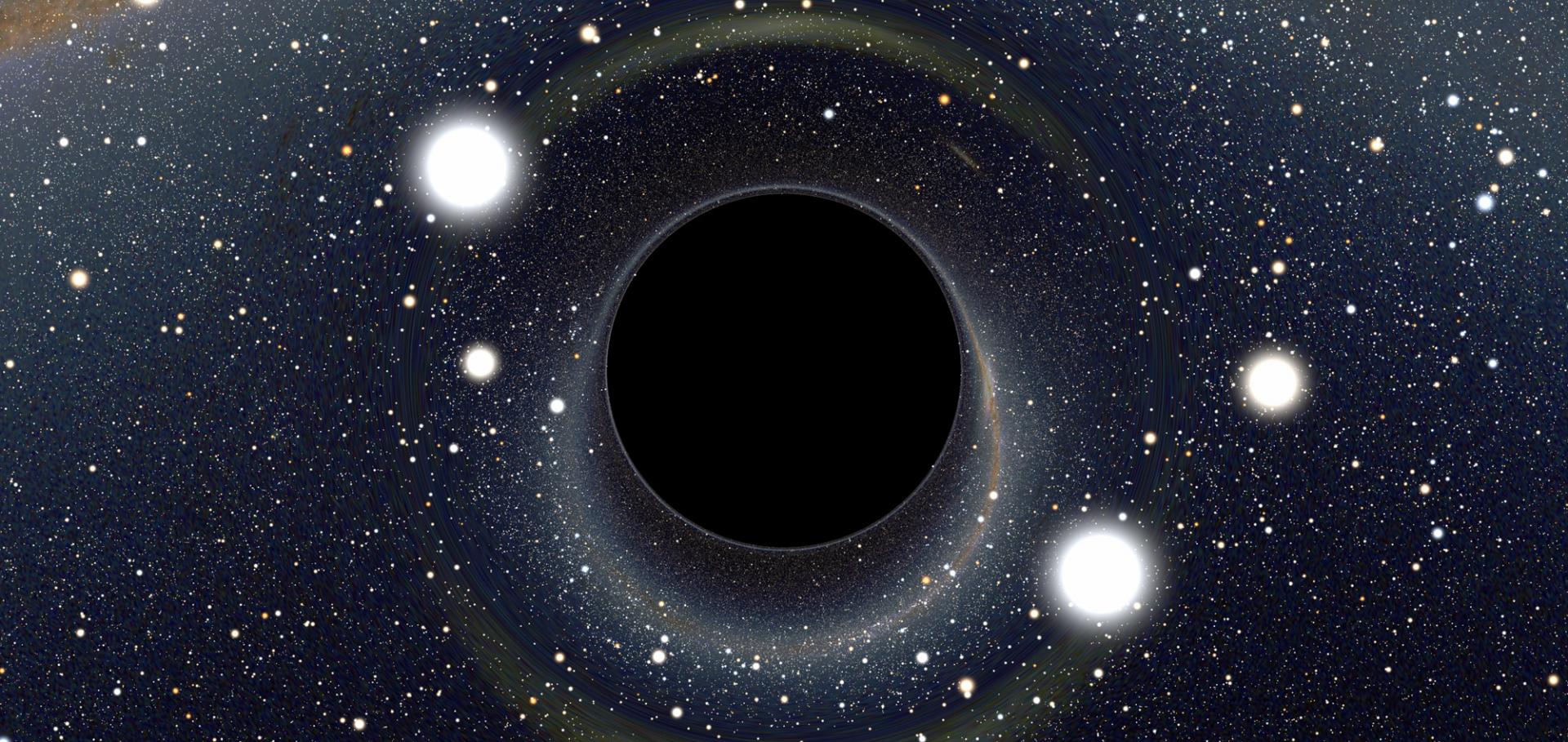
Black Hole

Lensing of space time around a black hole. At Oxford we study black holes observationally and theoretically on all size and time scales - it is some of our core work.

Credit: ALAIN RIAZUELO, IAP/UPMC/CNRS. CLICK HERE TO VIEW MORE IMAGES.

Julien Devriendt

Professor of Astrophysics

Research theme

  • Astronomy and astrophysics
  • Particle astrophysics & cosmology

Sub department

  • Astrophysics

Research groups

  • Beecroft Institute for Particle Astrophysics and Cosmology
  • Cosmology
  • Galaxy formation and evolution
julien.devriendt@physics.ox.ac.uk
Telephone: 01865 (2)73307
Denys Wilkinson Building, room 555D
  • About
  • Teaching
  • Publications

HORIZON-AGN virtual observatory – 2. Template-free estimates of galaxy properties from colours

Monthly Notices of the Royal Astronomical Society Oxford University Press 489:4 (2019) 4817-4835

Authors:

I Davidzon, C Laigle, PL Capak, O Ilbert, DC Masters, S Hemmati, N Apostolakos, J Coupon, SDL Torre, Julien Devriendt, Y Dubois, D Kashino, S Paltani, C Pichon

Abstract:

Using the HORIZON-AGN hydrodynamical simulation and self-organizing maps (SOMs), we show how to compress the complex, high-dimensional data structure of a simulation into a 2D grid, which greatly facilitates the analysis of how galaxy observables are connected to intrinsic properties. We first verify the tight correlation between the observed 0.3–5 μm broad-band colours of HORIZON-AGN galaxies and their high-resolution spectra. The correlation is found to extend to physical properties such as redshift, stellar mass, and star formation rate (SFR). This direct mapping from colour to physical parameter space still works after including photometric uncertainties that mimic the COSMOS survey. We then label the SOM grid with a simulated calibration sample to estimate redshift and SFR for COSMOS-like galaxies up to z ∼ 3. In comparison to state-of-the-art techniques based on synthetic templates, our method is comparable in performance but less biased at estimating redshifts, and significantly better at predicting SFRs. In particular, our ‘data-driven’ approach, in contrast to model libraries, intrinsically allows for the complexity of galaxy formation and can handle sample biases. We advocate that observations to calibrate this method should be one of the goals of next-generation galaxy surveys.

More details from the publisher
Details from ORA
More details
Details from ArXiV

The impact of AGN feedback on galaxy intrinsic alignments in the Horizon simulations

(2019)

Authors:

Adam Soussana, Nora Elisa Chisari, Sandrine Codis, Ricarda S Beckmann, Yohan Dubois, Julien Devriendt, Sebastien Peirani, Clotilde Laigle, Christophe Pichon, Adrianne Slyz
More details from the publisher

Population estimates for electromagnetically distinguishable supermassive binary black holes

Astrophysical Journal American Astronomical Society 879:2 (2019) 110

Authors:

JH Krolik, M Volonteri, Y Dubois, Julien Devriendt

Abstract:

Distinguishing the photon output of an accreting supermassive black hole binary system from that of a single supermassive black hole accreting at the same rate is intrinsically difficult because the majority of the light emerges from near the innermost stable orbits of the black holes. However, there are two possible signals that can distinctively mark binaries, both arising from the gap formed in circumbinary accretion flows inside approximately twice the binary separation. One of these is a "notch" cut into the thermal spectra of these systems in the IR/optical/UV, the other a periodically varying excess hard X-ray luminosity whose period is of order the binary orbital period. Using data from detailed galaxy evolution simulations, we estimate the distribution function in mass, mass ratio, and accretion rate for accreting supermassive binary black holes (SMBBHs) as a function of redshift and then transform this distribution function into predicted source counts for these two potential signals. At flux levels >~10−13 erg cm−2 s−1, there may be ~O(102) such systems in the sky, mostly in the redshift range 0.5 <~ z <~ 1. Roughly 10% should have periods short enough (<~5 yr) to detect the X-ray modulation; this is also the period range accessible to Pulsar Timing Array observations.
More details from the publisher
Details from ORA
More details
Details from ArXiV

On the Observed Diversity of Star Formation Efficiencies in Giant Molecular Clouds

Monthly Notices of the Royal Astronomical Society Oxford University Press (OUP) 468:4 (2019) 5482-5491

Authors:

Kearn Grisdale, Oscar Agertz, Florent Renaud, Alessandro B Romeo, Julien Devriendt, Adrianne Slyz

Abstract:

Observations find a median star formation efficiency per free-fall time in Milky Way Giant Molecular Clouds (GMCs) on the order of $\epsilon_{\rm ff}\sim 1\%$ with dispersions of $\sim0.5\,{\rm dex}$. The origin of this scatter in $\epsilon_{\rm ff}$ is still debated and difficult to reproduce with analytical models. We track the formation, evolution and destruction of GMCs in a hydrodynamical simulation of a Milky Way-like galaxy and by deriving cloud properties in an observationally motivated way, measure the distribution of star formation efficiencies which are in excellent agreement with observations. We find no significant link between $\epsilon_{\rm ff}$ and any measured global property of GMCs (e.g. gas mass, velocity dispersion). Instead, a wide range of efficiencies exist in the entire parameter space. From the cloud evolutionary tracks, we find that each cloud follow a \emph{unique} evolutionary path which gives rise to wide diversity in all properties. We argue that it is this diversity in cloud properties, above all else, that results in the dispersion of $\epsilon_{\rm ff}$.
More details from the publisher
More details
Details from ArXiV

Horizon-AGN virtual observatory -- 2: Template-free estimates of galaxy properties from colours

(2019)

Authors:

Iary Davidzon, Clotilde Laigle, Peter L Capak, Olivier Ilbert, Daniel C Masters, Shoubaneh Hemmati, Nikolaos Apostolakos, Jean Coupon, Sylvain de la Torre, Julien Devriendt, Yohan Dubois, Daichi Kashino, Stephane Paltani, Christophe Pichon
More details from the publisher

Pagination

  • First page First
  • Previous page Prev
  • …
  • Page 33
  • Page 34
  • Page 35
  • Page 36
  • Current page 37
  • Page 38
  • Page 39
  • Page 40
  • Page 41
  • …
  • Next page Next
  • Last page Last

Footer Menu

  • Contact us
  • Giving to the Dept of Physics
  • Work with us
  • Media

User account menu

  • Log in

Follow us

FIND US

Clarendon Laboratory,

Parks Road,

Oxford,

OX1 3PU

CONTACT US

Tel: +44(0)1865272200

University of Oxfrod logo Department Of Physics text logo
IOP Juno Champion logo Athena Swan Silver Award logo

© University of Oxford - Department of Physics

Cookies | Privacy policy | Accessibility statement

Built by: Versantus

  • Home
  • Research
  • Study
  • Engage
  • Our people
  • News & Comment
  • Events
  • Our facilities & services
  • About us
  • Giving to Physics
  • Current students
  • Staff intranet