
Home
Department Of Physics text logo
  • Research
    • Our research
    • Our research groups
    • Our research in action
    • Research funding support
    • Summer internships for undergraduates
  • Study
    • Undergraduates
    • Postgraduates
  • Engage
    • For young people
    • For teachers
    • For the public
    • For alumni
    • For business
  • Support
Menu
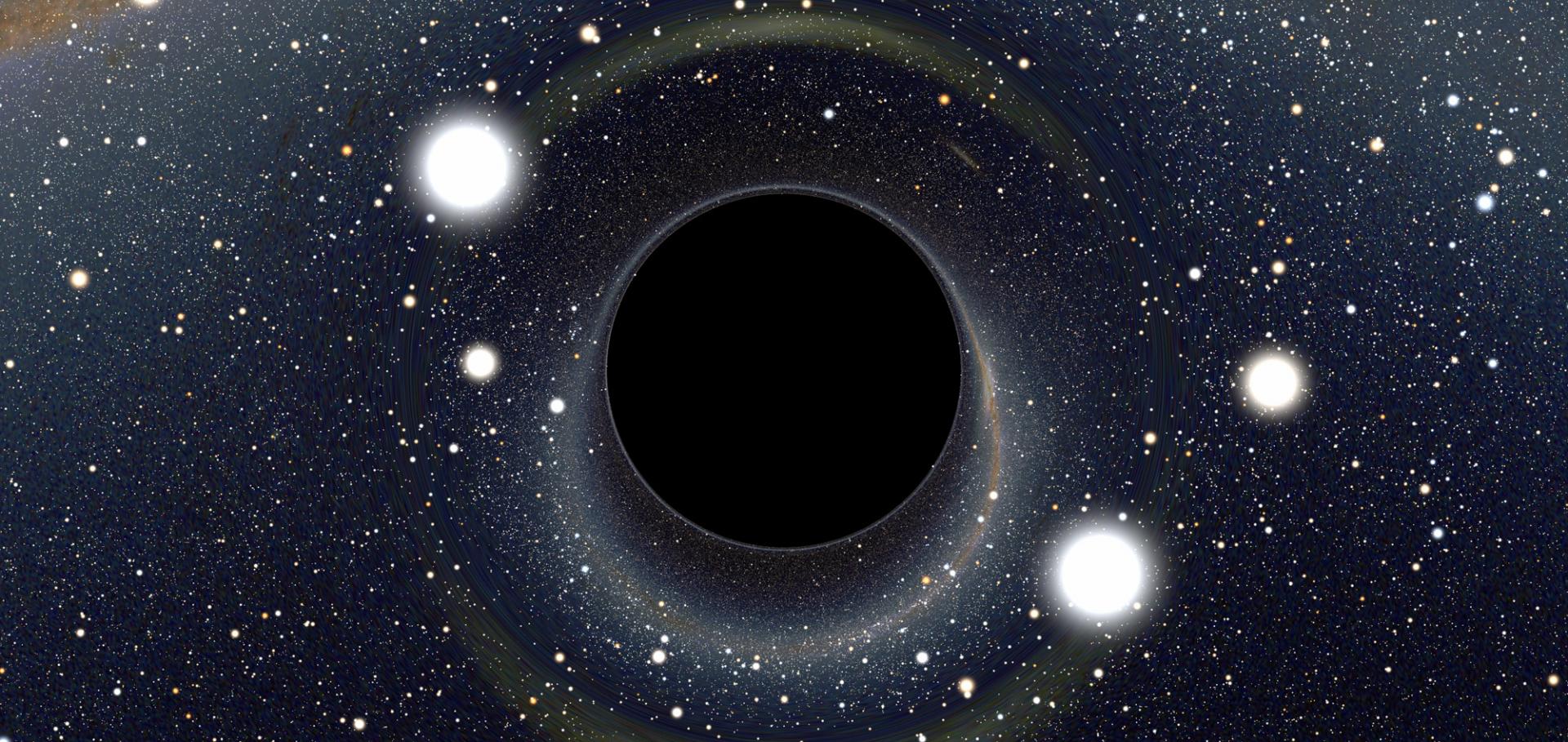
Black Hole

Lensing of space time around a black hole. At Oxford we study black holes observationally and theoretically on all size and time scales - it is some of our core work.

Credit: ALAIN RIAZUELO, IAP/UPMC/CNRS. CLICK HERE TO VIEW MORE IMAGES.

Julien Devriendt

Professor of Astrophysics

Research theme

  • Astronomy and astrophysics
  • Particle astrophysics & cosmology

Sub department

  • Astrophysics

Research groups

  • Beecroft Institute for Particle Astrophysics and Cosmology
  • Cosmology
  • Galaxy formation and evolution
julien.devriendt@physics.ox.ac.uk
Telephone: 01865 (2)73307
Denys Wilkinson Building, room 555D
  • About
  • Teaching
  • Publications

Lyman-alpha emission properties of simulated galaxies: interstellar medium structure and inclination effects

ArXiv 1208.4781 (2012)

Authors:

Anne Verhamme, Yohan Dubois, Jeremy Blaizot, Thibault Garel, Roland Bacon, Julien Devriendt, Bruno Guiderdoni, Adrianne Slyz

Abstract:

[abridged] Aims. The aim of this paper is to assess the impact of the interstellar medium (ISM) physics on Lyman-alpha (Lya) radiation transfer and to quantify how galaxy orientation with respect to the line of sight alters observational signatures. Methods. We compare the results of Lya radiation transfer calculations through the ISM of a couple of idealized galaxy simulations with different ISM models. Results. First, the small-scale structuration of the ISM plays a determinant role in shaping a galaxys Lya properties.The artificially warm, and hence smooth, ISM of G1 yields an escape fraction of 50 percent at the Lya line center, and produces symmetrical double-peak profiles. On the contrary, in G2, most young stars are embedded in thick star-forming clouds, and the result is a 10 times lower escape fraction. G2 also displays a stronger outflowing velocity field, which favors the escape of red-shifted photons, resulting in an asymmetric Lya line. Second, the Lya properties of G2 strongly depend on the inclination at which it is observed: From edge-on to face-on, the line goes from a double-peak profile with an equivalent width of -5 Angstrom to a 15 times more luminous red-shifted asymmetric line with EW 90 Angstrom. Conclusions. Lya radiation transfer calculations can only lead to realistic properties in simulations where galaxies are resolved into giant molecular clouds, putting these calculations out of reach of current large scale cosmological simulations. Finally, we find inclination effects to be much stronger for Lya photons than for continuum radiation. This could potentially introduce severe biases in the selection function of narrow-band Lya emitter surveys, which could indeed miss a significant fraction of the high-z galaxy population.
Details from ArXiV
More details from the publisher
Details from ORA
More details

Lyman-alpha emission properties of simulated galaxies: interstellar medium structure and inclination effects

(2012)

Authors:

Anne Verhamme, Yohan Dubois, Jeremy Blaizot, Thibault Garel, Roland Bacon, Julien Devriendt, Bruno Guiderdoni, Adrianne Slyz
More details from the publisher

The Epoch of Disk Settling: z~1 to Now

ArXiv 1207.7072 (2012)

Authors:

Susan A Kassin, Benjamin J Weiner, SM Faber, Jonathan P Gardner, CNA Willmer, Alison L Coil, Michael C Cooper, Julien Devriendt, Aaron A Dutton, Puragra Guhathakurta, David C Koo, AJ Metevier, Kai G Noeske, Joel R Primack

Abstract:

We present evidence from a sample of 544 galaxies from the DEEP2 Survey for evolution of the internal kinematics of blue galaxies with stellar masses ranging 8.0 log M* (M_Sun) 10.7 over 0.21.2. DEEP2 provides galaxy spectra and Hubble imaging from which we measure emission-line kinematics and galaxy inclinations, respectively. Our large sample allows us to overcome scatter intrinsic to galaxy properties in order to examine trends in kinematics. We find that at a fixed stellar mass galaxies systematically decrease in disordered motions and increase in rotation velocity and potential well depth with time. Massive galaxies are the most well-ordered at all times examined, with higher rotation velocities and less disordered motions than less massive galaxies. We quantify disordered motions with an integrated gas velocity dispersion corrected for beam smearing (sigma_g). It is unlike the typical pressure-supported velocity dispersion measured for early type galaxies and galaxy bulges. Because both seeing and the width of our spectral slits comprise a significant fraction of the galaxy sizes, sigma_g integrates over velocity gradients on large scales which can correspond to non-ordered gas kinematics. We compile measurements of galaxy kinematics from the literature over 1.23.8 and do not find any trends with redshift, likely for the most part because these datasets are biased toward the most highly star-forming systems. In summary, over the last ~8 billion years since z=1.2, blue galaxies evolve from disordered to ordered systems as they settle to become the rotation-dominated disk galaxies observed in the Universe today, with the most massive galaxies being the most evolved at any time.
Details from ArXiV
More details from the publisher
Details from ORA

The Epoch of Disk Settling: z~1 to Now

(2012)

Authors:

Susan A Kassin, Benjamin J Weiner, SM Faber, Jonathan P Gardner, CNA Willmer, Alison L Coil, Michael C Cooper, Julien Devriendt, Aaron A Dutton, Puragra Guhathakurta, David C Koo, AJ Metevier, Kai G Noeske, Joel R Primack
More details from the publisher

Blowing cold flows away: the impact of early AGN activity on the formation of a brightest cluster galaxy progenitor

(2012)

Authors:

Yohan Dubois, Christophe Pichon, Julien Devriendt, Joseph Silk, Martin Haehnelt, Taysun Kimm, Adrianne Slyz
More details from the publisher

Pagination

  • First page First
  • Previous page Prev
  • …
  • Page 61
  • Page 62
  • Page 63
  • Page 64
  • Current page 65
  • Page 66
  • Page 67
  • Page 68
  • Page 69
  • …
  • Next page Next
  • Last page Last

Footer Menu

  • Contact us
  • Giving to the Dept of Physics
  • Work with us
  • Media

User account menu

  • Log in

Follow us

FIND US

Clarendon Laboratory,

Parks Road,

Oxford,

OX1 3PU

CONTACT US

Tel: +44(0)1865272200

University of Oxfrod logo Department Of Physics text logo
IOP Juno Champion logo Athena Swan Silver Award logo

© University of Oxford - Department of Physics

Cookies | Privacy policy | Accessibility statement

Built by: Versantus

  • Home
  • Research
  • Study
  • Engage
  • Our people
  • News & Comment
  • Events
  • Our facilities & services
  • About us
  • Giving to Physics
  • Current students
  • Staff intranet