
Home
Department Of Physics text logo
  • Research
    • Our research
    • Our research groups
    • Our research in action
    • Research funding support
    • Summer internships for undergraduates
  • Study
    • Undergraduates
    • Postgraduates
  • Engage
    • For young people
    • For teachers
    • For the public
    • For alumni
    • For business
  • Support
Menu
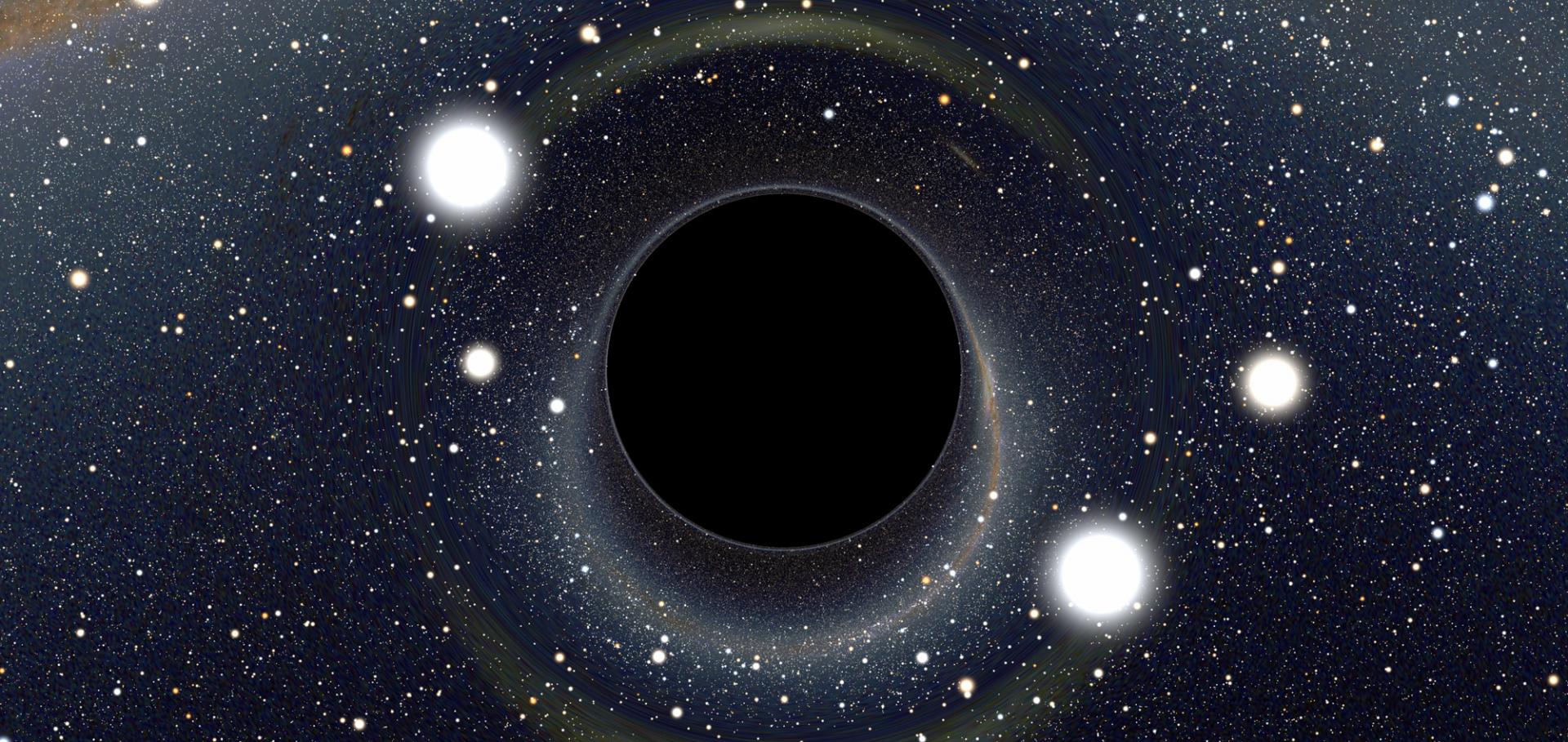
Black Hole

Lensing of space time around a black hole. At Oxford we study black holes observationally and theoretically on all size and time scales - it is some of our core work.

Credit: ALAIN RIAZUELO, IAP/UPMC/CNRS. CLICK HERE TO VIEW MORE IMAGES.

Julien Devriendt

Professor of Astrophysics

Research theme

  • Astronomy and astrophysics
  • Particle astrophysics & cosmology

Sub department

  • Astrophysics

Research groups

  • Beecroft Institute for Particle Astrophysics and Cosmology
  • Cosmology
  • Galaxy formation and evolution
julien.devriendt@physics.ox.ac.uk
Telephone: 01865 (2)73307
Denys Wilkinson Building, room 555D
  • About
  • Teaching
  • Publications

The Birth of Molecular Clouds: Formation of Atomic Precursors in Colliding Flows

(2006)

Authors:

F Heitsch, AD Slyz, JEG Devriendt, LW Hartmann, A Burkert
More details from the publisher

GalICS V : Low and high order clustering in mock SDSS's

ArXiv astro-ph/0603821 (2006)

Authors:

J Blaizot, I Szapudi, S Colombi, T Budavari, FR Bouchet, JEG Devriendt, B Guiderdoni, J Pan, A Szalay

Abstract:

[Abridged] We use mock catalogues based on the GALICS model (Hatton et al. 03) to explore the nature of galaxy clustering observed in the SDSS. We measure low and high order angular clustering statistic from these mock catalogues, after selecting galaxies the same way as for observations, and compare them directly to estimates from SDSS data. Note that we also present measurements of S3-S5 on the SDSS DR1. We find that our model is in general good agreement with observations in the scale/luminosity range where we can trust the predictions. This range is found to be limited (i) by the size of the dark matter simulation used -- which introduces finite volume effects at large scales -- and by the mass resolution of this simulation -- which introduces incompleteness at apparent magnitudes fainter than $r\sim 20$. We then focus on the small scale clustering properties of galaxies and investigate the behaviour of three different prescriptions for positioning galaxies within haloes of dark matter. We show that galaxies are poor tracers both of DM particles or DM sub-structures, within groups and clusters. Instead, SDSS data tells us that the distribution of galaxies lies somewhat in between these two populations. This confirms the general theoretical expectation from numerical simulations and semi-analytic modelling.
Details from ArXiV
More details from the publisher
More details

GalICS V : Low and high order clustering in mock SDSS's

(2006)

Authors:

J Blaizot, I Szapudi, S Colombi, T Budavari, FR Bouchet, JEG Devriendt, B Guiderdoni, J Pan, A Szalay
More details from the publisher

Modelling the Galaxy Bimodality: Shutdown Above a Critical Halo Mass

(2006)

Authors:

A Cattaneo, A Dekel, J Devriendt, B Guiderdoni, J Blaizot
More details from the publisher

UV-optical colours as probes of early-type galaxy evolution

(2006)

Authors:

S Kaviraj, K Schawinski, JEG Devriendt, I Ferreras, S Khochfar, S-J Yoon, SK Yi, J-M Deharveng, A Boselli, T Barlow, T Conrow, K Forster, P Friedman, DC Martin, P Morrissey, S Neff, D Schiminovich, M Seibert, T Small, T Wyder, L Bianchi, J Donas, T Heckman, Y-W Lee, B Madore, B Milliard, RM Rich, A Szalay
More details from the publisher

Pagination

  • First page First
  • Previous page Prev
  • …
  • Page 83
  • Page 84
  • Page 85
  • Page 86
  • Current page 87
  • Page 88
  • Page 89
  • Page 90
  • Page 91
  • …
  • Next page Next
  • Last page Last

Footer Menu

  • Contact us
  • Giving to the Dept of Physics
  • Work with us
  • Media

User account menu

  • Log in

Follow us

FIND US

Clarendon Laboratory,

Parks Road,

Oxford,

OX1 3PU

CONTACT US

Tel: +44(0)1865272200

University of Oxfrod logo Department Of Physics text logo
IOP Juno Champion logo Athena Swan Silver Award logo

© University of Oxford - Department of Physics

Cookies | Privacy policy | Accessibility statement

Built by: Versantus

  • Home
  • Research
  • Study
  • Engage
  • Our people
  • News & Comment
  • Events
  • Our facilities & services
  • About us
  • Giving to Physics
  • Current students
  • Staff intranet