Home
Department Of Physics text logo
  • Research
    • Our research
    • Our research groups
    • Our research in action
    • Research funding support
    • Summer internships for undergraduates
  • Study
    • Undergraduates
    • Postgraduates
  • Engage
    • For young people
    • For teachers
    • For the public
    • For alumni
    • For business
  • Support
Menu
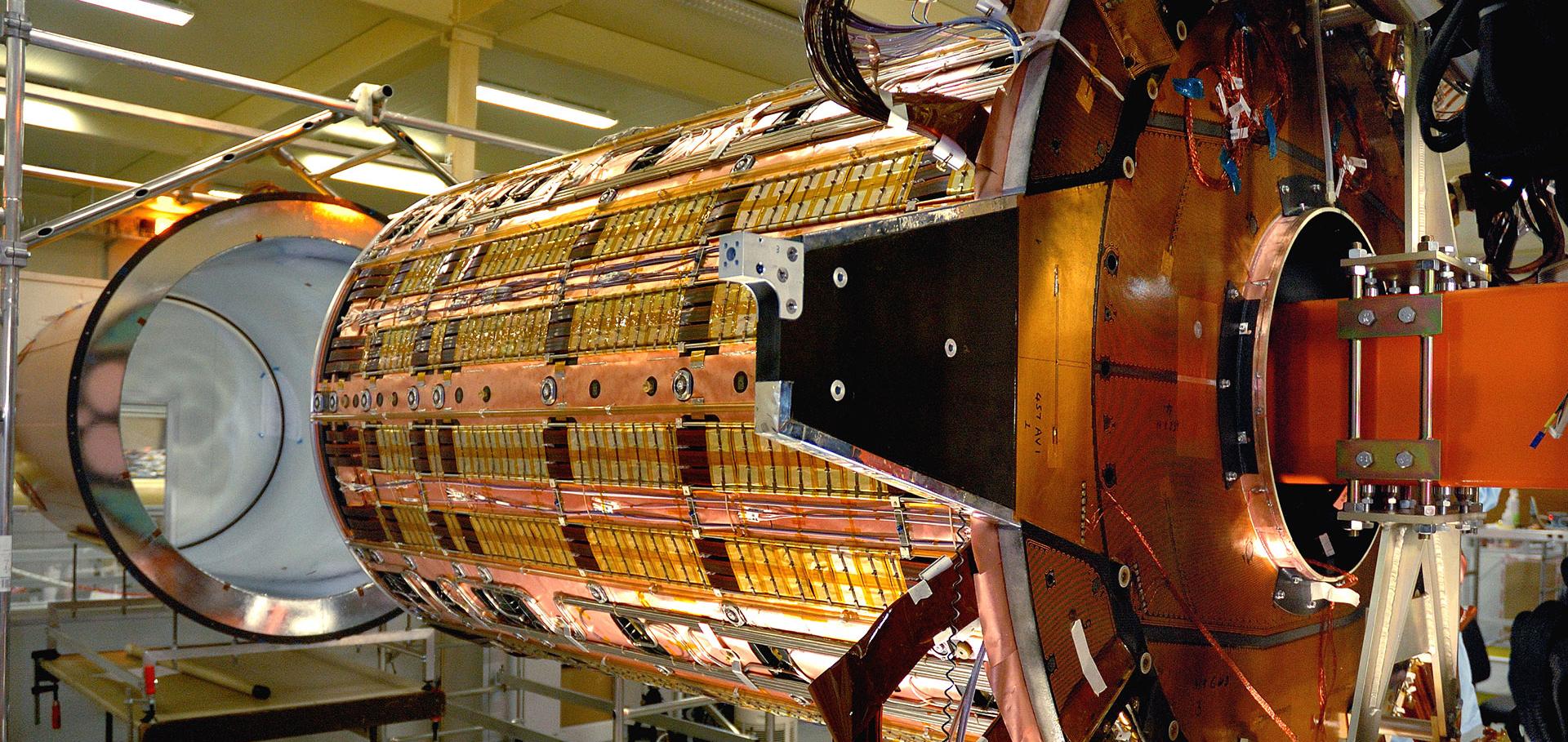
Insertion of STC into TRT at the Department of Physics, Oxford
Credit: CERN

Prof Dr Armin Reichold

Professor of Physics

Research theme

  • Accelerator physics
  • Fundamental particles and interactions

Sub department

  • Particle Physics

Research groups

  • Future Colliders
  • SNO+
Armin.Reichold@physics.ox.ac.uk
Telephone: 01865 (2)73358
Denys Wilkinson Building, room 473,617
  • About
  • Publications

Observation of a centrality-dependent dijet asymmetry in lead-lead collisions at √sNN=2.76 Tev with the ATLAS detector at the LHC

Physical Review Letters 105:25 (2010)

Authors:

G Aad, B Abbott, J Abdallah, AA Abdelalim, A Abdesselam, O Abdinov, B Abi, M Abolins, H Abramowicz, H Abreu, E Acerbi, BS Acharya, M Ackers, DL Adams, TN Addy, J Adelman, M Aderholz, S Adomeit, P Adragna, T Adye, S Aefsky, JA Aguilar-Saavedra, M Aharrouche, SP Ahlen, F Ahles, A Ahmad, M Ahsan, G Aielli, T Akdogan, TPA Åkesson, G Akimoto, AV Akimov, MS Alam, MA Alam, S Albrand, M Aleksa, IN Aleksandrov, M Aleppo, F Alessandria, C Alexa, G Alexander, G Alexandre, T Alexopoulos, M Alhroob, M Aliev, G Alimonti, J Alison, M Aliyev, PP Allport, SE Allwood-Spiers, J Almond, A Aloisio, R Alon, A Alonso, J Alonso, MG Alviggi, K Amako, P Amaral, C Amelung, VV Ammosov, A Amorim, G Amorós, N Amram, C Anastopoulos, T Andeen, CF Anders, KJ Anderson, A Andreazza, V Andrei, ML Andrieux, XS Anduaga, A Angerami, F Anghinolfi, N Anjos, A Annovi, A Antonaki, M Antonelli, S Antonelli, J Antos, F Anulli, S Aoun, L Aperio Bella, R Apolle, G Arabidze, I Aracena, Y Arai, ATH Arce, JP Archambault, S Arfaoui, JF Arguin, E Arik, M Arik, AJ Armbruster, KE Arms, SR Armstrong, O Arnaez, C Arnault, A Artamonov, G Artoni, D Arutinov

Abstract:

By using the ATLAS detector, observations have been made of a centrality-dependent dijet asymmetry in the collisions of lead ions at the Large Hadron Collider. In a sample of lead-lead events with a per-nucleon center of mass energy of 2.76 TeV, selected with a minimum bias trigger, jets are reconstructed in fine-grained, longitudinally segmented electromagnetic and hadronic calorimeters. The transverse energies of dijets in opposite hemispheres are observed to become systematically more unbalanced with increasing event centrality leading to a large number of events which contain highly asymmetric dijets. This is the first observation of an enhancement of events with such large dijet asymmetries, not observed in proton-proton collisions, which may point to an interpretation in terms of strong jet energy loss in a hot, dense medium.© 2010 CERN, for the ATLAS Collaboration.
More details from the publisher
More details
More details

Single-shot emittance measurement of a 508MeV electron beam using the pepper-pot method

Proceedings of the 23rd Particle Accelerator Conference Joint Accelerator Conferences Website (JACoW) (2010) 3597-3599

Authors:

Nicolas Delerue, Riccardo Bartolini, George Doucas, Peter Lau, Ken Peach, Armin Reichold, Rohan Senanayake, David Urner

Abstract:

We describe a method that uses a modified pepper-pot design to measure in a single shot the emittance of electron beams with energies above 100 MeV. Our setup consists of several thin layers of tantalum with spacers in between to leave slits through which the electron beam can be sampled. We report on a measurement done using this method at the DAFNE BTF with a 508 MeV electron beam.
Details from ORA

Simulation of the alignment of linear accelerators

Proceedings of the 23rd Particle Accelerator Conference Joint Accelerator Conferences Website (JACoW) (2010) 3361-3363

Authors:

John Dale, Armin Reichold

Abstract:

The alignment of the next generation of linear accelerators will be much more critical than that of currently existing machines. This is especially true for very long machines with ultra-low emittance beams; such as the ILC and CLIC. The design and study of such machines will require a large number of simulations. However, full simulation of misalignment currently requires computer programs which are very resource intensive, and cannot simulate novel reference network measurement devices. A model which can be used to rapidly generate reference networks with the required statistical properties will be presented.
Details from ORA

Longitudinal bunch profile diagnostics in the 50FS range using coherent smith-purcell radiation

IPAC 2010 - 1st International Particle Accelerator Conference (2010) 1155-1157

Authors:

N Delerue, G Doucas, E Maclean, A Reichold

Abstract:

We have considered the possibility of using coherent Smith-Purcell radiation for the single-shot determination of the longitudinal profile of 50 fs (FWHM) long electron bunches. A set of three gratings, with periods of 15, 85 and 500 μm, will produce detectable energy in the wavelength region 10-1000μm, which should be adequate for the reconstruction of the bunch shape by the Kramers-Kronig technique. For bunch charges of 109 electrons, or more, the radiated energy can be detected by room temperature pyroelectric detectors.
Details from ArXiV

Performance of the ATLAS detector using first collision data

Journal of High Energy Physics 2010:9 (2010)

Authors:

G Aad, E Abat, B Abbott, J Abdallah, AA Abdelalim, A Abdesselam, O Abdinov, B Abi, M Abolins, H Abramowicz, H Abreu, E Acerbi, BS Acharya, M Ackers, DL Adams, TN Addy, J Adelman, M Aderholz, S Adomeit, C Adorisio, P Adragna, T Adye, S Aefsky, JA Aguilar-Saavedra, M Aharrouche, SP Ahlen, F Ahles, A Ahmad, H Ahmed, M Ahsan, G Aielli, T Akdogan, PF Åkesson, TPA Åkesson, G Akimoto, AV Akimov, A Aktas, MS Alam, MA Alam, S Albrand, M Aleksa, IN Aleksandrov, M Aleppo, F Alessandria, C Alexa, G Alexander, G Alexandre, T Alexopoulos, M Alhroob, M Aliev, G Alimonti, J Alison, M Aliyev, PP Allport, SE Allwood-Spiers, J Almond, A Aloisio, R Alon, A Alonso, J Alonso, MG Alviggi, K Amako, P Amaral, G Ambrosini, G Ambrosio, C Amelung, VV Ammosov, A Amorim, G Amorós, N Amram, C Anastopoulos, T Andeen, CF Anders, KJ Anderson, A Andreazza, V Andrei, ML Andrieux, XS Anduaga, A Angerami, F Anghinolfi, N Anjos, A Annovi, A Antonaki, M Antonelli, S Antonelli, J Antos, B Antunovic, F Anulli, S Aoun, G Arabidze, I Aracena, Y Arai, ATH Arce, JP Archambault, S Arfaoui, JF Arguin, T Argyropoulos, E Arik, M Arik

Abstract:

More than half a million minimum-bias events of LHC collision data were collected by the ATLAS experiment in December 2009 at centre-of-mass energies of 0.9 TeV and 2.36 TeV. This paper reports on studies of the initial performance of the ATLAS detector from these data. Comparisons between data and Monte Carlo predictions are shown for distributions of several track-and calorimeter-based quantities. The good performance of the ATLAS detector in these first data gives confidence for successful running at higher energies.
More details from the publisher
More details

Pagination

  • First page First
  • Previous page Prev
  • …
  • Page 38
  • Page 39
  • Page 40
  • Page 41
  • Current page 42
  • Page 43
  • Page 44
  • Page 45
  • Page 46
  • …
  • Next page Next
  • Last page Last

Footer Menu

  • Contact us
  • Giving to the Dept of Physics
  • Work with us
  • Media

User account menu

  • Log in

Follow us

FIND US

Clarendon Laboratory,

Parks Road,

Oxford,

OX1 3PU

CONTACT US

Tel: +44(0)1865272200

University of Oxfrod logo Department Of Physics text logo
IOP Juno Champion logo Athena Swan Silver Award logo

© University of Oxford - Department of Physics

Cookies | Privacy policy | Accessibility statement

Built by: Versantus

  • Home
  • Research
  • Study
  • Engage
  • Our people
  • News & Comment
  • Events
  • Our facilities & services
  • About us
  • Giving to Physics
  • Current students
  • Staff intranet