Home
Department Of Physics text logo
  • Research
    • Our research
    • Our research groups
    • Our research in action
    • Research funding support
    • Summer internships for undergraduates
  • Study
    • Undergraduates
    • Postgraduates
  • Engage
    • For young people
    • For teachers
    • For the public
    • For alumni
    • For business
  • Support
Menu
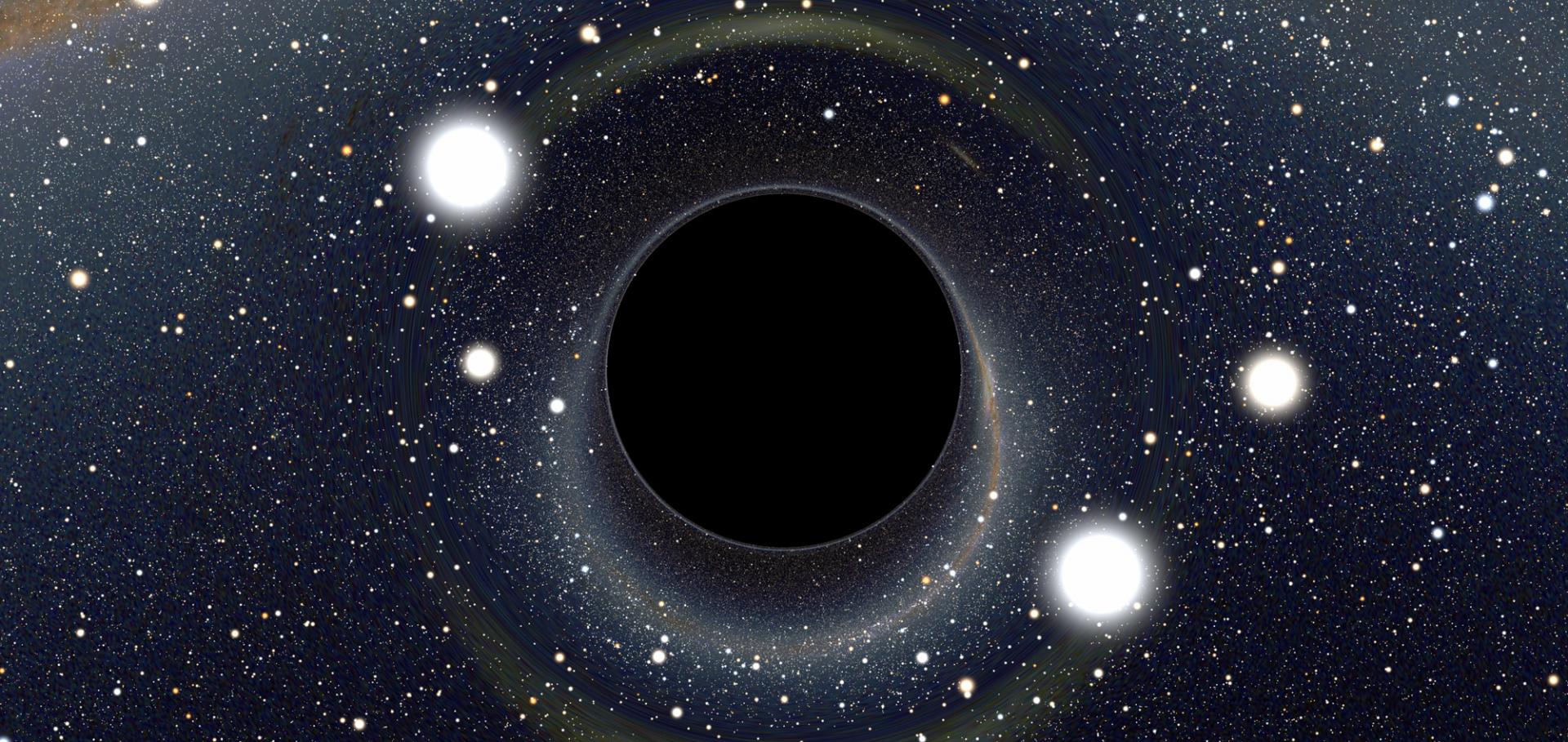
Black Hole

Lensing of space time around a black hole. At Oxford we study black holes observationally and theoretically on all size and time scales - it is some of our core work.

Credit: ALAIN RIAZUELO, IAP/UPMC/CNRS. CLICK HERE TO VIEW MORE IMAGES.

Dr Becky Smethurst

Royal Astronomical Society Research Fellow

Research theme

  • Astronomy and astrophysics

Sub department

  • Astrophysics

Research groups

  • Galaxy formation and evolution
  • Hintze Centre for Astrophysical Surveys
rebecca.smethurst@physics.ox.ac.uk
Personal website (with contact email address for non-academic queries)
  • About
  • Research
  • Prizes, awards and recognition
  • Science Communication
  • Publications

Massive black holes and their galaxies

Chapter in Encyclopedia of Astrophysics, (2025) V4-209

Authors:

RS Beckmann, RJ Smethurst

Abstract:

Almost every galaxy in the local Universe is observed to have a massive black hole in the center. The properties of these black holes are observed to tightly correlate with those of their host galaxy which has been interpreted as coevolution regulated by black hole feedback. This coevolution spans most of cosmic history, as the first active black holes, so-called active galactic nuclei, are already observed as early as z∼10. In this chapter, we lay out how we can find supermassive black holes, review what we know about the population of black holes and their host galaxies from observations, and summarize what we have learned about their coevolution across cosmic time from both observations and simulations.
More details from the publisher

The Effects of Bar Strength and Kinematics on Galaxy Evolution: Slow Strong Bars Affect Their Hosts the Most

The Astrophysical Journal American Astronomical Society 973:2 (2024) 129

Authors:

Tobias Géron, RJ Smethurst, Chris Lintott, Karen L Masters, IL Garland, Petra Mengistu, David O’Ryan, BD Simmons

Abstract:

We study how bar strength and bar kinematics affect star formation in different regions of the bar by creating radial profiles of EW[Hα] and Dn4000 using data from Sloan Digital Sky Survey-IV Mapping Nearby Galaxies at Apache Point Observatory (MaNGA). Bars in galaxies are classified as strong or weak using Galaxy Zoo DESI, and they are classified as fast and slow bars using the Tremaine–Weinberg method on stellar kinematic data from the MaNGA survey. In agreement with previous studies, we find that strong bars in star-forming (SF) galaxies have enhanced star formation in their center and beyond the bar-end region, while star formation is suppressed in the arms of the bar. This is not found for weakly barred galaxies, which have very similar radial profiles to unbarred galaxies. In addition, we find that slow bars in SF galaxies have significantly higher star formation along the bar than fast bars. However, the global star formation rate is not significantly different between galaxies with fast and slow bars. This suggests that the kinematics of the bar do not affect star formation globally, but changes where star formation occurs in the galaxy. Thus, we find that a bar will influence its host the most if it is both strong and slow.
More details from the publisher
Details from ORA
More details

Galaxy Zoo DESI: large-scale bars as a secular mechanism for triggering AGNs

Monthly Notices of the Royal Astronomical Society Oxford University Press (OUP) 532:2 (2024) 2320-2330

Authors:

Izzy L Garland, Mike Walmsley, Maddie S Silcock, Leah M Potts, Josh Smith, Brooke D Simmons, Chris J Lintott, Rebecca J Smethurst, James M Dawson, William C Keel, Sandor Kruk, Kameswara Bharadwaj Mantha, Karen L Masters, David O’Ryan, Jürgen J Popp, Matthew R Thorne
More details from the publisher
More details

Supermassive black holes in merger-free galaxies have higher spins which are preferentially aligned with their host galaxy

Monthly Notices of the Royal Astronomical Society Oxford University Press (OUP) 527:4 (2023) 10867-10877

Authors:

RS Beckmann, RJ Smethurst, BD Simmons, A Coil, Y Dubois, IL Garland, CJ Lintott, G Martin, S Peirani, C Pichon
More details from the publisher
More details

Evidence for non-merger co-evolution of galaxies and their supermassive black holes

Monthly Notices of the Royal Astronomical Society Oxford University Press 527:4 (2023) 10855-10866

Authors:

Rebecca J Smethurst, Rs Beckmann, Bd Simmons, A Coil, Julien Devriendt, Y Dubois, Il Garland, Cj Lintott, G Martin, S Peirani

Abstract:

Recent observational and theoretical studies have suggested that supermassive black holes (SMBHs) grow mostly through non-merger (‘secular’) processes. Since galaxy mergers lead to dynamical bulge growth, the only way to observationally isolate non-merger growth is to study galaxies with low bulge-to-total mass ratio (e.g. B/T < 10 per cent). However, bulge growth can also occur due to secular processes, such as disc instabilities, making disc-dominated selections a somewhat incomplete way to select merger-free systems. Here we use the Horizon-AGN simulation to select simulated galaxies which have not undergone a merger since z = 2, regardless of bulge mass, and investigate their location on typical black hole-galaxy scaling relations in comparison to galaxies with merger dominated histories. While the existence of these correlations has long been interpreted as co-evolution of galaxies and their SMBHs driven by galaxy mergers, we show here that they persist even in the absence of mergers. We find that the correlations between SMBH mass and both total mass and stellar velocity dispersion are independent of B/T ratio for both merger-free and merger-dominated galaxies. In addition, the bulge mass and SMBH mass correlation is still apparent for merger-free galaxies, the intercept for which is dependent on B/T. Galaxy mergers reduce the scatter around the scaling relations, with merger-free systems showing broader scatter. We show that for merger-free galaxies, the co-evolution is dominated by radio-mode feedback, and suggest that the long periods of time between galaxy mergers make an important contribution to the co-evolution between galaxies and SMBHs in all galaxies.
More details from the publisher
Details from ORA
More details

Pagination

  • First page First
  • Previous page Prev
  • Page 1
  • Page 2
  • Page 3
  • Page 4
  • Current page 5
  • Page 6
  • Page 7
  • Page 8
  • Page 9
  • …
  • Next page Next
  • Last page Last

Footer Menu

  • Contact us
  • Giving to the Dept of Physics
  • Work with us
  • Media

User account menu

  • Log in

Follow us

FIND US

Clarendon Laboratory,

Parks Road,

Oxford,

OX1 3PU

CONTACT US

Tel: +44(0)1865272200

University of Oxfrod logo Department Of Physics text logo
IOP Juno Champion logo Athena Swan Silver Award logo

© University of Oxford - Department of Physics

Cookies | Privacy policy | Accessibility statement

Built by: Versantus

  • Home
  • Research
  • Study
  • Engage
  • Our people
  • News & Comment
  • Events
  • Our facilities & services
  • About us
  • Giving to Physics
  • Current students
  • Staff intranet