

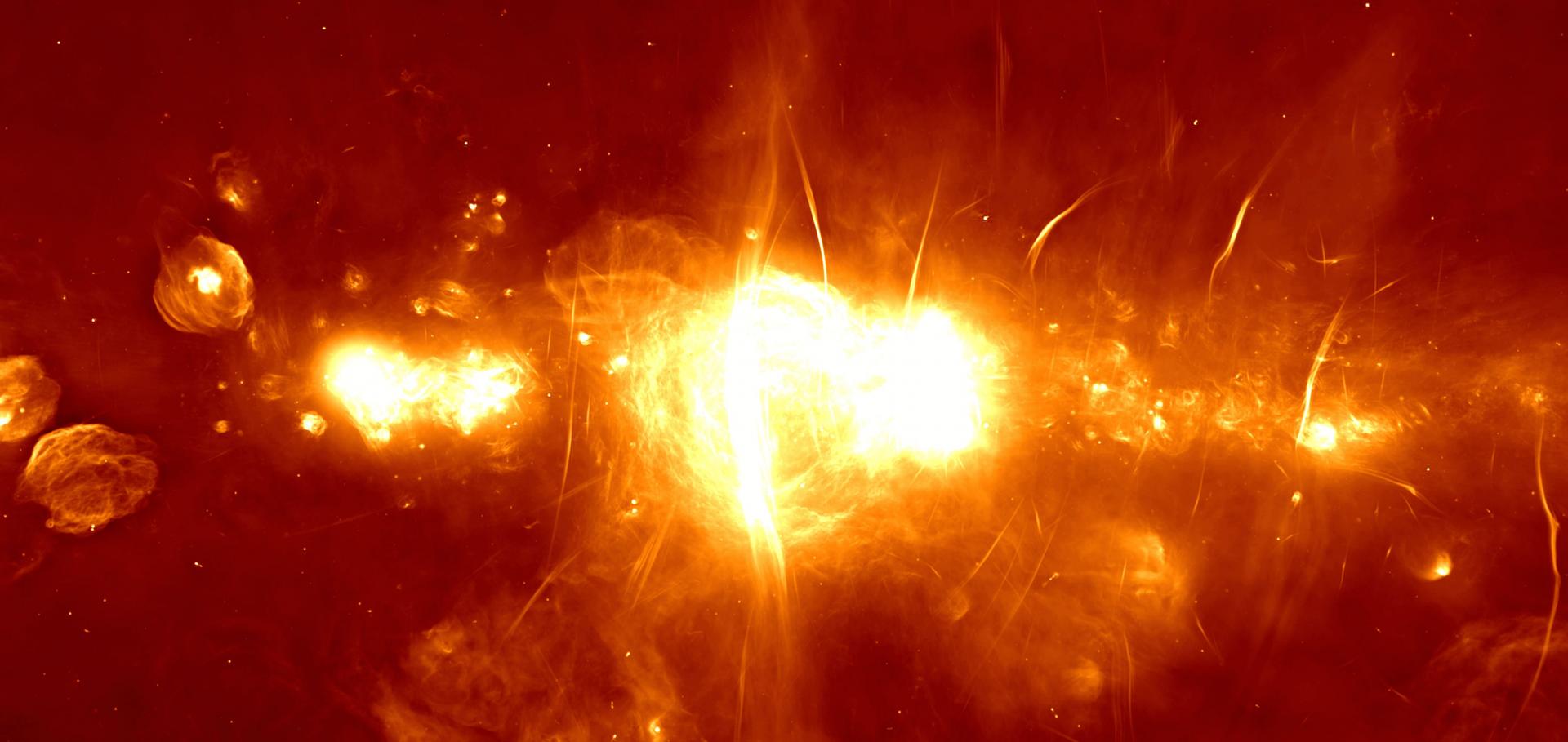
Chandra imaging spectroscopy of 1E 1740.7–2942
Monthly Notices of the Royal Astronomical Society Oxford University Press (OUP) 337:3 (2002) 869-874
The Gemini-North multiobject spectrograph integration, test and commissioning
Proceedings of SPIE - The International Society for Optical Engineering 4841:3 (2002) 1645-1656
Abstract:
The first of two Gemini Multi Object Spectrographs (GMOS) has recently begun operation at the Gemini-North 8m telescope. In this presentation we give an overview of the instrument and describe the overall performance of GMOS-North both in the laboratory during integration, and at the telescope during commissioning. We describe the development process which led to meeting the demanding reliability and performance requirements on flexure, throughput and image quality. We then show examples of GMOS data and performance on the telescope in its imaging, long-slit and MOS modes. We also briefly highlight novel features in GMOS that are described in more detail in separate presentations, particularly the flexure compensation system and the on-instrument wavefront sensor. Finally we give an update of the current status of GMOS on Gemini-North and future plans.The Gemini-North multiobject spectrograph stability performance
Proceedings of SPIE the International Society for Optical Engineering 4841:2 (2002) 1189-1200
Abstract:
Of the Gemini Multi-Object Spectrograph's (GMOS) scientific requirements, one which led to technically interesting areas was the ability to measure velocities to a accuracy of 2 km/s over the entire 5.5 arcminute square field. GMOS's design to meet this requirement includes a mechanical design for stiffness and without hysteresis or image rotation, and an open loop flexure control system which translates the detector position to compensate for flexure. The model used to predict the flexure is an empirical one developed from measured flexure results. In this paper we present the analysis of factors which enable meeting the 2 km/s requirement, and the observing strategies needed to make those observations. We look in particular detail at the development and test of that flexure compensation system, including both lab results and on-telescope results.The Gemini-North multiobject spectrograph optical performance
Proceedings of SPIE the International Society for Optical Engineering 4841:3 (2002) 1440-1451