Measurement of charm fragmentation fractions in photoproduction at HERA

Journal of High Energy Physics 2013:9 (2013)

Authors:

H Abramowicz, I Abt, L Adamczyk, M Adamus, R Aggarwal, S Antonelli, P Antonioli, A Antonov, M Arneodo, O Arslan, V Aushev, Y Aushev, O Bachynska, A Bamberger, AN Barakbaev, G Barbagli, G Bari, F Barreiro, N Bartosik, D Bartsch, M Basile, O Behnke, J Behr, U Behrens, L Bellagamba, A Bertolin, S Bhadra, M Bindi, C Blohm, V Bokhonov, T Bold, EG Boos, K Borras, D Boscherini, D Bot, I Brock, E Brownson, R Brugnera, N Brümmer, A Bruni, G Bruni, B Brzozowska, PJ Bussey, B Bylsma, A Caldwell, M Capua, R Carlin, CD Catterall, S Chekanov, J Chwastowski, J Ciborowski, R Ciesielski, L Cifarelli, F Cindolo, A Contin, AM Cooper-Sarkar, N Coppola, M Corradi, F Corriveau, M Costa, G D'Agostini, FD Corso, J Del Peso, RK Dementiev, S De Pasquale, M Derrick, RCE Devenish, D Dobur, BA Dolgoshein, G Dolinska, AT Doyle, V Drugakov, LS Durkin, S Dusini, Y Eisenberg, PF Ermolov, A Eskreys, S Fang, S Fazio, J Ferrando, MI Ferrero, J Figiel, B Foster, G Gach, A Galas, E Gallo, A Garfagnini, A Geiser, I Gialas, A Gizhko, LK Gladilin, D Gladkov, C Glasman, O Gogota, YA Golubkov, P Göttlicher, I Grabowska-Bold, J Grebenyuk, I Gregor, G Grigorescu

Abstract:

The production of D 0, D *+, D +, Ds+ and Λc+ charm hadrons and their antiparticles in ep scattering at HERA has been studied with the ZEUS detector, using a total integrated luminosity of 372 pb-1. The fractions of charm quarks hadronising into a particular charm hadron were derived. In addition, the ratio of neutral to charged D-meson production rates, the fraction of charged D mesons produced in a vector state, and the stangeness-suppression factor have been determined. The measurements have been performed in the photoproduction regime. The charm hadrons were reconstructed in the range of transverse momentum p T > 3.8 GeV and pseudorapidity |η| < 1.6. The charm fragmentation fractions are compared to previous results from HERA and from e + e - experiments. The data support the hypothesis that fragmentation is independent of the production process. © 2013 SISSA.

Measurement of D ± production in deep inelastic ep scattering with the ZEUS detector at HERA

Journal of High Energy Physics 2013:5 (2013)

Authors:

H Abramowicz, I Abt, L Adamczyk, M Adamus, R Aggarwal, S Antonelli, P Antonioli, A Antonov, M Arneodo, O Arslan, V Aushev, Y Aushev, O Bachynska, A Bamberger, AN Barakbaev, G Barbagli, G Bari, F Barreiro, N Bartosik, D Bartsch, M Basile, O Behnke, J Behr, U Behrens, L Bellagamba, A Bertolin, S Bhadra, M Bindi, C Blohm, V Bokhonov, T Bold, EG Boos, K Borras, D Boscherini, D Bot, I Brock, E Brownson, R Brugnera, N Brümmer, A Bruni, G Bruni, B Brzozowska, PJ Bussey, B Bylsma, A Caldwell, M Capua, R Carlin, CD Catterall, S Chekanov, J Chwastowski, J Ciborowski, R Ciesielski, L Cifarelli, F Cindolo, A Contin, AM Cooper-Sarkar, N Coppola, M Corradi, F Corriveau, M Costa, G D'Agostini, F Dal Corso, J Del Peso, RK Dementiev, S De Pasquale, M Derrick, RCE Devenish, D Dobur, BA Dolgoshein, G Dolinska, AT Doyle, V Drugakov, LS Durkin, S Dusini, Y Eisenberg, PF Ermolov, A Eskreys, S Fang, S Fazio, J Ferrando, MI Ferrero, J Figiel, B Foster, G Gach, A Galas, E Gallo, A Garfagnini, A Geiser, I Gialas, A Gizhko, LK Gladilin, D Gladkov, C Glasman, O Gogota, YA Golubkov, P Göttlicher, I Grabowska-Bold, J Grebenyuk, I Gregor, G Grigorescu

Abstract:

Charm production in deep inelastic ep scattering was measured with the ZEUS detector using an integrated luminosity of 354 pb-1. Charm quarks were identified by reconstructing D± mesons in the D ± → K∓π±π ± decay channel. Lifetime information was used to reduce combinatorial background substantially. Differential cross sections were measured in the kinematic region 5 < Q 2 < 1000 GeV 2, 0.02 < y < 0.7, 1.5 < p T (D ±) < 15 GeV and |η(D ±)| < 1.6, where Q 2 is the photon virtuality, y is the inelasticity, and p T (D ±) and η(D ±) are the transverse momentum and the pseudorapidity of the D ± meson, respectively. Next-to-leading-order QCD predictions are compared to the data. The charm contribution, F2cc̄, to the proton structure-function F 2 was extracted. © 2013 SISSA.

Investigation of GeV-scale electron acceleration in a gas-filled capillary discharge waveguide

New Journal of Physics 15 (2013)

Authors:

PA Walker, N Bourgeois, W Rittershofer, J Cowley, N Kajumba, AR Maier, J Wenz, CM Werle, S Karsch, F Grüner, DR Symes, PP Rajeev, SJ Hawkes, O Chekhlov, CJ Hooker, B Parry, Y Tang, SM Hooker

Abstract:

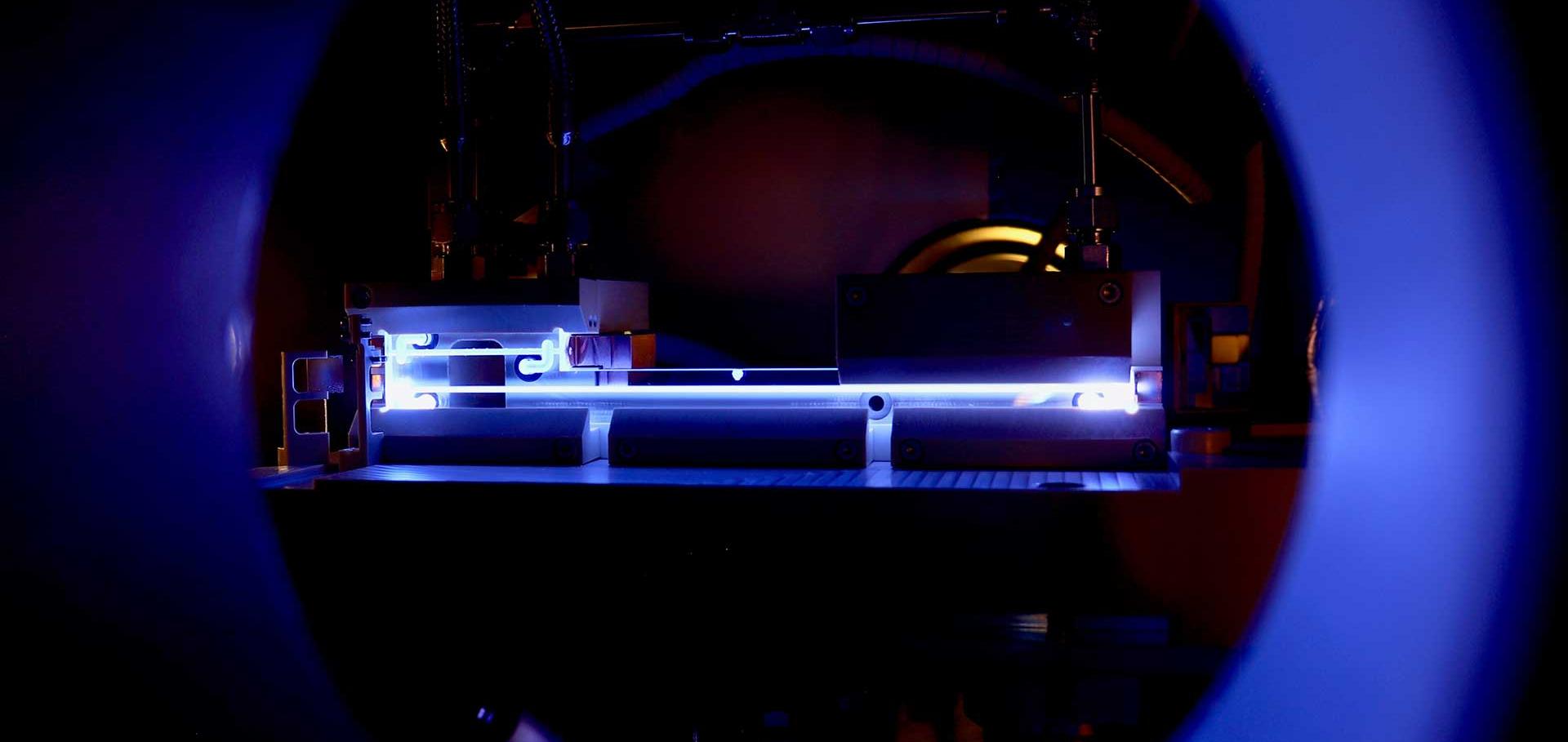
The generation of GeV-scale electron beams in a gas-filled capillary discharge waveguide with good reproducibility is discussed. Beams of electrons with energies above 900 MeV, and with root-mean-square divergences of 3.5 mrad, are observed for a plasma density of 2.2 × 1018 cm-3 and a peak input laser power of 55 TW. The variation of the maximum electron energy with the plasma density is measured and found to agree well with simple models. Injection and acceleration of electrons at the to date lowest plasma density of 3.2 × 1017 cm-3 are reported. The energy spectra of the generated electron beams exhibit good shot-to-shot reproducibility, with the observed variations attributable to the measured shot-to-shot jitter of the laser parameters. Two methods for correcting the effect of beam pointing variations on the measured energy spectrum are described. © IOP Publishing and Deutsche Physikalische Gesellschaft.

First measurements of muon production rate using a novel pion capture system at MuSIC

Journal of Physics Conference Series IOP Publishing 408:1 (2013) 012079

Authors:

S Cook, R D'Arcy, M Fukuda, K Hatanaka, Y Hino, Y Kuno, M Lancaster, Y Mori, TH Nam, T Ogitsu, H Sakamoto, A Sato, NM Truong, A Yamamoto, M Yoshida, M Wing

Measurement of inelastic J/ψ and ψ′ photoproduction at HERA

Journal of High Energy Physics 2013:2 (2013) 1-30

Authors:

H Abramowicz, I Abt, L Adamczyk, M Adamus, R Aggarwal, S Antonelli, P Antonioli, A Antonov, M Arneodo, O Arslan, V Aushev, Y Aushev, O Bachynska, A Bamberger, AN Barakbaev, G Barbagli, G Bari, F Barreiro, N Bartosik, D Bartsch, M Basile, O Behnke, J Behr, U Behrens, L Bellagamba, A Bertolin, S Bhadra, M Bindi, C Blohm, V Bokhonov, T Bołd, K Bondarenko, EG Boos, K Borras, D Boscherini, D Bot, I Brock, E Brownson, R Brugnera, N Brümmer, A Bruni, G Bruni, B Brzozowska, PJ Bussey, B Bylsma, A Caldwell, M Capua, R Carlin, CD Catterall, S Chekanov, J Chwastowski, J Ciborowski, R Ciesielski, L Cifarelli, F Cindolo, A Contin, AM Cooper-Sarkar, N Coppola, M Corradi, F Corriveau, M Costa, G D'Agostini, F Dal Corso, J Del Peso, RK Dementiev, S De Pasquale, M Derrick, RCE Devenish, D Dobur, BA Dolgoshein, G Dolinska, AT Doyle, V Drugakov, LS Durkin, S Dusini, Y Eisenberg, PF Ermolov, A Eskreys, S Fang, S Fazio, J Ferrando, MI Ferrero, J Figiel, B Foster, G Gach, A Galas, E Gallo, A Garfagnini, A Geiser, I Gialas, A Gizhko, LK Gladilin, D Gladkov, C Glasman, O Gogota, YA Golubkov, P Göttlicher, I Grabowska-Bołd, J Grebenyuk, I Gregor

Abstract:

The cross sections for inelastic photoproduction of J/ψ and ψ′ mesons have been measured in ep collisions with the ZEUS detector at HERA, using an integrated luminosity of 468 pb-1 collected in the period 1996-2007. The ψ′ to J/ψ cross section ratio was measured in the range 0.55 < z < 0.9 and 60 < W < 190 GeV as a function of W, z and pT. Here W denotes the photon-proton centre-of-mass energy, z is the fraction of the incident photon energy carried by the meson and p T is the transverse momentum of the meson with respect to the beam axis. The J/ψ cross sections were measured for 0.1 < z < 0.9, 60 < W < 240 GeV and pT > 1 GeV. Theoretical predictions within the non-relativistic QCD framework including NLO colour-singlet and colour-octet contributions were compared to the data, as were predictions based on the k T-factorisation approach. © 2013 SISSA.