Jet mass and substructure of inclusive jets in sqrt(s) = 7 TeV pp collisions with the ATLAS experiment

Abstract:

Recent studies have highlighted the potential of jet substructure techniques to identify the hadronic decays of boosted heavy particles. These studies all rely upon the assumption that the internal substructure of jets generated by QCD radiation is well understood. In this article, this assumption is tested on an inclusive sample of jets recorded with the ATLAS detector in 2010, which corresponds to 35 pb^-1 of pp collisions delivered by the LHC at sqrt(s) = 7 TeV. In a subsample of events with single pp collisions, measurementes corrected for detector efficiency and resolution are presented with full systematic uncertainties. Jet invariant mass, kt splitting scales and n-subjettiness variables are presented for anti-kt R = 1.0 jets and Cambridge-Aachen R = 1.2 jets. Jet invariant-mass spectra for Cambridge-Aachen R = 1.2 jets after a splitting and filtering procedure are also presented. Leading-order parton-shower Monte Carlo predictions for these variables are found to be broadly in agreement with data. The dependence of mean jet mass on additional pp interactions is also explored.

Measurement of neutron-proton capture in the SNO+ water phase

Authors:

The SNO Collaboration, Mr Anderson, S Andringa, M Askins, Dj Auty, N Barros, F Barão, R Bayes, Ew Beier, A Bialek, Sd Biller, E Blucher, R Bonventre, M Boulay, E Caden, Ej Callaghan, J Caravaca, D Chauhan, M Chen, O Chkvorets, B Cleveland, M Cox, Mm Depatie, J Dittmer, F Di Lodovico, Ad Earle, E Falk, V Fischer, E Fletcher, R Ford, K Frankiewicz, K Gilje, D Gooding, C Grant, J Grove, Al Hallin, D Hallman, S Hans, J Hartnell, P Harvey, Wj Heintzelman, Rl Helmer, D Horne, B Hreljac, J Hu, Asm Hussain, As Inácio, Cj Jillings, T Kaptanoglu, P Khaghani

Abstract:

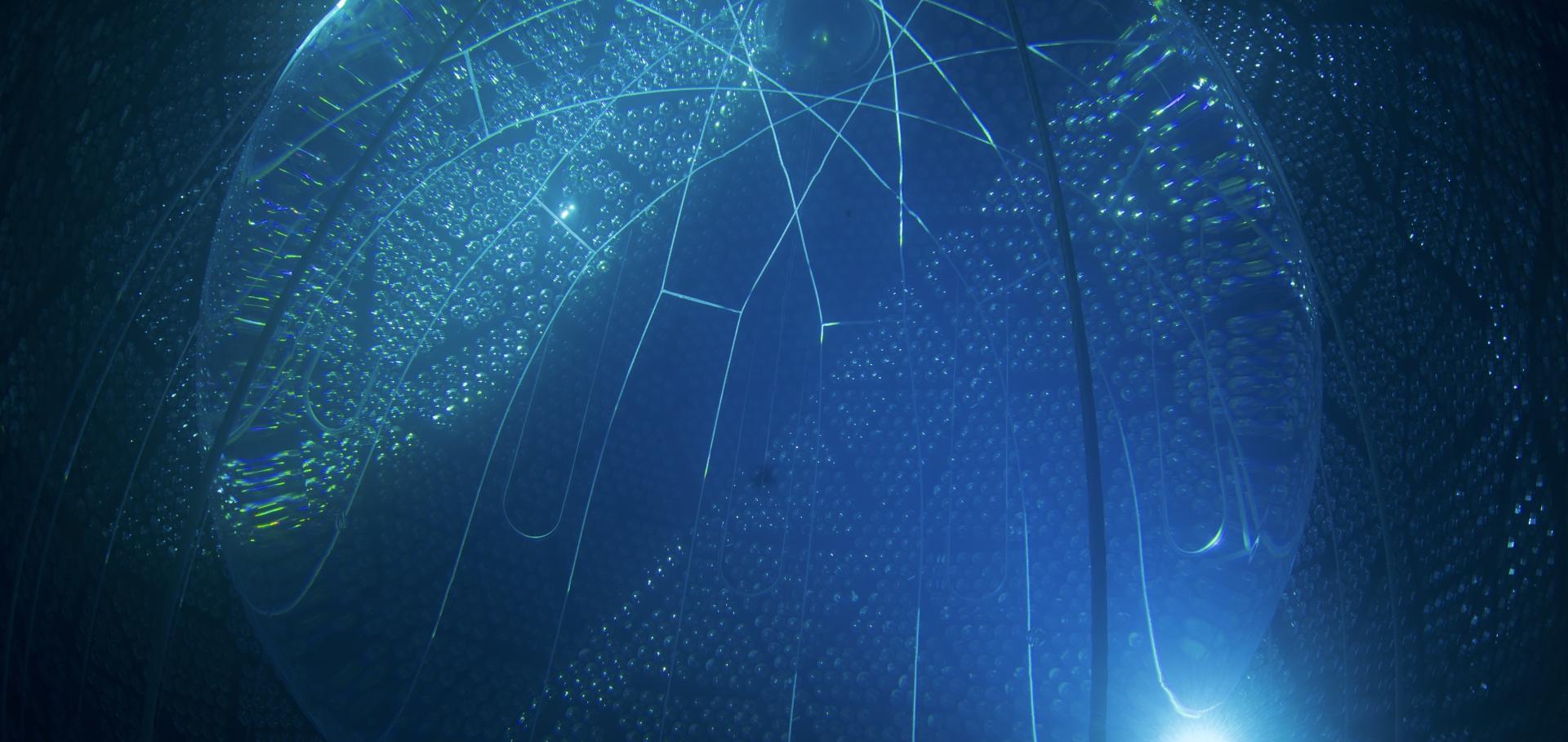
The SNO+ experiment collected data as a low-threshold water Cherenkov detector from September 2017 to July 2019. Measurements of the 2.2-MeV $\gamma$ produced by neutron capture on hydrogen have been made using an Am-Be calibration source, for which a large fraction of emitted neutrons are produced simultaneously with a 4.4-MeV $\gamma$. Analysis of the delayed coincidence between the 4.4-MeV $\gamma$ and the 2.2-MeV capture $\gamma$ revealed a neutron detection efficiency that is centered around 50% and varies at the level of 1% across the inner region of the detector, which to our knowledge is the highest efficiency achieved among pure water Cherenkov detectors. In addition, the neutron capture time constant was measured and converted to a thermal neutron-proton capture cross section of $336.3^{+1.2}_{-1.5}$ mb.

Measurement of oscillations in solar boron-8 neutrinos and studies of optical scattering in the SNO+ detector

Abstract:

SNO+ is a large-scale liquid scintillator experiment based in Sudbury, Canada, capable of probing many aspects of neutrinos. One major property of interest is the neutrino’s ability to oscillate between different flavours, an indirect demonstration that neutrinos must have mass.

This thesis performs the first ever measurement of oscillations from 8B solar neutrinos in the scintillator phase of SNO+. Assuming the current global fit flux of 8 B solar neutrinos, the neutrino oscillation parameter theta_12 was measured to be 38.9 degrees +8.0-7.9 degrees, using an initial 80.6 days of data. This result is consistent with the current global fit result of 33.44 degrees +0.77-0.74 degrees. A sensitivity study indicates that the precision of this result is capable of improving by at least a factor of two within two years of livetime.

On top of this, substantial improvements were made to all aspects of the optical calibration system known as SMELLIE. This is a series of optical-wavelength lasers whose light is emitted from optical fibres attached to the edge of the SNO+ detector. By developing a new analysis, this system was able to measure the scintillator extinction lengths as a function of wavelength and time in-situ for the first time. A new analysis was also built and demonstrated to observe changes in scattering and scintillator re-emission properties of the scintillator as a function of time and wavelength. Alongside this, major upgrades were made to both the hardware and simulation of the SMELLIE system, enabling higher-quality data to be taken, and simulations to be made with much greater speed.

Measurement of the $ν_μ$ charged-current cross sections on water, hydrocarbon, iron, and their ratios with the T2K on-axis detectors

Authors:

K Abe, R Akutsu, A Ali, C Andreopoulos, L Anthony, M Antonova, S Aoki, A Ariga, Y Ashida, Y Awataguchi, Y Azuma, S Ban, M Barbi, GJ Barker, G Barr, C Barry, M Batkiewicz-Kwasniak, F Bench, V Berardi, S Berkman, RM Berner, L Berns, S Bhadra, S Bienstock, A Blondely, S Bolognesi, B Bourguille, SB Boyd, D Brailsford, A Bravar, C Bronner, MB Avanzini, J Calcutt, T Campbell, S Cao, SL Cartwright, A Cervera, A Chappell, C Checchia, D Cherdack, N Chikuma, G Christodoulouy, J Coleman, G Collazuol, D Coplowe, A Cudd, A Dabrowska, GD Rosa, T Dealtry

Abstract:

We report a measurement of the flux-integrated $\nu_{\mu}$ charged-current cross sections on water, hydrocarbon, and iron in the T2K on-axis neutrino beam with a mean neutrino energy of 1.5 GeV. The measured cross sections on water, hydrocarbon, and iron are $\sigma^{\rm{H_{2}O}}_{\rm{CC}}$ = (0.840$\pm 0.010$(stat.)$^{+0.10}_{-0.08}$(syst.))$\times$10$^{-38}$cm$^2$/nucleon, $\sigma^{\rm{CH}}_{\rm{CC}}$ = (0.817$\pm 0.007$(stat.)$^{+0.11}_{-0.08}$(syst.))$\times$10$^{-38}$cm$^2$/nucleon, and $\sigma^{\rm{Fe}}_{\rm{CC}}$ = (0.859$\pm 0.003$(stat.) $^{+0.12}_{-0.10}$(syst.))$\times$10$^{-38}$cm$^2$/nucleon respectively, for a restricted phase space of induced muons: $\theta_{\mu}<45^{\circ}$ and $p_{\mu}>$0.4 GeV/$c$ in the laboratory frame. The measured cross section ratios are ${\sigma^{\rm{H_{2}O}}_{\rm{CC}}}/{\sigma^{\rm{CH}}_{\rm{CC}}}$ = 1.028$\pm 0.016$(stat.)$\pm 0.053$(syst.), ${\sigma^{\rm{Fe}}_{\rm{CC}}}/{\sigma^{\rm{H_{2}O}}_{\rm{CC}}}$ = 1.023$\pm 0.012$(stat.)$\pm 0.058$(syst.), and ${\sigma^{\rm{Fe}}_{\rm{CC}}}/{\sigma^{\rm{CH}}_{\rm{CC}}}$ = 1.049$\pm 0.010$(stat.)$\pm 0.043$(syst.). These results, with an unprecedented precision for the measurements of neutrino cross sections on water in the studied energy region, show good agreement with the current neutrino interaction models used in the T2K oscillation analyses.

Measurements of $\barν_μ$ and $\barν_μ + ν_μ$ charged-current cross-sections without detected pions nor protons on water and hydrocarbon at mean antineutrino energy of 0.86 GeV

Prog Theor Exp Phys (2021)

Authors:

K Abe, N Akhlaq, R Akutsu, A Ali, C Alt, C Andreopoulos, L Anthony, M Antonova, S Aoki, A Ariga, T Arihara, Y Asada, Y Ashida, Et Atkin, Y Awataguchi, S Ban, M Barbi, Gj Barker, G Barr, D Barrow, C Barry, M Batkiewicz-Kwasniak, A Beloshapkin, F Bench, V Berardi, S Berkman, L Berns, S Bhadra, S Bienstock, A Blondel, S Bolognesi, T Bonus, B Bourguille, Sb Boyd, D Brailsford, A Bravar, D Bravo Berguño, C Bronner, S Bron, A Bubak, M Buizza Avanzini, J Calcutt, T Campbell, S Cao, Sl Cartwright, Mg Catanesi, A Cervera, A Chappell, C Checchia, D Cherdack

Abstract:

We report measurements of the flux-integrated $\bar{\nu}_\mu$ and $\bar{\nu}_\mu+\nu_\mu$ charged-current cross-sections on water and hydrocarbon targets using the T2K anti-neutrino beam, with a mean neutrino energy of 0.86 GeV. The signal is defined as the (anti-)neutrino charged-current interaction with one induced $\mu^\pm$ and no detected charged pion nor proton. These measurements are performed using a new WAGASCI module recently added to the T2K setup in combination with the INGRID Proton module. The phase space of muons is restricted to the high-detection efficiency region, $p_{\mu}>400~{\rm MeV}/c$ and $\theta_{\mu}<30^{\circ}$, in the laboratory frame. Absence of pions and protons in the detectable phase space of "$p_{\pi}>200~{\rm MeV}/c$ and $\theta_{\pi}<70^{\circ}$", and "$p_{\rm p}>600~{\rm MeV}/c$ and $\theta_{\rm p}<70^{\circ}$" is required. In this paper, both of the $\bar{\nu}_\mu$ cross-sections and $\bar{\nu}_\mu+\nu_\mu$ cross-sections on water and hydrocarbon targets, and their ratios are provided by using D'Agostini unfolding method. The results of the integrated $\bar{\nu}_\mu$ cross-section measurements over this phase space are $\sigma_{\rm H_{2}O}\,=\,(1.082\pm0.068(\rm stat.)^{+0.145}_{-0.128}(\rm syst.)) \times 10^{-39}~{\rm cm^{2}/nucleon}$, $\sigma_{\rm CH}\,=\,(1.096\pm0.054(\rm stat.)^{+0.132}_{-0.117}(\rm syst.)) \times 10^{-39}~{\rm cm^{2}/nucleon}$, and $\sigma_{\rm H_{2}O}/\sigma_{\rm CH} = 0.987\pm0.078(\rm stat.)^{+0.093}_{-0.090}(\rm syst.)$. The $\bar{\nu}_\mu+\nu_\mu$ cross-section is $\sigma_{\rm H_{2}O} = (1.155\pm0.064(\rm stat.)^{+0.148}_{-0.129}(\rm syst.)) \times 10^{-39}~{\rm cm^{2}/nucleon}$, $\sigma_{\rm CH}\,=\,(1.159\pm0.049(\rm stat.)^{+0.129}_{-0.115}(\rm syst.)) \times 10^{-39}~{\rm cm^{2}/nucleon}$, and $\sigma_{\rm H_{2}O}/\sigma_{\rm CH}\,=\,0.996\pm0.069(\rm stat.)^{+0.083}_{-0.078}(\rm syst.)$.