

Dione’s Thermal Inertia and Bolometric Bond Albedo Derived from Cassini/CIRS Observations of Solar Eclipse Ingress
Planetary Science Journal 3:8 (2022)
Abstract:
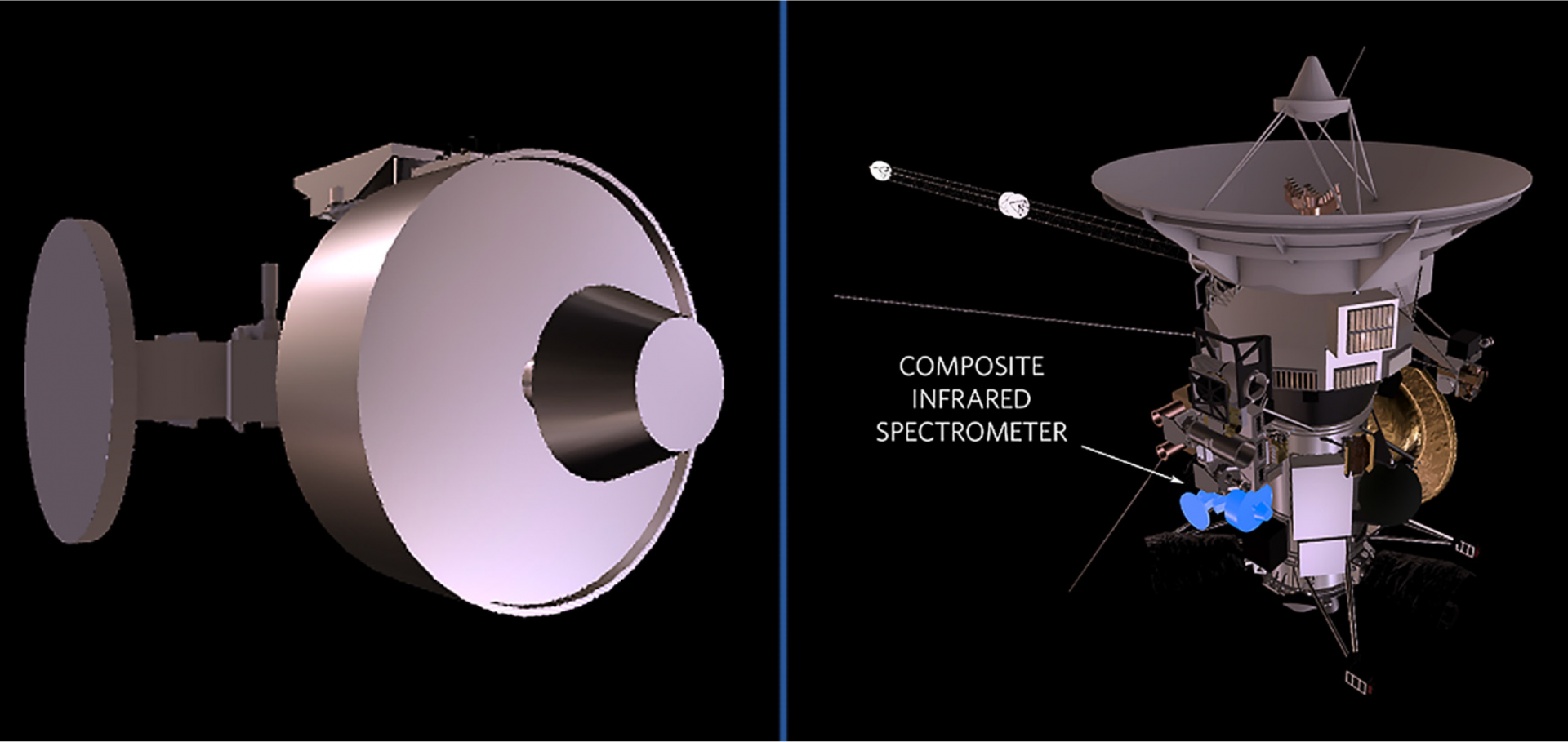
On 2010 May 18 Cassini’s Composite Infrared Spectrometer (CIRS) observed Dione’s leading hemisphere as its surface went into solar eclipse. Surface temperatures derived from each of CIRS’ focal plane 3 (FP3, 600−1100 cm−1) show a rapid decrease in Dione’s surface temperature upon eclipse ingress. This change was compared to the model surface emission to constrain bolometric Bond albedo and thermal inertia. Seven FP3 detectors were able to constrain the observed surface’s thermophysical properties. The bolometric Bond albedo derived from these detectors are consistent with one another (0.54 ± 0.05 to 0.62 ± 0.03) and that of diurnal studies (e.g., 0.49 ± 0.11, Howett et al. 2014). This indicates that Dione’s albedo is uniform to within the uncertainties across the observed region of its leading hemisphere. The derived thermal inertias are consistent across detectors, 9 ± 4 J m−2 K−1 s−1/2 (MKS) to 16 ± 8 MKS, and with previous diurnal studies (e.g., 8 to 12 MKS, Howett et al. 2014). The skin depth probed by the eclipse thermal wave is ∼0.6–1 mm, which is much shallower than that probed by diurnal cycles (∼50 mm). Thus, the agreement in thermal inertia between the eclipse and diurnal studies indicates that Dione’s subsurface structure is uniform from submillimeter to subcentimeter depths. This is different from the Jovian system, where eclipse-derived thermal inertias are much lower than those derived from diurnal studies. The cause of this difference is not known, but one possibility is that the E-ring grains that bombard Dione’s leading hemisphere overturn it, causing uniformity to centimeter depths.Visible and infrared spectral analysis of the Winchcombe Meteorite for comparison with planetary Surfaces
Proceedings of the 85th Annual Meeting of the Meteoritical Society (MetSoc 2022) Wiley 57:S1 (2022)
Modeling Thermal Emission under Lunar Surface Environmental Conditions
Planetary Science Journal 3:7 (2022)
Abstract:
Thermal emission spectra can provide key insights into the composition and thermophysical properties of the regolith on the Moon and other airless bodies. However, under lunar surface environmental conditions, the uppermost millimeters of the regolith (from which thermal emission originates) cannot be characterized by a single temperature, leading to changes in spectral characteristics that should be accounted for in interpreting thermal emission measurements. Here, we develop and apply a Monte Carlo radiative transfer method to model thermal emission from particulate media with varying, nonisothermal subsurface temperature profiles. We model emission spectra for three major lunar mineral phases (pyroxene, olivine, and plagioclase), and investigate the effects of particle size and packing density. Modeled spectra are compared to lab measurements acquired under both ambient and simulated lunar conditions. We find that in some cases, the model provides useful constraints on the magnitude of the temperature profile established in a lab sample under lunar-like conditions, whereas in other cases, lab spectra are not well represented by the linear temperature profiles considered in this work. The model is generally successful at predicting changes in spectral contrast under lunar-like conditions, but less successful in accurately predicting shifts in the position of the Christiansen feature emissivity maximum; we illustrate and discuss the validity of the modeling approach for a range of different cases. Model results can also be used to quantify the depth within which observed thermal emission originates; this depth depends on composition and grain size, and ranges from ∼100 to 1000 μm for representative packing densities.Charon's refractory factory.
Science advances 8:24 (2022) eabq5701-eabq5701
Abstract:
We combine novel laboratory experiments and exospheric modeling to reveal that "dynamic" Ly-α photolysis of Plutonian methane generates a photolytic refractory distribution on Charon that increases with latitude, consistent with poleward darkening observed in the New Horizons images. The flux ratio of the condensing methane to the interplanetary medium Ly-α photons, φ, controls the distribution and composition of Charon's photoproducts. Mid-latitude regions are likely to host complex refractories emerging from low-φ photolysis, while high-φ photolysis at the polar zones primarily generate ethane. However, ethane being colorless does not contribute to the reddish polar hue. Solar wind radiolysis of Ly-α-cooked polar frost past spring sunrise may synthesize increasingly complex, redder refractories responsible for the unique albedo on this enigmatic moon.A Near-surface Temperature Model of Arrokoth
Planetary Science Journal 3:5 (2022)