Home
Department Of Physics text logo
  • Research
    • Our research
    • Our research groups
    • Our research in action
    • Research funding support
    • Summer internships for undergraduates
  • Study
    • Undergraduates
    • Postgraduates
  • Engage
    • For alumni
    • For business
    • For schools
    • For the public
  • Support
Menu
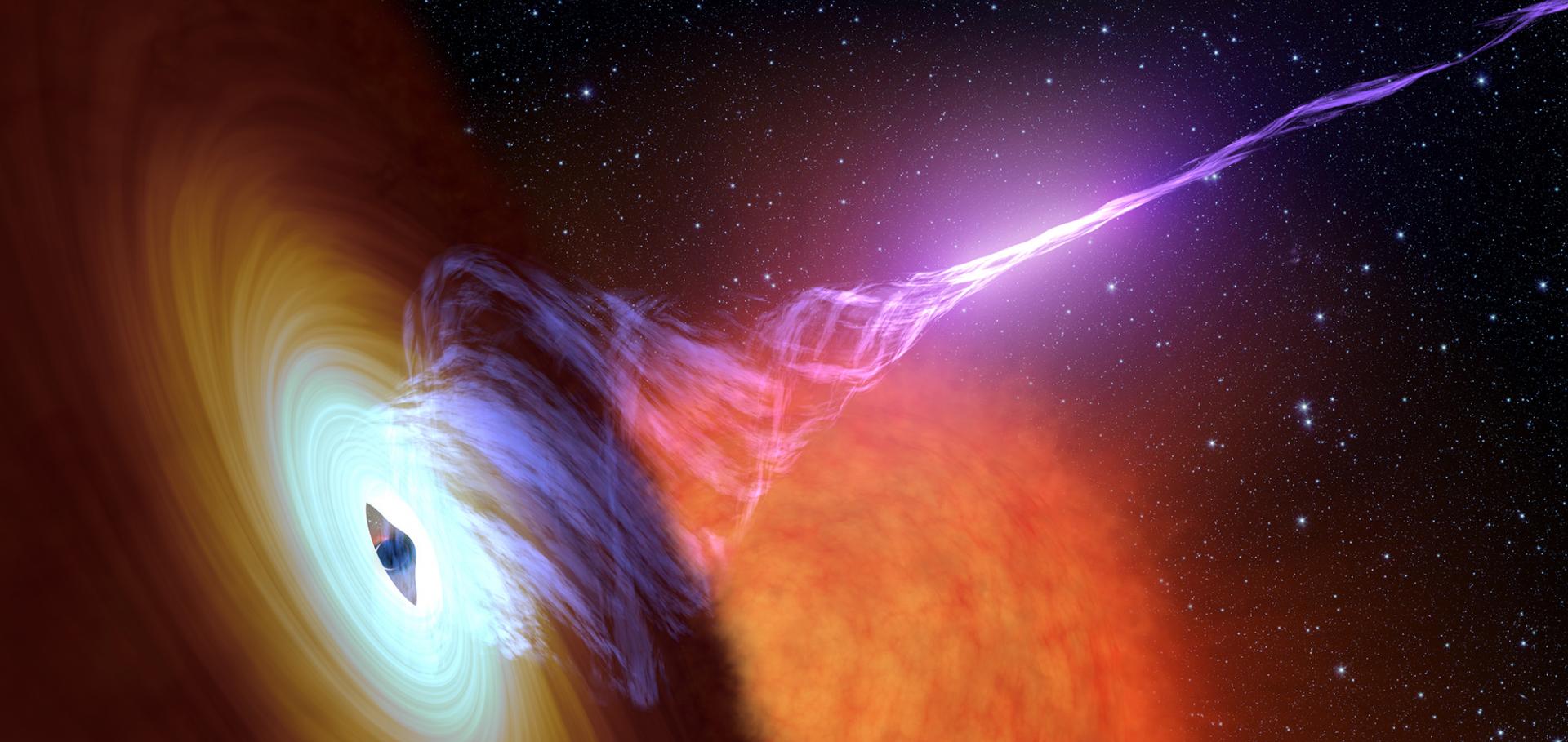
Relativistic Jet from Black Hole

An artist's impression of a relativistic jet propagating away from a black hole at close to the speed of light. Such jets are formed by the inner regions of the accretion flow: matter flowing inwards towards the black hole, via processes which are not yet fully understood. The accretion flow emits primarily in X-rays, the relativistic jet in the radio band: by combing observations in each band we can try and understand how such jets form and how much energy they carry away from the black hole.

Professor Rob Fender

Professor of Astrophysics

Research theme

  • Astronomy and astrophysics

Sub department

  • Astrophysics

Research groups

  • Hintze Centre for Astrophysical Surveys
  • MeerKAT
  • Pulsars, transients and relativistic astrophysics
  • Rubin-LSST
  • The Square Kilometre Array (SKA)
  • Gamma-ray astronomy
Rob.Fender@physics.ox.ac.uk
Telephone: 01865 (2)73435
Denys Wilkinson Building, room 712
  • About
  • Publications

Comprehensive coverage of particle acceleration and kinetic feedback from the stellar mass black hole V404 Cygni

(2022)

Authors:

RP Fender, KP Mooley, SE Motta, JS Bright, DRA Williams, AP Rushton, RJ Beswick, JCA Miller-Jones, M Kimura, K Isogai, T Kato
More details from the publisher
Details from ArXiV

VLBI observations of GRB 201015A, a relatively faint GRB with a hint of very high-energy gamma-ray emission

Astronomy & Astrophysics EDP Sciences 664 (2022) A36-A36

Authors:

S Giarratana, L Rhodes, B Marcote, R Fender, G Ghirlanda, M Giroletti, L Nava, JM Paredes, ME Ravasio, M Ribó, M Patel, J Rastinejad, G Schroeder, W Fong, BP Gompertz, AJ Levan, P O’Brien

Abstract:

Context. A total of four long-duration gamma-ray bursts (GRBs) have been confirmed at very high-energy (≥100GeV) with high significance, and any possible peculiarities of these bursts will become clearer as the number of detected events increases. Multi-wavelength follow-up campaigns are required to extract information on the physical conditions within the jets that lead to the very high-energy counterpart, hence they are crucial to reveal the properties of this class of bursts. Aims. GRB 201015A is a long-duration GRB detected using the MAGIC telescopes from ~40 s after the burst. If confirmed, this would be the fifth and least luminous GRB ever detected at these energies. The goal of this work is to constrain the global and microphysical parameters of its afterglow phase, and to discuss the main properties of this burst in a broader context. Methods. Since the radio band, together with frequent optical and X-ray observations, proved to be a fundamental tool for overcoming the degeneracy in the afterglow modelling, we performed a radio follow-up of GRB 201015A over 12 different epochs, from 1.4 days (2020 October 17) to 117 days (2021 February 9) post-burst, with the Karl G. Jansky Very Large Array, e-MERLIN, and the European VLBI Network. We include optical and X-ray observations, performed respectively with the Multiple Mirror Telescope and the Chandra X-ray Observatory, together with publicly available data, in order to build multi-wavelength light curves and to compare them with the standard fireball model. Results. We detected a point-like transient, consistent with the position of GRB 201015A until 23 and 47 days post-burst at 1.5 and 5 GHz, respectively. No emission was detected in subsequent radio observations. The source was also detected in optical (1.4 and 2.2 days post-burst) and in X-ray (8.4 and 13.6 days post-burst) observations. Conclusions. The multi-wavelength afterglow light curves can be explained with the standard model for a GRB seen on-axis, which expands and decelerates into a medium with a homogeneous density. A circumburst medium with a wind-like profile is disfavoured. Notwithstanding the high resolution provided by the VLBI, we could not pinpoint any expansion or centroid displacement of the outflow. If the GRB is seen at the viewing angle θ that maximises the apparent velocity βapp (i.e. θ ~ βapp-1), we estimate that the Lorentz factor for the possible proper motion is Гα ≤ 40 in right ascension and Гδ ≤ 61 in declination. On the other hand, if the GRB is seen on-axis, the size of the afterglow is ≤5pc and ≤16pc at 25 and 47 days. Finally, the early peak in the optical light curve suggests the presence of a reverse shock component before 0.01 days from the burst
More details from the publisher
Details from ORA
More details
More details

Discovery of a radio emitting neutron star with an ultra-long spin period of 76 seconds

(2022)

Authors:

Manisha Caleb, Ian Heywood, Kaustubh Rajwade, Mateusz Malenta, Benjamin Stappers, Ewan Barr, Weiwei Chen, Vincent Morello, Sotiris Sanidas, Jakob van den Eijnden, Michael Kramer, David Buckley, Jaco Brink, Sara Elisa Motta, Patrick Woudt, Patrick Weltevrede, Fabian Jankowski, Mayuresh Surnis, Sarah Buchner, Mechiel Christiaan Bezuidenhout, Laura Nicole Driessen, Rob Fender
More details from the publisher
Details from ArXiV

A Multiwavelength Study of GRS 1716-249 in Outburst: Constraints on Its System Parameters

The Astrophysical Journal American Astronomical Society 932:1 (2022) 38

Authors:

Payaswini Saikia, David M Russell, MC Baglio, DM Bramich, Piergiorgio Casella, Maria Diaz Trigo, Poshak Gandhi, Jiachen Jiang, Thomas Maccarone, Roberto Soria, Hind Al Noori, Aisha Al Yazeedi, Kevin Alabarta, Tomaso Belloni, Marion Cadolle Bel, Chiara Ceccobello, Stéphane Corbel, Rob Fender, Elena Gallo, Jeroen Homan, Karri Koljonen, Fraser Lewis, Sera B Markoff, James CA Miller-Jones, Jerome Rodriguez, Thomas D Russell, Tariq Shahbaz, Gregory R Sivakoff, Vincenzo Testa, Alexandra J Tetarenko
More details from the publisher
More details

Discovery of a radio-emitting neutron star with an ultra-long spin period of 76 s

Nature Astronomy Springer Nature 6:7 (2022) 828-836

Authors:

Manisha Caleb, Ian Heywood, Kaustubh Rajwade, Mateusz Malenta, Benjamin Stappers, Ewan Barr, Weiwei Chen, Vincent Morello, Sotiris Sanidas, Jakob van den Eijnden, Michael Kramer, David Buckley, Jaco Brink, Sara Elisa Motta, Patrick Woudt, Patrick Weltevrede, Fabian Jankowski, Mayuresh Surnis, Sarah Buchner, Mechiel Christiaan Bezuidenhout, Laura Nicole Driessen, Rob Fender

Abstract:

The radio-emitting neutron star population encompasses objects with spin periods ranging from milliseconds to tens of seconds. As they age and spin more slowly, their radio emission is expected to cease. We present the discovery of an ultra-long period radio-emitting neutron star, PSR J0901-4046, with spin properties distinct from the known spin and magnetic-decay powered neutron stars. With a spin-period of 75.88 s, a characteristic age of 5.3 Myr, and a narrow pulse duty-cycle, it is uncertain how radio emission is generated and challenges our current understanding of how these systems evolve. The radio emission has unique spectro-temporal properties such as quasi-periodicity and partial nulling that provide important clues to the emission mechanism. Detecting similar sources is observationally challenging, which implies a larger undetected population. Our discovery establishes the existence of ultra-long period neutron stars, suggesting a possible connection to the evolution of highly magnetized neutron stars, ultra-long period magnetars, and fast radio bursts.
More details from the publisher
Details from ORA
More details
More details

Pagination

  • First page First
  • Previous page Prev
  • …
  • Page 29
  • Page 30
  • Page 31
  • Page 32
  • Current page 33
  • Page 34
  • Page 35
  • Page 36
  • Page 37
  • …
  • Next page Next
  • Last page Last

Footer Menu

  • Contact us
  • Giving to the Dept of Physics
  • Work with us
  • Media

User account menu

  • Log in

Follow us

FIND US

Clarendon Laboratory,

Parks Road,

Oxford,

OX1 3PU

CONTACT US

Tel: +44(0)1865272200

University of Oxfrod logo Department Of Physics text logo
IOP Juno Champion logo Athena Swan Silver Award logo

© University of Oxford - Department of Physics

Cookies | Privacy policy | Accessibility statement

Built by: Versantus

  • Home
  • Research
  • Study
  • Engage
  • Our people
  • News & Comment
  • Events
  • Our facilities & services
  • About us
  • Giving to Physics
  • Current students
  • Staff intranet