

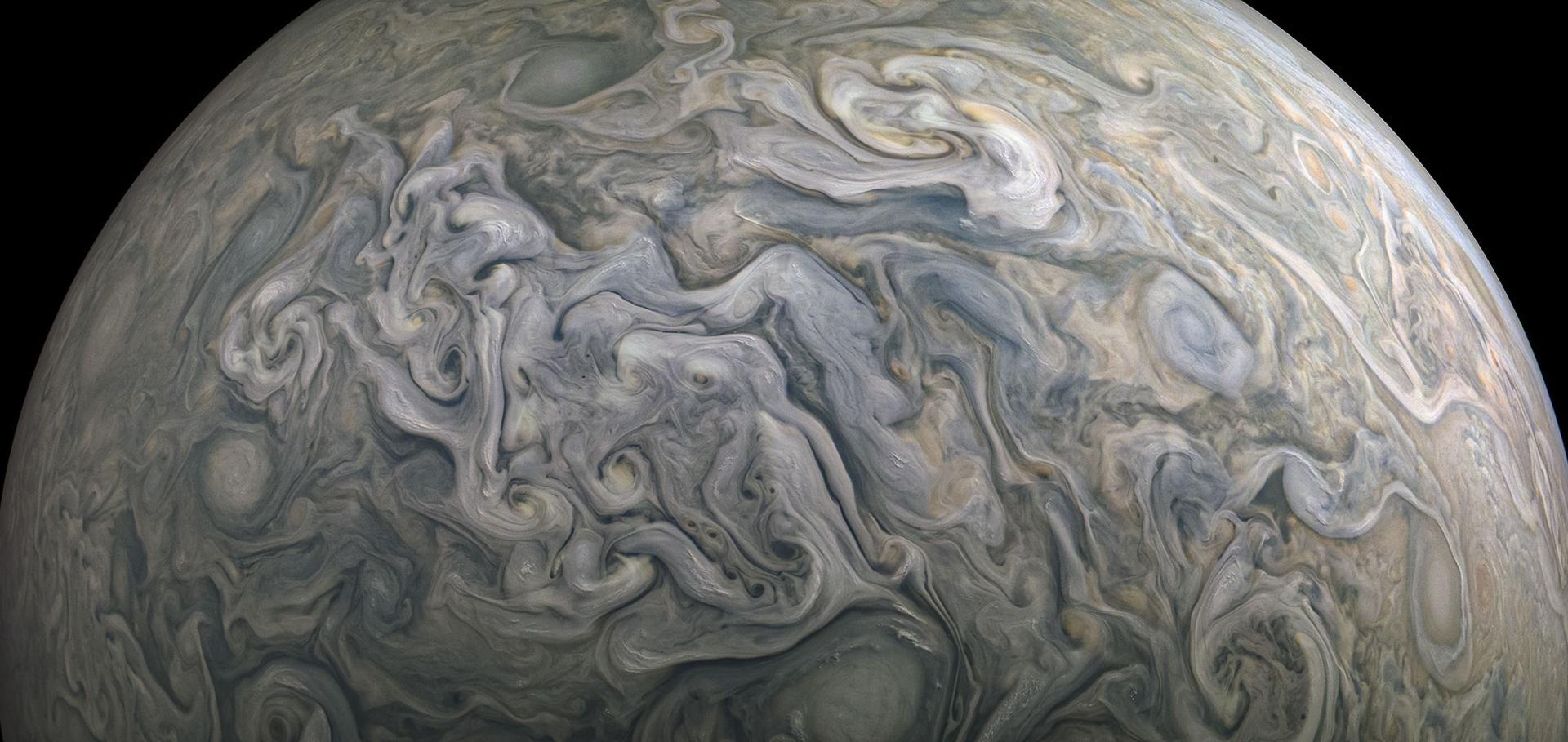

Detection of propadiene (CH 2 CCH 2 ), propene (C 3 H 6 ) and non-detection of propane (C 3 H 8 ) in Jupiter’s northern polar stratosphere
Icarus Elsevier 457 (2026) 117156
Abstract:
We report the first detection of stratospheric propadiene (CH 2 CCH 2 ) and propene (C 3 H 6 ) at Jupiter’s mid-to-high northern latitudes using IRTF-TEXES measurements recorded on March 5-6, 2025. Using radiative transfer software to quantitatively test for the presence of propadiene and propene, we report a > 12- σ detection of propadiene and a > 17- σ detection of propene at high latitudes inside Jupiter’s auroral region, where the species are most concentrated. For example, at 62 °N (planetocentric) inside Jupiter’s northern auroral region (henceforth ‘NAR’), we derive a 1-mbar propadiene abundance of 2.0 ± 0.2 ppbv, which is 40 ± 3 higher than abundances predicted by the Moses and Poppe (2017) photochemical model (henceforth ‘MP17’), and significantly higher than the 1.2-pbbv upper limit abundance derived at 42 °N (the lowest latitude sampled by the observations). Similarly, we derive a 1-mbar propene abundance 8.1 ± 0.5 ppbv at 62 °N inside Jupiter’s NAR, which is 28 ± 2 higher than the MP17 predicted abundance and significantly higher than the 6-ppbv 1-mbar upper limit abundance derived at 42 °N. The fact that propadiene and propene are most enriched inside Jupiter’s NAR strongly suggests that perturbations to the chemistry by auroral-related heating and exogenous ions/electrons are responsible for their significant enrichment, as has been observed for other unsaturated/aromatic hydrocarbon species. Spectral features of propane (C 3 H 8 ) were not detected at any of the locations sampled by the data (poleward of 42 °N): 3- σ upper limits of ∼ 10 ppbv at 10 mbar were derived at 62 °N inside Jupiter’s NAR, which is ∼ 2.5 times the MP17 predicted abundance. The non-detection of propane could, in part, be explained by the vertical sensitivity of its mid-infrared emission lines to deeper pressures, where there is negligible auroral-related heating to warm the line forming region. The results of this work strongly advocate for development of ion-neutral chemistry models of Jupiter’s polar stratosphere to quantify how strong auroral-related heating and magnetospheric particles modify the reaction pathways that produce higher-order hydrocarbons.Microphysical model of Jupiter's Great Red Spot upper chromophore haze
Icarus 451 (2026)
Abstract:
The origin of the red colouration in Jupiter's Great Red Spot (GRS) is a long-standing question in planetary science. While several candidate chromophores have been proposed, no clear conclusions have been reached regarding its nature, evolution, or relationship to atmospheric dynamics. In this work, we perform microphysical simulations of the reddish haze over the GRS and quantify the production rates and timescales required to sustain it. Matching the previously reported chromophore column mass and effective radius in the GRS requires column-integrated injection fluxes in the range 1×10<sup>−12</sup>–7×10<sup>−12</sup> kg m<sup>−2</sup> s<sup>−1</sup>, under low upwelling velocities in the upper troposphere (v<inf>trop</inf>≲1.5×10<sup>−4</sup> m s<sup>−1</sup>) and particle charges of at least 20 electrons/μm. Such rates exceed the mass flux that standard photochemical models of Jupiter currently supply via NH<inf>3</inf>–C<inf>2</inf>H<inf>2</inf> photochemistry at 0.1–0.2 bar, the most popular chromophore pathway in recent literature. We find a lower limit of 7 years on the haze formation time. We also assess commonly used size and vertical distribution parameterisations for the chromophore haze, finding that eddy diffusion prevents the long-term confinement of a thin layer and that the extinction is dominated by particles that can be represented by a single log-normal size distribution.Reconciling near-infrared and microwave analyses of Neptune’s hydrogen sulphide distribution
Monthly Notices of the Royal Astronomical Society Oxford University Press 548:2 (2026) stag688
Abstract:
Previous analysis of Neptune’s atmosphere using near-infrared Gemini/NIFS observations found the strongest spectral signature of hydrogen sulphide (HS) to be at the planet’s south pole. Conversely, analysis of microwave observations with the Atacama Large Millimeter/submillimeter Array in 2019 suggested a distribution of HS that peaks in the mid-latitudes and is strongly depleted towards the pole. We analyse near-infrared observations from VLT-SINFONI in 2018 and fit a parametrized cloud model to the data using nested sampling. By prescribing a latitudinally varying methane (CH) profile previously derived from visible light observations, we find general agreement with the microwave analysis, with an enhancement of HS by a factor of 4 at the southern mid-latitudes compared to polar latitudes. The stronger spectral signature at the pole is explained with a deeper cloud top, resulting in a higher cloud-top HS column abundance in this region. Our results are indicative of deep upwelling at the mid-latitudes, with downwelling at the pole and possibly near the equator.Comparative analysis of Venera 11, 13, and 14 spectrophotometric data: implications for the near-surface particulate layer
(2026)
Abstract:
A voyage of discovery: Exploring the atmospheres of solar system planets and exoplanets with NEMESIS
(2026)