Home
Department Of Physics text logo
  • Research
    • Our research
    • Our research groups
    • Our research in action
    • Research funding support
    • Summer internships for undergraduates
  • Study
    • Undergraduates
    • Postgraduates
  • Engage
    • For young people
    • For teachers
    • For the public
    • For alumni
    • For business
  • Support
Menu
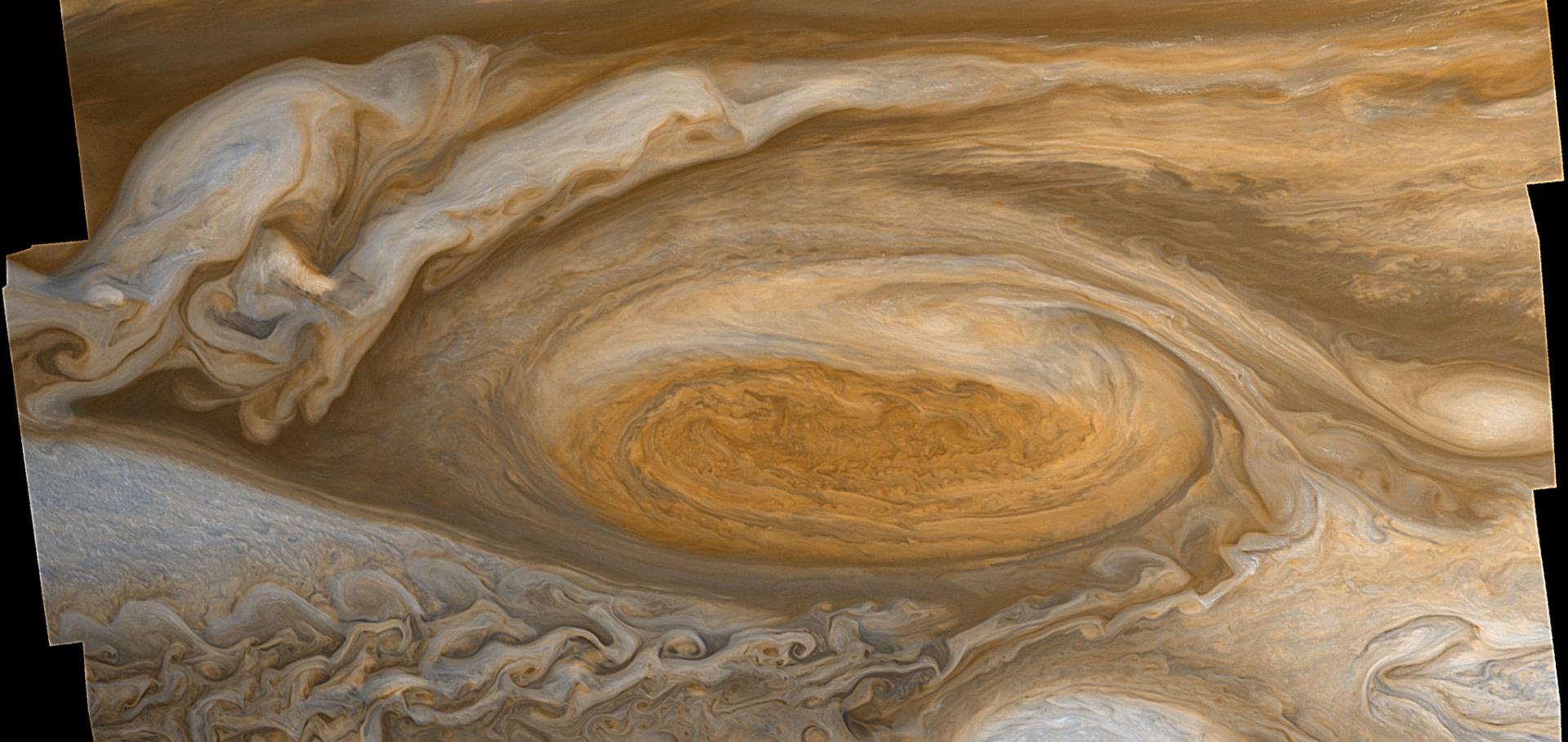
Image of Jupiter's Great Red Spot from Voyager 1

Image of Jupiter's Great Red Spot, obtained during the fly-by of Jupiter by NASA's Voyager 1 spacecraft in 1979.

Credit: NASA/JPL

Prof. Peter Read

Emeritus/researcher

Research theme

  • Climate physics
  • Exoplanets and planetary physics

Sub department

  • Atmospheric, Oceanic and Planetary Physics

Research groups

  • Geophysical and Astrophysical Fluid Dynamics
  • Planetary Climate Dynamics
Peter.Read@physics.ox.ac.uk
Telephone: 01865 (2)72082
Atmospheric Physics Clarendon Laboratory, room 210
  • About
  • Publications

Response to Reviewer 2

Copernicus GmbH (2020)
More details from the publisher

Response to editorial comments

Copernicus GmbH (2020)
More details from the publisher

Responses to Referee comments

Copernicus GmbH (2019)
More details from the publisher

Raymond Hide. 17 May 19296 September 2016

Biographical Memoirs of Fellows of the Royal Society The Royal Society 67 (2019) 191-215
More details from the publisher

Shadowing the rotating annulus. Part II: Gradient descent in the perfect model scenario

(2019)

Authors:

Roland MB Young, Roman Binter, Falk Niehörster, Peter L Read, Leonard A Smith

Abstract:

Shadowing trajectories are model trajectories consistent with a sequence of observations of a system, given a distribution of observational noise. The existence of such trajectories is a desirable property of any forecast model. Gradient descent of indeterminism is a well-established technique for finding shadowing trajectories in low-dimensional analytical systems. Here we apply it to the thermally-driven rotating annulus, a laboratory experiment intermediate in model complexity and physical idealisation between analytical systems and global, comprehensive atmospheric models. We work in the perfect model scenario using the MORALS model to generate a sequence of noisy observations in a chaotic flow regime. We demonstrate that the gradient descent technique recovers a pseudo-orbit of model states significantly closer to a model trajectory than the initial sequence. Gradient-free descent is used, where the adjoint model is set to $\lambda$I in the absence of a full adjoint model. The indeterminism of the pseudo-orbit falls by two orders of magnitude during the descent, but we find that the distance between the pseudo-orbit and the initial, true, model trajectory reaches a minimum and then diverges from truth. We attribute this to the use of the $\lambda$-adjoint, which is well suited to noise reduction but not to finely-tuned convergence towards a model trajectory. We find that $\lambda=0.25$ gives optimal results, and that candidate model trajectories begun from this pseudo-orbit shadow the observations for up to 80 s, about the length of the longest timescale of the system, and similar to expected shadowing times based on the distance between the pseudo-orbit and the truth. There is great potential for using this method with real laboratory data.
More details from the publisher
Details from ArXiV

Pagination

  • First page First
  • Previous page Prev
  • …
  • Page 6
  • Page 7
  • Page 8
  • Page 9
  • Current page 10
  • Page 11
  • Page 12
  • Page 13
  • Page 14
  • …
  • Next page Next
  • Last page Last

Footer Menu

  • Contact us
  • Giving to the Dept of Physics
  • Work with us
  • Media

User account menu

  • Log in

Follow us

FIND US

Clarendon Laboratory,

Parks Road,

Oxford,

OX1 3PU

CONTACT US

Tel: +44(0)1865272200

University of Oxfrod logo Department Of Physics text logo
IOP Juno Champion logo Athena Swan Silver Award logo

© University of Oxford - Department of Physics

Cookies | Privacy policy | Accessibility statement

Built by: Versantus

  • Home
  • Research
  • Study
  • Engage
  • Our people
  • News & Comment
  • Events
  • Our facilities & services
  • About us
  • Giving to Physics
  • Current students
  • Staff intranet