Home
Department Of Physics text logo
  • Research
    • Our research
    • Our research groups
    • Our research in action
    • Research funding support
    • Summer internships for undergraduates
  • Study
    • Undergraduates
    • Postgraduates
  • Engage
    • For young people
    • For teachers
    • For the public
    • For alumni
    • For business
  • Support
Menu
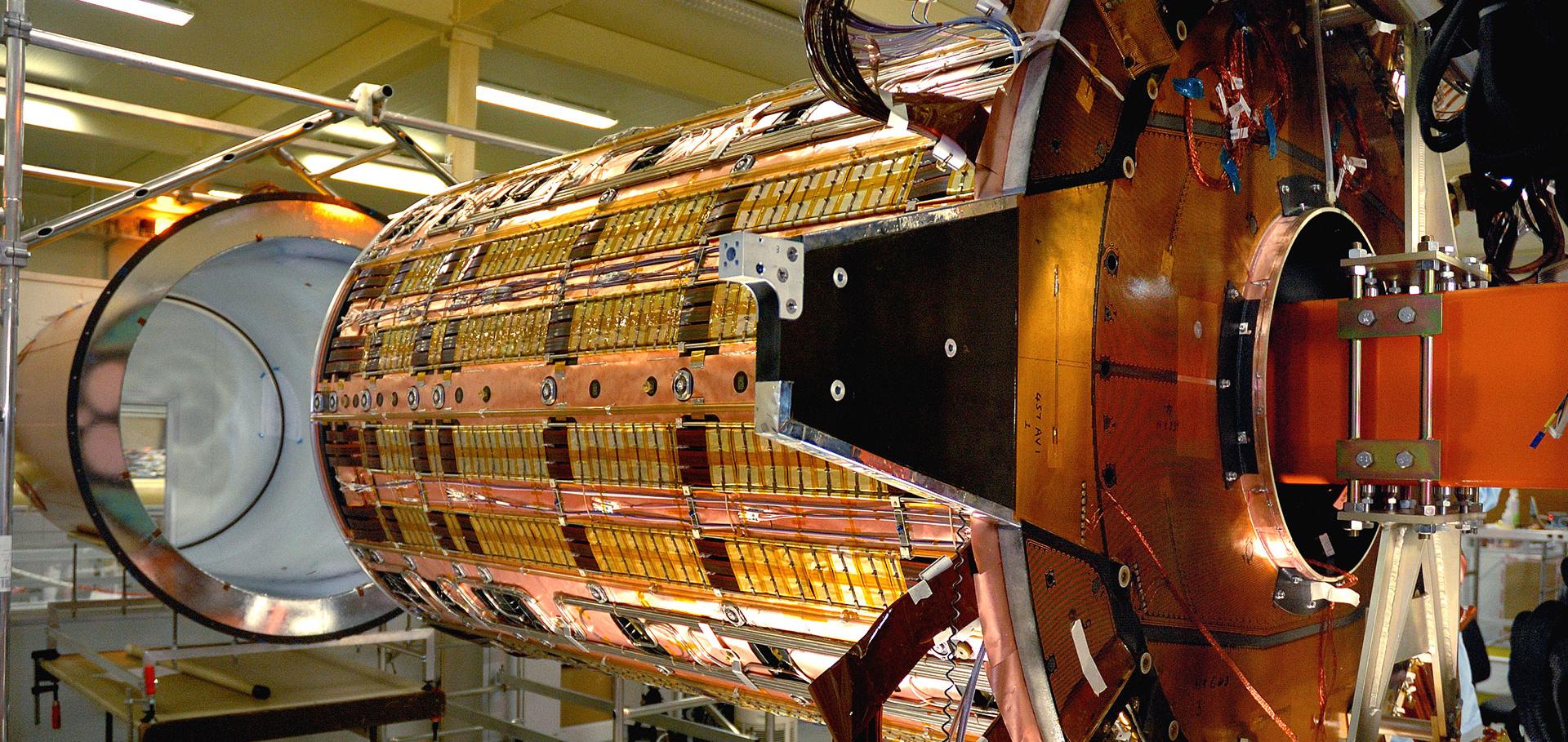
Insertion of STC into TRT at the Department of Physics, Oxford
Credit: CERN

Prof Dr Armin Reichold

Professor of Physics

Research theme

  • Accelerator physics
  • Fundamental particles and interactions

Sub department

  • Particle Physics

Research groups

  • Future Colliders
  • SNO+
Armin.Reichold@physics.ox.ac.uk
Telephone: 01865 (2)73358
Denys Wilkinson Building, room 473,617
  • About
  • Publications

Development, characterisation, and deployment of the SNO+ liquid scintillator

JINST (2021)

Authors:

Sno Collaboration, Mr Anderson, S Andringa, L Anselmo, E Arushanova, S Asahi, M Askins, Dj Auty, Ar Back, Z Barnard, N Barros, D Bartlett, F Barão, C Connors, It Coulter, Ma Cox, D Cressy, Mm Depatie, F Descamps, J Dittmer, F Di Lodovico, N Duhaime, E Falk, J Paton, A Reichold

Abstract:

A liquid scintillator consisting of linear alkylbenzene as the solvent and 2,5-diphenyloxazole as the fluor was developed for the SNO+ experiment. This mixture was chosen as it is compatible with acrylic and has a competitive light yield to pre-existing liquid scintillators while conferring other advantages including longer attenuation lengths, superior safety characteristics, chemical simplicity, ease of handling, and logistical availability. Its properties have been extensively characterized and are presented here. This liquid scintillator is now used in several neutrino physics experiments in addition to SNO+.
More details from the publisher

Measurement of neutron-proton capture in the SNO+ water phase

PhysRevC (2020)

Authors:

The SNO Collaboration, Mr Anderson, S Andringa, M Askins, Dj Auty, N Barros, F Barão, R Bayes, Ew Beier, A Bialek, Sd Biller, E Blucher, R Bonventre, M Boulay, E Caden, Ej Callaghan, K Frankiewicz, K Gilje, Rl Helmer, D Horne, B Hreljac, J Hu, Asm Hussain, As Inácio, A Reichold

Abstract:

The SNO+ experiment collected data as a low-threshold water Cherenkov detector from September 2017 to July 2019. Measurements of the 2.2-MeV $\gamma$ produced by neutron capture on hydrogen have been made using an Am-Be calibration source, for which a large fraction of emitted neutrons are produced simultaneously with a 4.4-MeV $\gamma$. Analysis of the delayed coincidence between the 4.4-MeV $\gamma$ and the 2.2-MeV capture $\gamma$ revealed a neutron detection efficiency that is centered around 50% and varies at the level of 1% across the inner region of the detector, which to our knowledge is the highest efficiency achieved among pure water Cherenkov detectors. In addition, the neutron capture time constant was measured and converted to a thermal neutron-proton capture cross section of $336.3^{+1.2}_{-1.5}$ mb.
More details from the publisher

Measurement of neutron-proton capture in the SNO+ water phase

Physical Review C: Nuclear Physics American Physical Society (2020)

Authors:

The SNO Collaboration, Mr Anderson, S Andringa, M Askins, Dj Auty, N Barros, C Grant, J Grove, Al Hallin, D Hallman, S Hans, J Hartnell, P Harvey, Wj Heintzelman, Rl Helmer, D Horne, B Hreljac, J Hu, Asm Hussain, As Inácio, Cj Jillings, T Kaptanoglu, P Khaghani, J Paton, A Reichold

Abstract:

The SNO+ experiment collected data as a low-threshold water Cherenkov detector from September 2017 to July 2019. Measurements of the 2.2-MeV $\gamma$ produced by neutron capture on hydrogen have been made using an Am-Be calibration source, for which a large fraction of emitted neutrons are produced simultaneously with a 4.4-MeV $\gamma$. Analysis of the delayed coincidence between the 4.4-MeV $\gamma$ and the 2.2-MeV capture $\gamma$ revealed a neutron detection efficiency that is centered around 50% and varies at the level of 1% across the inner region of the detector, which to our knowledge is the highest efficiency achieved among pure water Cherenkov detectors. In addition, the neutron capture time constant was measured and converted to a thermal neutron-proton capture cross section of $336.3^{+1.2}_{-1.5}$ mb.
More details from the publisher
Details from ORA
More details
Details from ArXiV

Measurement of neutron-proton capture in the SNO+ water phase

(2020)

Authors:

The SNO Collaboration, :, MR Anderson, S Andringa, M Askins, DJ Auty, N Barros, F Barão, R Bayes, EW Beier, A Bialek, SD Biller, E Blucher, R Bonventre, M Boulay, E Caden, EJ Callaghan, J Caravaca, D Chauhan, M Chen, O Chkvorets, B Cleveland, MA Cox, MM Depatie, J Dittmer, F Di Lodovico, AD Earle, E Falk, N Fatemighomi, V Fischer, E Fletcher, R Ford, K Frankiewicz, K Gilje, D Gooding, C Grant, J Grove, AL Hallin, D Hallman, S Hans, J Hartnell, P Harvey, WJ Heintzelman, RL Helmer, D Horne, B Hreljac, J Hu, ASM Hussain, AS Inácio, CJ Jillings, T Kaptanoglu, P Khaghani, JR Klein, R Knapik, LL Kormos, B Krar, C Kraus, CB Krauss, T Kroupova, I Lam, BJ Land, A LaTorre, I Lawson, L Lebanowski, EJ Leming, A Li, J Lidgard, B Liggins, YH Lin, Y Liu, V Lozza, M Luo, S Maguire, A Maio, S Manecki, J Maneira, RD Martin, E Marzec, A Mastbaum, N McCauley, AB McDonald, P Mekarski, M Meyer, C Mills, I Morton-Blake, S Nae, M Nirkko, LJ Nolan, HM O'Keeffe, GD Orebi Gann, MJ Parnell, J Paton, SJM Peeters, T Pershing, L Pickard, G Prior, A Reichold, S Riccetto, R Richardson, M Rigan, J Rose, R Rosero, PM Rost, J Rumleskie, I Semenec, F Shaker, MK Sharma, K Singh, P Skensved, M Smiley, MI Stringer, R Svoboda, B Tam, L Tian, J Tseng, E Turner, R Van Berg, JGC Veinot, CJ Virtue, E Vázquez-Jáuregui, SC Walton, J Wang, M Ward, JJ Weigand, JR Wilson, P Woosaree, A Wright, JP Yanez, M Yeh, T Zhang, Y Zhang, K Zuber, A Zummo
More details from the publisher

The “stabilization of the final focus of the ILC” project

Proceedings of NANOBEAM 2005, 36th ICFA Advanced Beam Dynamics Workshop (2020) 66-71

Authors:

D Urner, P Coe, A Reichold

Abstract:

We describe techniques to measure and stabilize the relative motion of two objects with respect to each. The position measurements are based on interferometry. Several potential applications at the ILC are studied.

Pagination

  • First page First
  • Previous page Prev
  • Page 1
  • Page 2
  • Page 3
  • Current page 4
  • Page 5
  • Page 6
  • Page 7
  • Page 8
  • Page 9
  • …
  • Next page Next
  • Last page Last

Footer Menu

  • Contact us
  • Giving to the Dept of Physics
  • Work with us
  • Media

User account menu

  • Log in

Follow us

FIND US

Clarendon Laboratory,

Parks Road,

Oxford,

OX1 3PU

CONTACT US

Tel: +44(0)1865272200

University of Oxfrod logo Department Of Physics text logo
IOP Juno Champion logo Athena Swan Silver Award logo

© University of Oxford - Department of Physics

Cookies | Privacy policy | Accessibility statement

Built by: Versantus

  • Home
  • Research
  • Study
  • Engage
  • Our people
  • News & Comment
  • Events
  • Our facilities & services
  • About us
  • Giving to Physics
  • Current students
  • Staff intranet