

The Changing-Atmosphere Infrared Tomography Explorer CAIRT – an infrared limb-imaging satellite concept to chart the middle atmosphere in the climate system
Bulletin of the American Meteorological Society, under review, 2025
Abstract:
Transformational astrophysics and exoplanet science with Habitable Worlds Observatory's High Resolution Imager
White paper submitted to the UK Space Agency's initiative "UK Space Frontiers 2035
Abstract:
Habitable Worlds Observatory (HWO) will be NASA’s flagship space telescope of the 2040s, designed to search for life on other planets and to transform broad areas of astrophysics. NASA are
seeking international partners, and the UK is well-placed to lead the design and construction of its
imaging camera — which is likely to produce the mission’s most visible public impact. Early participation in the mission would return investment to UK industry, and bring generational leadership for
the UK in space science, space technology, and astrophysics.
Magma Ocean Evolution at Arbitrary Redox State
Journal of Geophysical Research: Planets American Geophysical Union 129:12 (2024) e2024JE008576
Abstract:
Interactions between magma oceans and overlying atmospheres on young rocky planets leads to an evolving feedback of outgassing, greenhouse forcing, and mantle melt fraction. Previous studies have predominantly focused on the solidification of oxidized Earth‐similar planets, but the diversity in mean density and irradiation observed in the low‐mass exoplanet census motivate exploration of strongly varying geochemical scenarios. We aim to explore how variable redox properties alter the duration of magma ocean solidification, the equilibrium thermodynamic state, melt fraction of the mantle, and atmospheric composition. We develop a 1D coupled interior‐atmosphere model that can simulate the time‐evolution of lava planets. This is applied across a grid of fixed redox states, orbital separations, hydrogen endowments, and C/H ratios around a Sun‐like star. The composition of these atmospheres is highly variable before and during solidification. The evolutionary path of an Earth‐like planet at 1 AU ranges between permanent magma ocean states and solidification within 1 Myr. Recently solidified planets typically host H 2 O ${\mathrm{H}}_{2}\mathrm{O}$ ‐ or H 2 ${\mathrm{H}}_{2}$ ‐dominated atmospheres in the absence of escape. Orbital separation is the primary factor determining magma ocean evolution, followed by the total hydrogen endowment, mantle oxygen fugacity, and finally the planet's C/H ratio. Collisional absorption by H 2 ${\mathrm{H}}_{2}$ induces a greenhouse effect which can prevent or stall magma ocean solidification. Through this effect, as well as the outgassing of other volatiles, geochemical properties exert significant control over the fate of magma oceans on rocky planets.Influence of high-latitude blocking and the northern stratospheric polar vortex on cold-air outbreaks under Arctic amplification of global warming
Environmental Research: Climate IOP Publishing 3:4 (2024) 042004
Abstract:
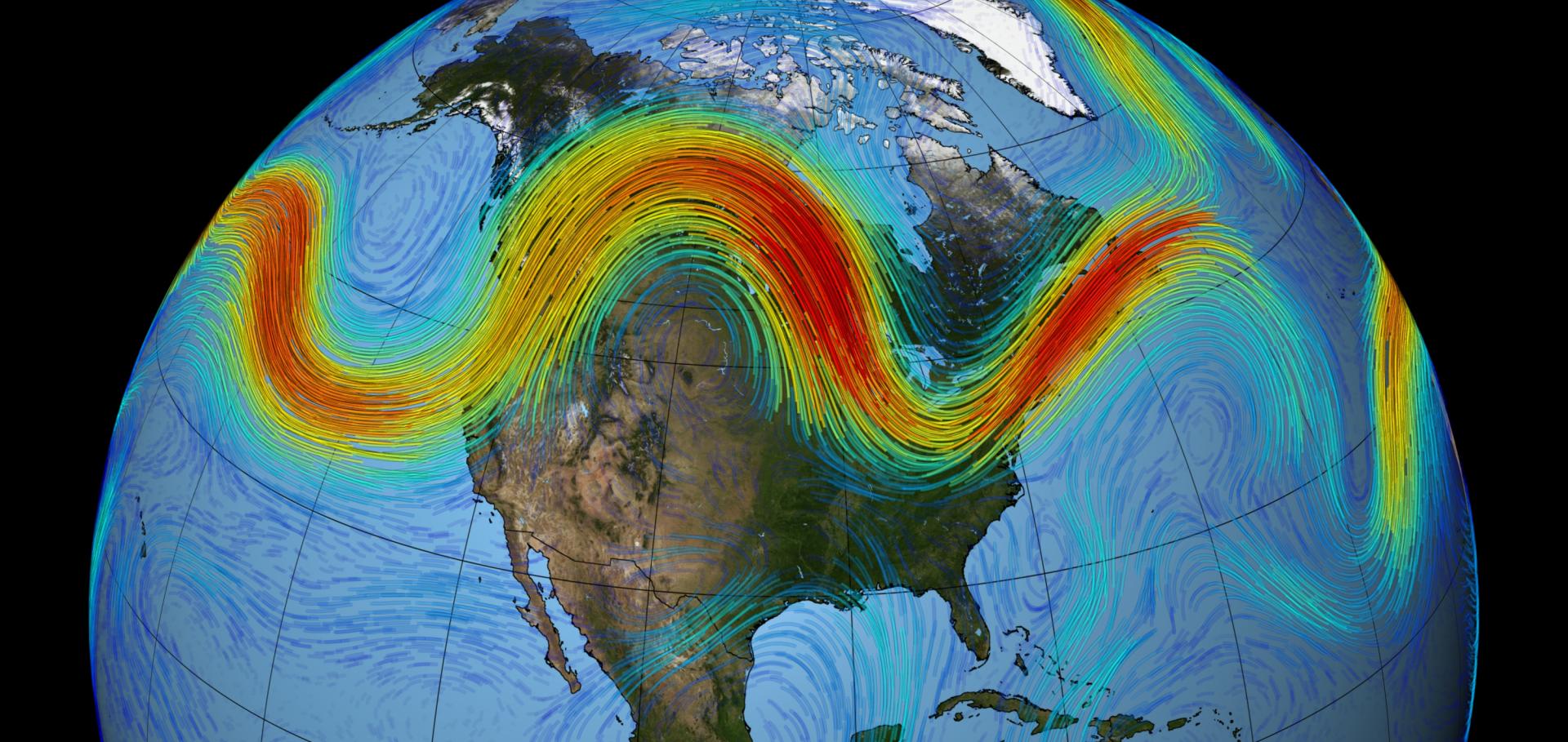
It is widely accepted that Arctic amplification (AA)—enhanced Arctic warming relative to global warming—will increasingly moderate cold-air outbreaks (CAOs) to the midlatitudes. Yet, some recent studies also argue that AA over the last three decades to the rest of the present century may contribute to more frequent severe winter weather including disruptive cold spells. To prepare society for future extremes, it is necessary to resolve whether AA and severe midlatitude winter weather are coincidental or physically linked. Severe winter weather events in the northern continents are often related to a range of stratospheric polar vortex (SPV) configurations and atmospheric blocking, but these dynamical drivers are complex and still not fully understood. Here we review recent research advances and paradigms including a nonlinear theory of atmospheric blocking that helps to explain the location, timing and duration of AA/midlatitude weather connections, studies of the polar vortex’s zonal asymmetric and intra-seasonal variations, its southward migration over continents, and its surface impacts. We highlight novel understanding of SPV variability—polar vortex stretching and a stratosphere–troposphere oscillation—that have remained mostly hidden in the predominant research focus on sudden stratospheric warmings. A physical explanation of the two-way vertical coupling process between the polar vortex and blocking highs, taking into account local surface conditions, remains elusive. We conclude that evidence exists for tropical preconditioning of Arctic-midlatitude climate linkages. Recent research using very large-ensemble climate modelling provides an emerging opportunity to robustly quantify internal atmospheric variability when studying the potential response of midlatitude CAOs to AA and sea-ice loss.Reply to Comment on ‘Extreme weather events in early summer 2018 connected by a recurrent hemispheric wave-7 pattern’
Environmental Research Letters IOP Publishing 20:1 (2024) 018001