

ThousandWorlds: A benchmark for climate emulation of potentially habitable exoplanets
Machine Learning (cs.LG)
Abstract:
The search for life beyond Earth will depend on detecting faint signatures in the atmospheres of potentially habitable exoplanets. Interpreting those signatures requires understanding the host planet's climate: the same molecule may signal life on one planet and abiotic chemistry on another. Global climate models (GCMs) provide this understanding, but individual runs can require up to millions of core-hours and substantial domain expert time. Machine-learning emulators could remove this bottleneck, but progress has been limited by the absence of a curated, multi-model exoclimate dataset. We introduce ThousandWorlds, an ML-ready benchmark for exoclimate emulation and for the broader regime of low-data, multi-simulator, parameter-to-field regression. The dataset contains approximately 1800 simulations from five GCMs, mapping eight planet parameters to 3D atmospheric fields including temperature, humidity, winds, clouds, and radiation. Three nested subsets define progressively harder challenges: single-simulator regression, multi-simulator regression with complete observations, and multi-simulator regression with structured missingness. We propose two evaluation protocols: one for ranking methods, and one that measures performance relative to the disagreement between GCMs themselves. We evaluate seven baselines spanning simple methods, deep learning, and Gaussian processes. GP-based methods perform best, suggesting that ThousandWorlds exposes a regime where off-the-shelf deep learning does not yet succeed.
Environmental Influences on Deep Convective Upscale Growth Rate in Central Argentina From a Convection‐Permitting Simulation
Journal of Geophysical Research: Atmospheres American Geophysical Union 131:1 (2025) e2025JD044251
Abstract:
Plain Language Summary: Understanding the environments that support spatial growth of storms is crucial for predicting their impacts. This study uses a 6.5‐month‐long high‐resolution model simulation to examine the environments of simulated storm systems separated based on their rate of spatial growth. Results show that environments with a faster growth rate have greater moisture and instability. While vertical wind shear, defined as the change in wind speed and/or direction with height, is a well‐known factor in storm organization, its magnitude does not vary strongly with growth rate when shear is averaged over a large area, likely due to the large spread in values present. However, the direction of wind shear is likely an important factor in the rate of growth, and faster spatial growth is found for storms growing near the mountains when a favorable shear direction (parallel to the mountain range) is present. A low‐level jet, an area of stronger wind speeds elevated off of the surface, is found more frequently in environments with a faster growth rate and is likely an important mechanism that facilitates differences in thermodynamics and wind shear.A Thick Volatile Atmosphere on the Ultrahot Super-Earth TOI-561 b
The Astrophysical Journal Letters American Astronomical Society 995:2 (2025) L39
Abstract:
Ultrashort-period (USP) exoplanets—with Rp ≤ 2R⊕ and periods ≤1 day—are expected to be stripped of volatile atmospheres by intense host star irradiation, which is corroborated by their nominal bulk densities and previous eclipse observations, consistent with bare-rock surfaces. However, a few USP planets appear anomalously underdense relative to an Earth-like composition, suggesting an exotic interior structure (e.g., coreless) or a volatile-rich secondary atmosphere increasing their apparent radius. Here, we present the first dayside emission spectrum of the low-density (4.3 ± 0.4 g cm−3) USP planet TOI-561 b, which orbits an iron-poor, alpha-rich, ∼10 Gyr old thick-disk star. Our 3–5 μm JWST/NIRSpec observations demonstrate the dayside of TOI-561 b is inconsistent with a bare-rock surface at high statistical significance, suggesting instead a thick volatile envelope that is cooling the dayside to well below the ∼3000 K expected in the bare-rock or thin-atmosphere case. These results reject the popular hypothesis of complete atmospheric desiccation for highly irradiated exoplanets and support predictions that planetary-scale magma oceans can retain substantial reservoirs of volatiles, opening up the geophysical study of ultrahot super-Earths through the lenses of their atmospheres.3D Modeling of Moist Convective Inhibition in Idealized Sub-Neptune Atmospheres
The Astrophysical Journal American Astronomical Society 995:1 (2025) 41
Abstract:
Atmospheric convection behaves differently in hydrogen-rich atmospheres compared to higher mean molecular weight atmospheres due to compositional gradients of tracers. Previous 1D studies predict that when a condensable tracer exceeds a critical mixing ratio in H2-rich atmospheres, convection is inhibited, leading to the formation of radiative layers where the temperature decreases faster with height than in convective profiles. We use 3D convection-resolving simulations to test whether convection is inhibited in H2-rich atmospheres when the tracer mixing ratio exceeds the critical threshold, while including processes neglected in 1D, e.g., turbulent mixing and evaporation. We run two sets of simulations. First, we perform simulations initialized on saturated isothermal states and find that compositional gradients can destabilize isothermal atmospheres. Second, we perform simulations initialized on adiabatic profiles, which show distinct, stable inhibition layers form when the condensable tracer exceeds the critical threshold. Within the inhibition layer, only a small amount of energy is carried by latent heat flux, and turbulent mixing transports a small amount of tracer upward, but both are generally too weak to sustain substantial tracer or heat transport. The thermal profile gradually relaxes to a steep radiative state, but radiative relaxation timescales are long. Our results suggest stable layers driven by condensation-induced convective inhibition form in H2-rich atmospheres, including those of sub-Neptune exoplanets.Seasonal and regional jet stream changes and drivers
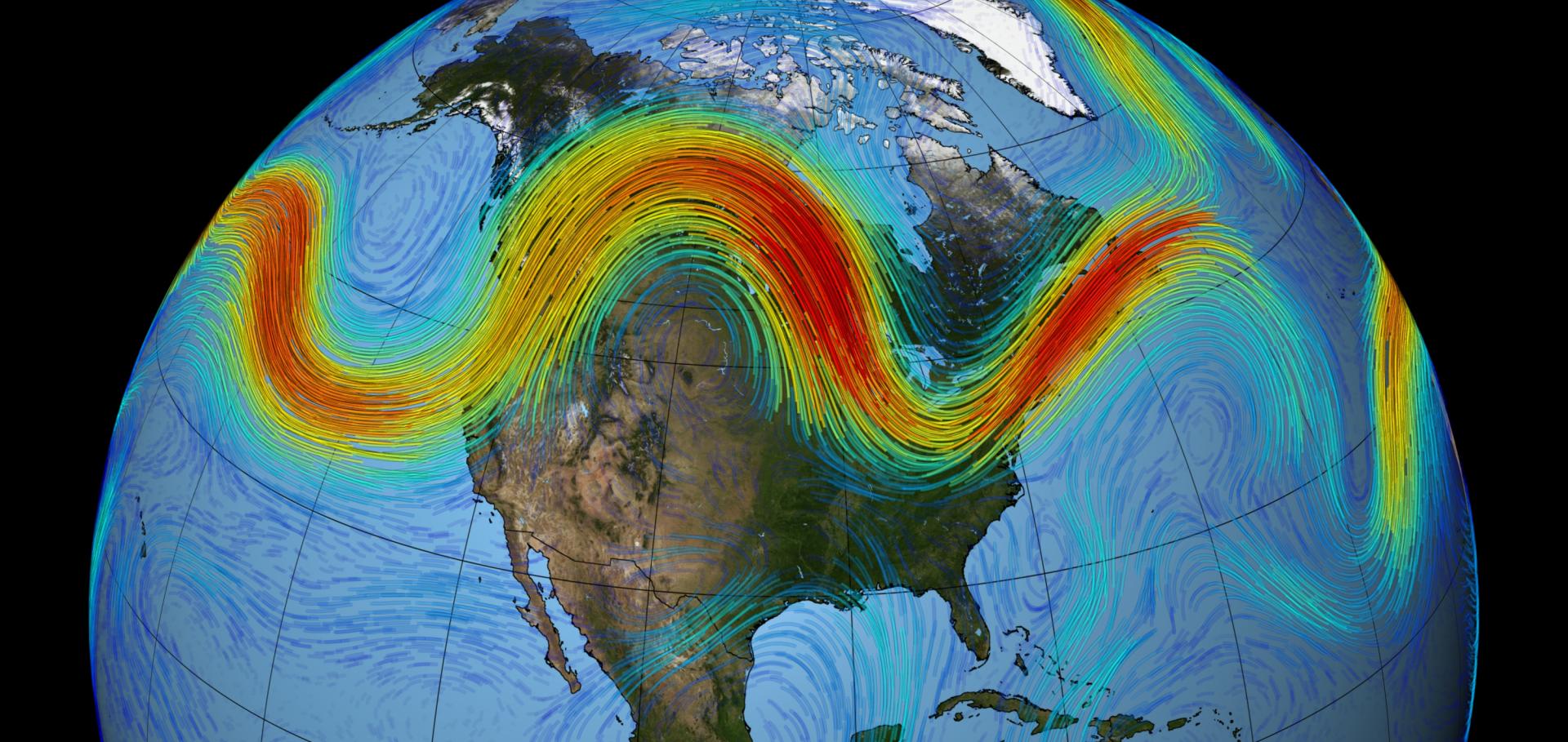
Nature Reviews Earth & Environment Springer Nature 6:12 (2025) 824-842