

Elucidating the long-range charge carrier mobility in metal halide perovskite thin films
Energy & Environmental Science Royal Society of Chemistry (RSC) (2018)
Abstract:
Many optoelectronic properties have been reported for lead halide perovskite polycrystalline films. However, ambiguities in the evaluation of these properties remain, especially for long-range lateral charge transport, where ionic conduction...
Hysteresis Index: A Figure without Merit for Quantifying Hysteresis in Perovskite Solar Cells
ACS Energy Letters American Chemical Society (ACS) 3:10 (2018) 2472-2476
Perovskite based optoelectronics: molecular design perspectives – a themed collection
Molecular Systems Design & Engineering Royal Society of Chemistry (RSC) 3:5 (2018) 700-701
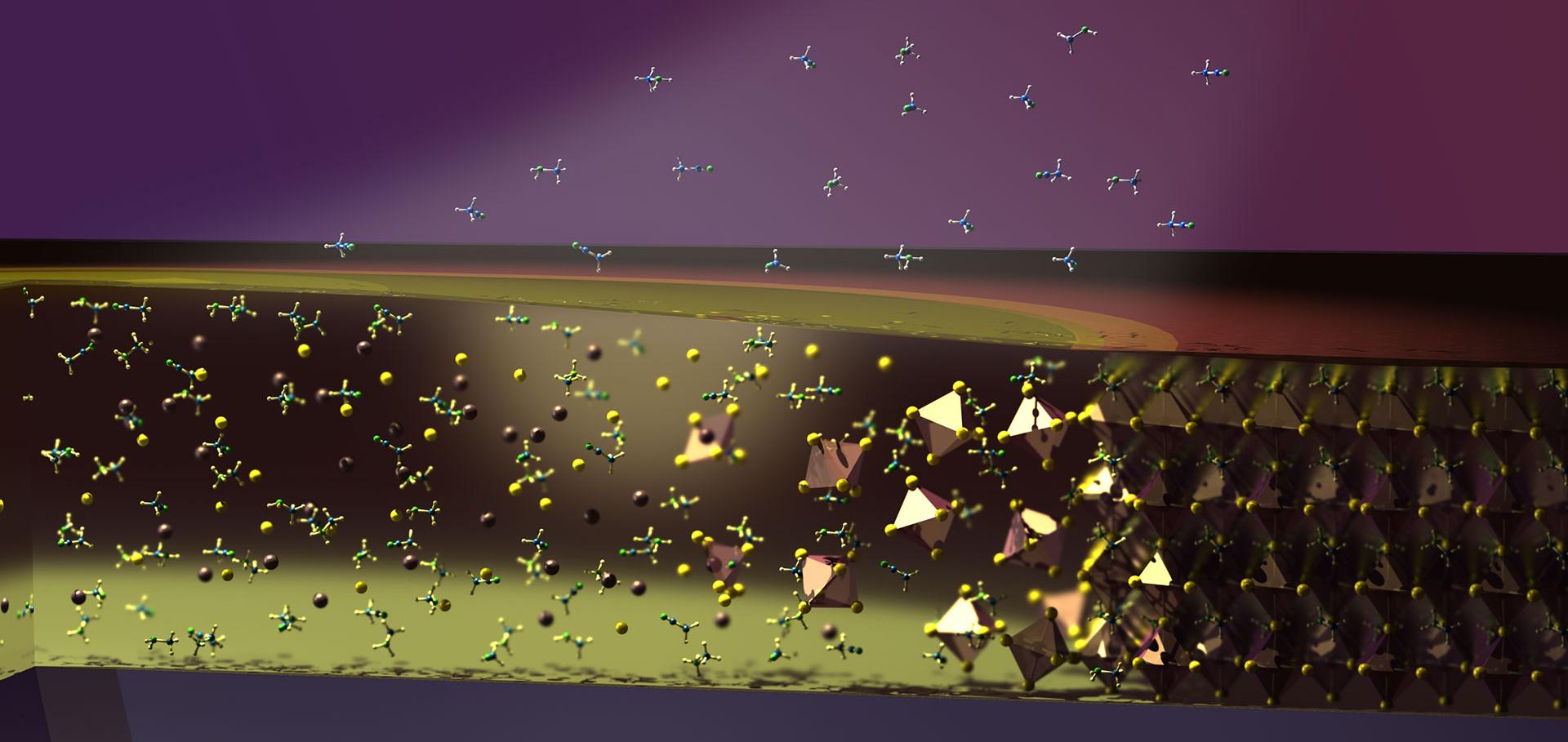
Unravelling the improved electronic and structural properties of methylammonium lead iodide deposited from acetonitrile
Chemistry of Materials American Chemical Society 30:21 (2018) 7737-7743
Abstract:
Perovskite-based photovoltaics are an emerging solar technology with lab scale device efficiencies of over 22 %, and significant steps are being made toward their commercialization. Conventionally high efficiency perovskite solar cells are formed from high boiling point, polar aprotic solvent solutions. Methylammonium lead iodide (CH3NH3PbI3) films can be made from a range of solvents and blends; however, the role the solvent system plays in determining the properties of the resulting perovskite films is poorly understood. Acetonitrile (ACN), in the presence of methylamine (MA), is a viable nontoxic solvent for fabrication of CH3NH3PbI3 photovoltaic devices with efficiencies >18 %. Herein we examine films prepared from ACN/MA and dimethylformamide (DMF) and scrutinize their physical and electronic properties using spectroscopy, scanning probe imaging, and ion scattering. Significant differences are observed in the chemistry and electronic structure of CH3NH3PbI3 films made with each solvent, ACN/MA produces films with superior properties resulting in more efficient photovoltaic devices. Here we present a holistic and complete understanding of a high performance perovskite material from an electronic, physical, and structural perspective and establish a robust toolkit with which to understand and optimize photovoltaic perovskites.Modification of the fluorinated tin oxide/electron-transporting material interface by a strong reductant and its effect on perovskite solar cell efficiency
Molecular Systems Design and Engineering Royal Society of Chemistry 3:5 (2018) 741-747