

A low viscosity, low boiling point, clean solvent system for the rapid crystallisation of highly specular perovskite films
ENERGY & ENVIRONMENTAL SCIENCE 10:1 (2017) 145-152
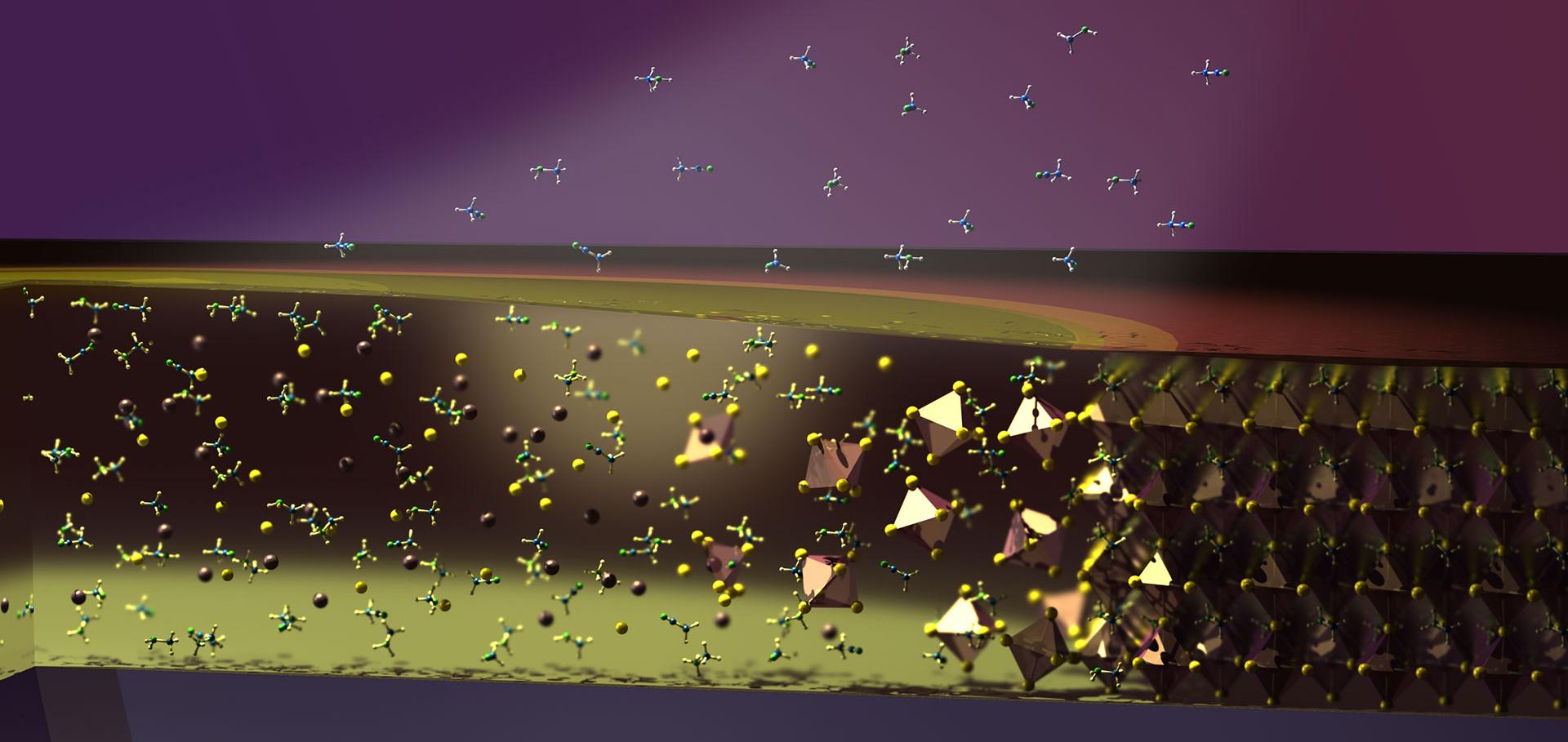
Mechanism for rapid growth of organic-inorganic halide perovskite crystals.
Nat Commun 7 (2016) 13303-13303
Abstract:
Optoelectronic devices based on hybrid halide perovskites have shown remarkable progress to high performance. However, despite their apparent success, there remain many open questions about their intrinsic properties. Single crystals are often seen as the ideal platform for understanding the limits of crystalline materials, and recent reports of rapid, high-temperature crystallization of single crystals should enable a variety of studies. Here we explore the mechanism of this crystallization and find that it is due to reversible changes in the solution where breaking up of colloids, and a change in the solvent strength, leads to supersaturation and subsequent crystallization. We use this knowledge to demonstrate a broader range of processing parameters and show that these can lead to improved crystal quality. Our findings are therefore of central importance to enable the continued advancement of perovskite optoelectronics and to the improved reproducibility through a better understanding of factors influencing and controlling crystallization.Investigating the role of 4-tert butylpyridine in perovskite solar cells
Advanced Energy Materials Wiley 7:1 (2016) 1601079
Abstract:
The majority of hole‐transporting layers used in n‐i‐p perovskite solar cells contain 4‐tert butylpyridine (tBP). High power‐conversion efficiencies and, in particular, good steady‐state performance appears to be contingent on the inclusion of this additive. On the quest to improve the steady state efficiencies of the carbon nanotube‐based hole‐transporter system, this study has found that the presence of tBP results in an extraordinary improvement in the performance of these devices. By deconstructing a prototypical device and investigating the effect of tBP on each individual layer, the results of this study indicate that this performance enhancement must be due to a direct chemical interaction between tBP and the perovskite material. This study proposes that tBP serves to p‐dope the perovskite layer and investigates this theory with poling and work function measurements.Hydrophobic Organic Hole Transporters for Improved Moisture Resistance in Metal Halide Perovskite Solar Cells
ACS Applied Materials & Interfaces American Chemical Society (ACS) 8:9 (2016) 5981-5989
Enhanced optoelectronic quality of perovskite thin films with hypophosphorous acid for planar heterojunction solar cells
(2015)