

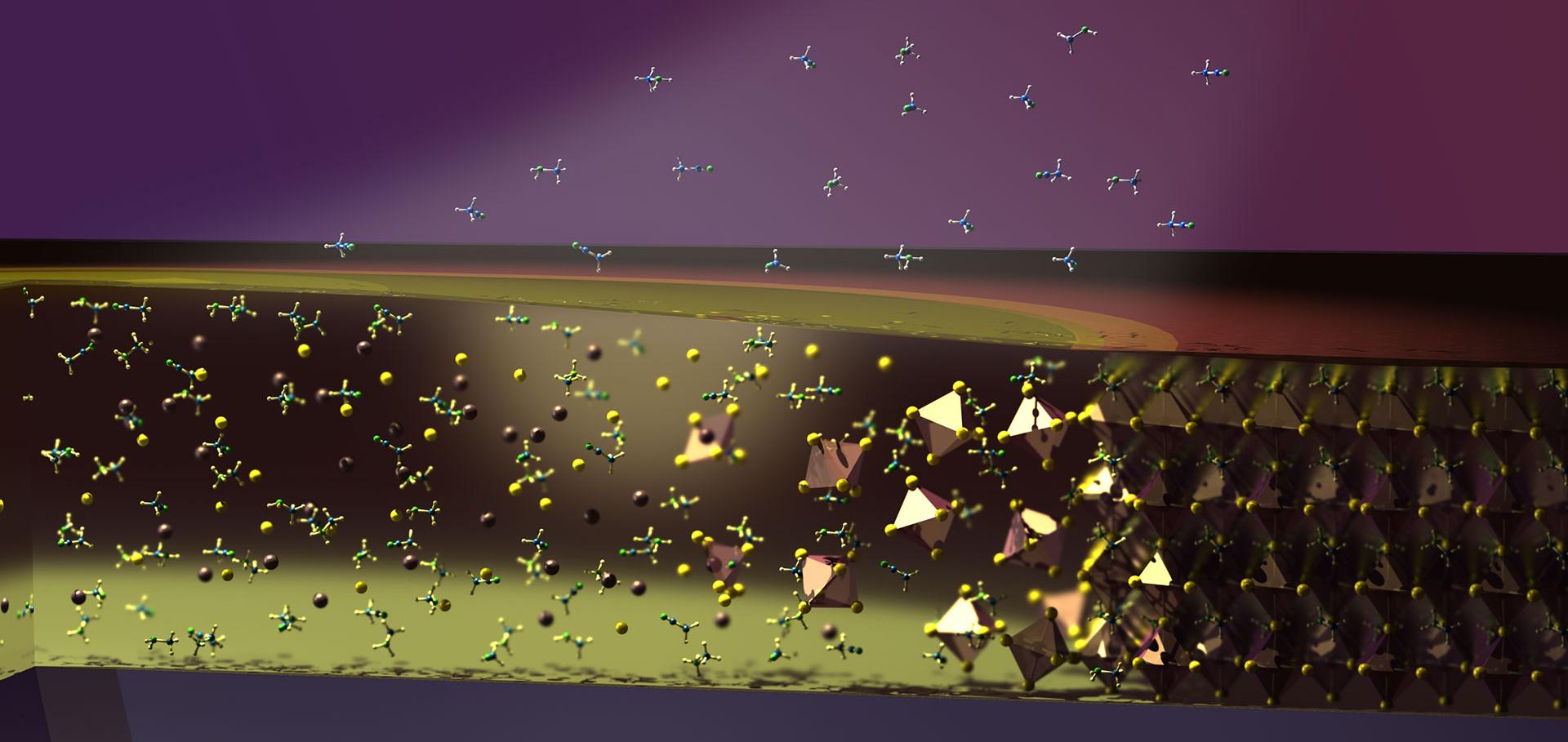
Circumventing the miscibility gap: kinetic pathways to ensure true bandage tunability in metal halide perovskites
Abstract:
Mixed-halide metal halide perovskites offer tunable bandgaps and are promising candidates for photovoltaic applications. However, the practical use of formamidinium (FA)-based mixed-halide perovskites has been limited by the presence of a compositional miscibility gap, which prevents the formation of the photoactive α-phase across a significant portion of the iodide–bromide composition range using conventional processing methods.In this work, the miscibility gap is reproduced experimentally and its origin is investigated using machine-learning interatomic potential (MLIP) modelling. The results show that the miscibility gap arises from a near-degeneracy in the Gibbs free energy of the α- and δ-phases at intermediate bromide compositions, rather than from an intrinsic instability of the α-phase alone. The results also indicate that the presence of the miscibility gap, and the degree of suppression of the α-phase, are dependent on the crystallisation pathway used to process the films.
Based on this, a 2D/3D templated crystallisation strategy is developed using butylammoniumbased Ruddlesden–Popper templates. This approach enables phase-pure α-FAPb(I1−xBrx)3 to be obtained across the full composition range. Computational modelling suggests that the 2D template stabilises mixed-halide compositions through site-selective ordering on inequivalent halide sites, while subsequent thermal conversion kinetically preserves the halide framework.The resulting films exhibit favourable optoelectronic properties, including high charge-carrier mobility and long carrier lifetimes. Photovoltaic devices fabricated using the templated films achieve a stabilised power conversion efficiency of 17.1%, demonstrating the viability of this approach for device applications.
The final set of investigations examined whether Cs incorporation or templating plays a more important role in determining film stability. Although Cs was successfully incorporated into the films, they remained metastable and were substantially less stable than conventional FACs films. As a result, this question remains unresolved, as the templated films exhibit a distinct degradation pathway that appears to be independent of Cs content.
Overall, this work provides both a comprehensive understanding of the miscibility gap and a practical strategy for overcoming it, enabling access to FA-based mixed-halide perovskites across the full compositional space.
Passivation of vapour deposited metal halide perovskites for high performance photovoltaic devices
Abstract:
Metal-halide perovskites have exhibited excellent optoelectronic properties and are widely used as the photoactive layers in photovoltaics. While predominantly a research innovation which showed significant promise on a lab-scale, as of 2024, perovskite solar cells are moving towards large-scale commercialisation. While vapour phase deposition processes dominate the established thin-film manufacturing, perovskite solar cells are still predominantly developed using solution-based methods. To enable scalable fabrication and industry adoption, it is imperative to advance the understanding of metal-halide perovskite thin-films fabricated by the vapour deposition technique. This thesis advances the understanding of vapourdeposited perovskite thin films and establishes several key strategies to reduce bulk and interfacial defect densities, thereby enhancing the performance and stability of vapour-deposited devices.A major advance presented in this work is the elucidation of how organic impurities in commercial formamidinium iodide precursors influence film formation in both solution- and vapour-deposited systems. It is demonstrated that, while such impurities can beneficially passivate defects in solution-processed films, they induce altered sublimation behaviour in vapour deposition, leading to off-stoichiometric compositions and the formation of non-photoactive polytype phases. These findings establish impurity control as a critical requirement for achieving phase-pure, highquality perovskite layers by vapour deposition.
A second key contribution is the introduction of a templating strategy that decouples perovskite nucleation from the underlying charge-transport substrate. This approach enables consistent film morphology, crystallographic orientation, and optoelectronic quality across diverse substrates. By providing a means to tune initial perovskite stoichiometry and suppress unwanted interfacial reactions, this templating method offers a scalable route toward reproducible, high-performance vapour-deposited perovskite devices.
Furthermore, this thesis demonstrates the use of aromatic ammonium halides as vapour-deposited passivation agents and reveals that their structural and functional properties depend strongly on the deposition method and post-deposition treatment. The work establishes that measurement atmosphere and thermal annealing can drive surface reconstruction and modulate passivation efficiency, thereby highlighting new levers for interface engineering in vapour-deposited perovskites.
Collectively, this research provides a comprehensive understanding of impurity effects, interfacial templating, and molecular passivation in vapour-deposited perovskite solar cells. These insights pave the way toward scalable, stable, and highefficiency perovskite photovoltaics compatible with industrial thin-film manufacturing.