

Atomic Layer Deposited Electron Transport Layers in Efficient Organometallic Halide Perovskite Devices
MRS Advances 3:51 (2018) 3075-3084
Abstract:
Copyright © Materials Research Society 2018Â. Amorphous TiO2 and SnO2 electron transport layers (ETLs) were deposited by low-Temperature atomic layer deposition (ALD). Surface morphology and x-ray photoelectron spectroscopy (XPS) indicate uniform and pinhole free coverage of these ALD hole blocking layers. Both mesoporous and planar perovskite solar cells were fabricated based on these thin films with aperture areas of 1.04 cm2for TiO2 and 0.09 cm2and 0.70 cm2for SnO2. The resulting cell performance of 18.3 % power conversion efficiency (PCE) using planar SnO2 on 0.09 cm2and 15.3 % PCE using mesoporous TiO2 on 1.04 cm2active areas are discussed in conjunction with the significance of growth parameters and ETL composition.Highly crystalline methylammonium lead tribromide perovskite films for efficient photovoltaic devices
ACS Energy Letters American Chemical Society 3:6 (2018) 1233−1240
Abstract:
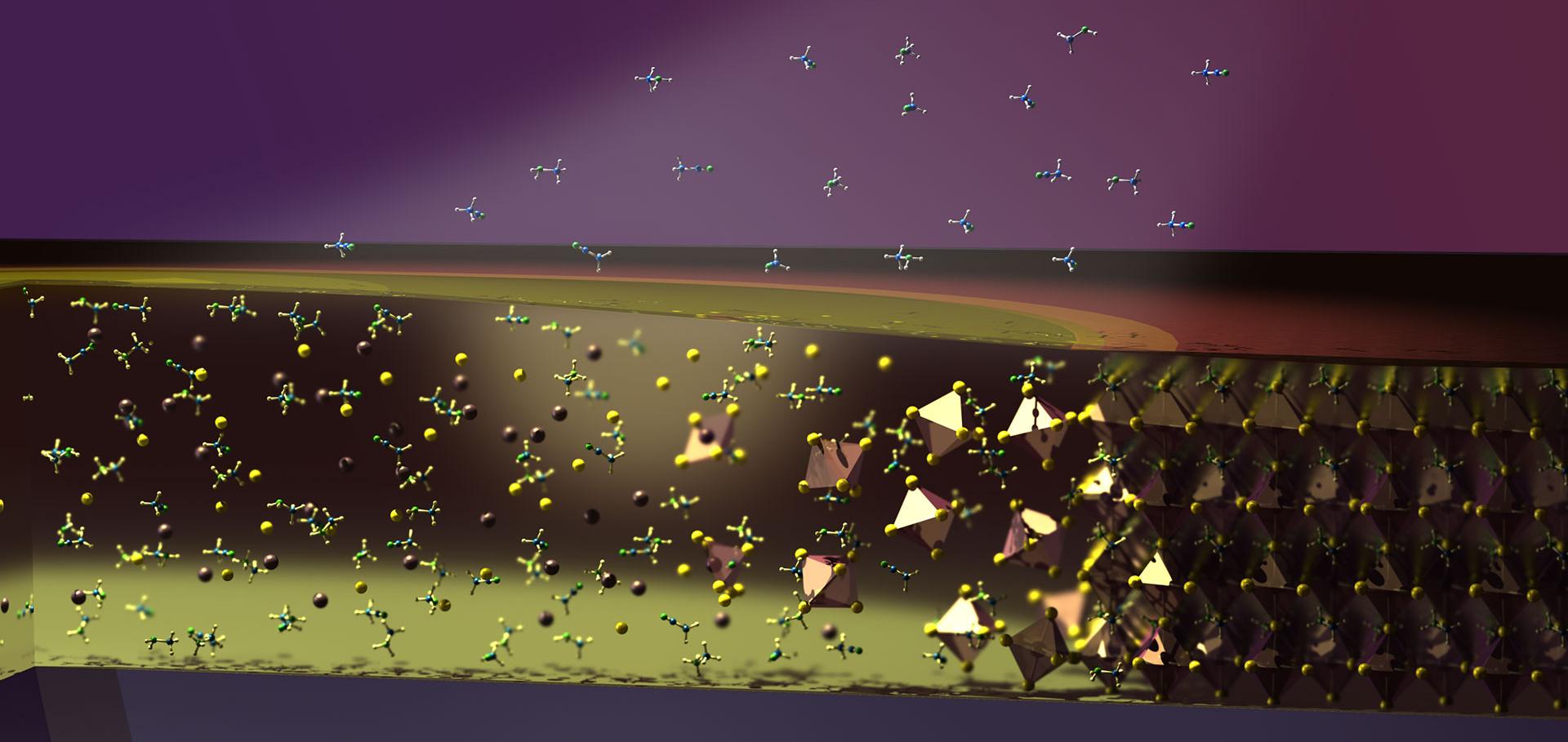
The rise of metal-halide perovskite solar cells has captivated the research community, promising to disrupt the current energy landscape. While a sizable percentage of the research done on this class of materials has been focused on the neat and iodide-rich perovskites, bromide-based perovskites can deliver substantially higher voltages because of their relatively wide band gaps of over 2 eV. The potential for efficient, high-voltage devices makes materials such as these incredibly attractive for multijunction photovoltaic applications. Here, we use the acetonitrile/methylamine solvent system to deposit smooth, highly crystalline films of CH3NH3PbBr3. By using choline chloride as a passivating agent for these films, we achieve photoluminescence quantum efficiencies of up to 5.5% and demonstrate charge-carrier mobilities of 17.8 cm2/(V s). Incorporating these films into photovoltaic devices, we achieve scanned power conversion efficiencies of up to 8.9%, with stabilized efficiencies of 7.6%, providing a simple route to realizing efficient, high-voltage CH3NH3PbBr3 planar-heterojunction devices.Carbon Nanotubes - the p-Type Contact of the Future for Perovskite Solar Cells?
ECS Meeting Abstracts The Electrochemical Society MA2018-01:5 (2018) 643-643
Crystallization kinetics and morphology control of formamidinium-cesium mixed-cation lead mixed-halide perovskite via tunability of the colloidal precursor solution
Fundacio Scito (2017)
Unveiling the influence of pH on the crystallization of hybrid perovskites, felivering low voltage loss photovoltaics
Joule Cell Press 1:2 (2017) 328-343