

A mini-chemical scheme with net reactions for 3D general circulation models
Astronomy & Astrophysics EDP Sciences 672 (2023) A110-A110
Abstract:
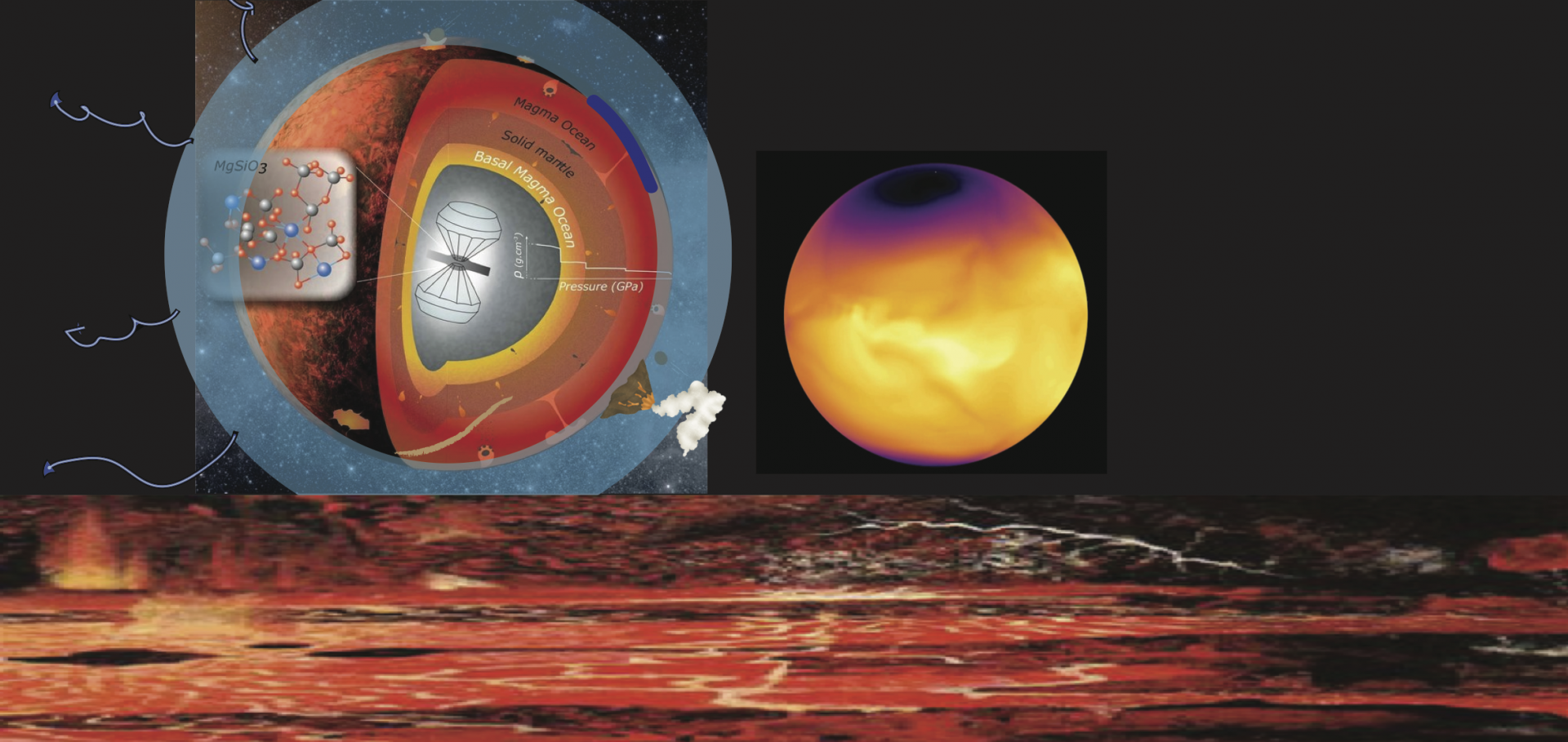
The chemical inventory of hot Jupiter (HJ) exoplanets atmospheres continue to be observed by various ground and space based instruments in increasing detail and precision. It is expected that some HJs will exhibit strong non-equilibrium chemistry characteristics in their atmospheres, which might be inferred from spectral observations. We aim to model the three dimensional thermochemical non-equilibrium chemistry in the atmospheres of the HJs WASP-39b and HD 189733b. We couple a lightweight, reduced chemical network `mini-chem' that utilises net reaction rate tables to the Exo-FMS General Circulation Model (GCM). We perform GCM models of the exoplanets WASP-39b and HD 189733b as case studies of the coupled mini-chem scheme. The GCM results are then post-processed using the 3D radiative-transfer model gCMCRT to produce transmission and emission spectra to assess the impact of non-equilibrium chemistry on their observable properties. Both simulations show significant departures from chemical equilibrium (CE) due to the dynamical motions of the atmosphere. The spacial distribution of species generally follows closely the dynamical features of the atmosphere rather than the temperature field. Each molecular species exhibits a different quench level in the simulations, also dependent on the latitude of the planet. Major differences are seen in the transmission and emission spectral features between the CE and kinetic models. Our simulations indicate that considering the 3D kinetic chemical structures of HJ atmospheres has an important impact on physical interpretation of observational data. Drawing bulk atmospheric parameters from fitting feature strengths may lead to inaccurate interpretation of chemical conditions in the atmosphere of HJs. Our open source mini-chem module is simple to couple with contemporary HJ GCM models without substantially increasing required computational resources.Comment: A&A Accepted 17 Feb 202The Runaway Greenhouse Effect on Hycean Worlds
(2023)
Early Release Science of the exoplanet WASP-39b with JWST NIRISS
Nature Springer Nature 614:7949 (2023) 670-675
Patchy Forsterite Clouds in the Atmospheres of Two Highly Variable Exoplanet Analogs
The Astrophysical Journal American Astronomical Society 944:2 (2023) 138-138
Abstract:
© 2023. The Author(s). Published by the American Astronomical Society. This is an open access article distributed under the Creative Commons Attribution License, to view a copy of the license, see: https://creativecommons.org/licenses/by/4.0/We present an atmospheric retrieval analysis of a pair of highly variable, ∼200 Myr old, early T type planetary-mass exoplanet analogs SIMP J01365662+0933473 and 2MASS J21392676+0220226 using the Brewster retrieval framework. Our analysis, which makes use of archival 1–15 μm spectra, finds almost identical atmospheres for both objects. For both targets, we find that the data is best described by a patchy, high-altitude forsterite (Mg2SiO4) cloud above a deeper, optically thick iron (Fe) cloud. Our model constrains the cloud properties well, including the cloud locations and cloud particle sizes. We find that the patchy forsterite slab cloud inferred from our retrieval may be responsible for the spectral behavior of the observed variability. Our retrieved cloud structure is consistent with the atmospheric structure previously inferred from spectroscopic variability measurements, but clarifies this picture significantly. We find consistent C/O ratios for both objects, which supports their formation within the same molecular cloud in the Carina-Near moving group. Finally, we note some differences in the constrained abundances of H2O and CO, which may be caused by data quality and/or astrophysical processes such as auroral activity and their differing rotation rates. The results presented in this work provide a promising preview of the detail with which we will characterize extrasolar atmospheres with JWST, which will yield higher-quality spectra across a wider wavelength range.Peer revieweThe Runaway Greenhouse on Sub-Neptune Waterworlds
The Astrophysical Journal American Astronomical Society 944:1 (2023) 20-20