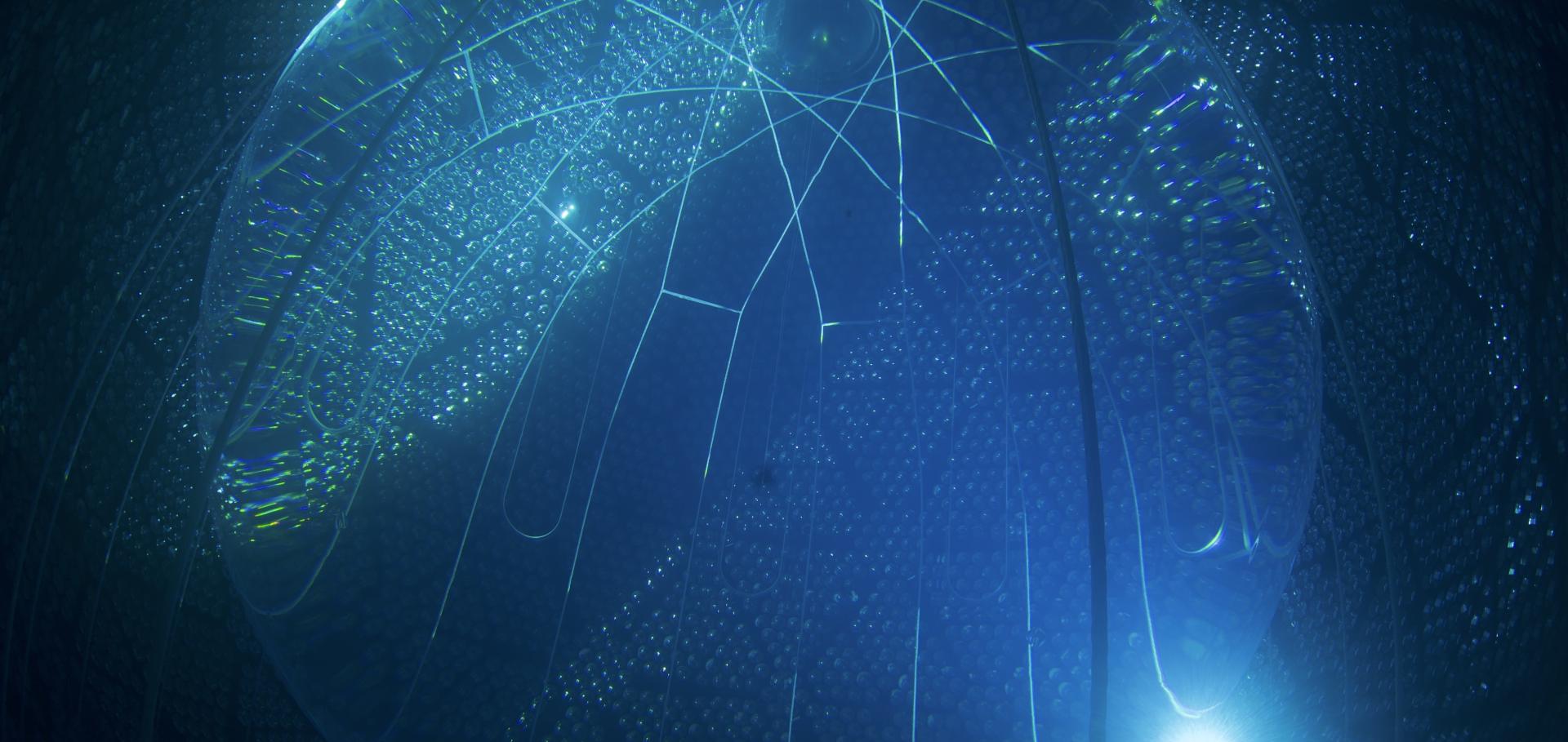
Constraints on Nucleon Decay via Invisible Modes from the Sudbury Neutrino Observatory

Physical Review Letters 92 (2004) 102004 4pp

Authors:

SD Biller, A.E. Anthony, E.W. Beier, S.N. Ahmed

Search for Pair Production of Scalar Top Quarks in R-Parity Violating Decay Modes in pp̄ Collisions at √s = 1.8 TeV

Physical Review Letters 92:5 (2004) 518031-518037

Authors:

D Acosta, T Affolder, H Akimoto, MG Albrow, D Ambrose, D Amidei, K Anikeev, J Antos, G Apollinari, T Arisawa, A Artikov, T Asakawa, W Ashmanskas, F Azfar, P Azzi-Bacchetta, N Bacchetta, H Bachacou, W Badgett, S Bailey, P de Barbaro, A Barbaro-Galtieri, VE Barnes, BA Barnett, S Baroiant, M Barone, G Bauer, F Bedeschi, S Behari, S Belforte, WH Bell, G Bellettini, J Bellinger, D Benjamin, J Bensinger, A Beretvas, J Berryhill, A Bhatti, M Binkley, D Bisello, M Bishai, RE Blair, C Blocker, K Bloom, B Blumenfeld, SR Blusk, A Bocci, A Bodek, G Bolla, A Bolshov, Y Bonushkin, D Bortoletto, J Boudreau, A Brandl, C Bromberg, M Brozovic, E Brubaker, N Bruner, J Budagov, HS Budd, K Burkett, G Busetto, KL Byrum, S Cabrera, P Calafiura, M Campbell, W Carithers, J Carlson, D Carlsmith, W Caskey, A Castro, D Cauz, A Cerri, L Cerrito, AW Chan, PS Chang, PT Chang, J Chapman, C Chen, YC Chen, MT Cheng, M Chertok, G Chiarelli, I Chirikov-Zorin, G Chlachidze, F Chlebana, L Christofek, ML Chu, JY Chung, WH Chung, YS Chung, CI Ciobanu, AG Clark, M Coca, AP Colijn, A Connolly, M Convery, J Conway, M Cordelli, J Cranshaw, R Culbertson

Abstract:

The search for pair production of scalar top quarks in an R-parity violating supersymmetry scenario in 106 pb-f of pp̄ collisions at √s = 1.8 TeV collected by the Collider Detector at Fermilab was discussed. It was found that in this mode each t1̃ decayed into a τ lepton and a b quark. The events with two τ's, one decaying leptonically and one decaying hadronically and two jets were searched. It was observed that a 95% confidence level lower limit was set on the t 1̄ mass at 122 GeV/c2 for Br(t1̃ → τb).

Direct photon cross section with conversions at CDF

Physical Review D - Particles, Fields, Gravitation and Cosmology 70:7 (2004)

Authors:

D Acosta, T Affolder, MG Albrow, D Ambrose, D Amidei, K Anikeev, J Antos, G Apollinari, T Arisawa, A Artikov, W Ashmanskas, F Azfar, P Azzi-Bacchetta, N Bacchetta, H Bachacou, W Badgett, A Barbaro-Galtieri, VE Barnes, BA Barnett, S Baroiant, M Barone, G Bauer, F Bedeschi, S Behari, S Belforte, WH Bell, G Bellettini, J Bellinger, D Benjamin, A Beretvas, A Bhatti, M Binkley, D Bisello, M Bishai, RE Blair, C Blocker, K Bloom, B Blumenfeld, A Bocci, A Bodek, G Bolla, A Bolshov, D Bortoletto, J Boudreau, C Bromberg, E Brubaker, J Budagov, HS Budd, K Burkett, G Busetto, KL Byrum, S Cabrera, M Campbell, W Carithers, D Carlsmith, A Castro, D Cauz, A Cerri, L Cerrito, J Chapman, C Chen, YC Chen, M Chertok, G Chiarelli, G Chlachidze, F Chlebana, ML Chu, JY Chung, WH Chung, YS Chung, CI Ciobanu, AG Clark, M Coca, A Connolly, M Convery, J Conway, M Cordelli, J Cranshaw, R Culbertson, D Dagenhart, S D'Auria, P Barbaro, S Cecco, S Dell'Agnello, M Dell'Orso, S Demers, L Demortier, M Deninno, D Pedis, PF Derwent, C Dionisi, JR Dittmann, A Dominguez, S Donati, M D'Onofrio, T Dorigo, N Eddy, R Erbacher, D Errede, S Errede

Abstract:

We present a measurement of the isolated direct photon cross section in [Formula Presented] collisions at [Formula Presented] and [Formula Presented] using data collected between 1994 and 1995 by the Collider Detector at Fermilab (CDF). The measurement is based on events where the photon converts into an electron-positron pair in the material of the inner detector, resulting in a two track event signature. To remove [Formula Presented] and [Formula Presented] events from the data we use a new background subtraction technique which takes advantage of the tracking information available in a photon conversion event. We find that the shape of the cross section as a function of photon [Formula Presented] is poorly described by next-to-leading-order QCD predictions, but agrees with previous CDF measurements. © 2004 The American Physical Society.

Heavy flavor properties of jets produced in pp̄ interactions at √s = 1.8 TeV

Physical Review D 69:7 (2004)

Authors:

D Acosta, D Ambrose, K Anikeev, J Antos, G Apollinari, T Arisawa, A Artikov, F Azfar, P Azzi-Bacchetta, N Bacchetta, VE Barnes, BA Barnett, M Barone, G Bauer, F Bedeschi, S Behari, S Belforte, WH Bell, G Bellettini, J Bellinger, A Beretvas, A Bhatti, D Bisello, C Blocker, B Blumenfeld, A Bocci, G Bolla, A Bolshov, D Bortoletto, J Budagov, HS Budd, K Burkett, G Busetto, S Cabrera, W Carithers, D Carlsmith, R Carosi, A Castro, D Cauz, A Cerri, C Chen, YC Chen, G Chiarelli, G Chlachidze, ML Chu, WH Chung, YS Chung, AG Clark, M Coca, M Convery, M Cordelli, J Cranshaw, D Dagenhart, S D'Auria, S Dell'Agnello, P de Barbaro, S de Cecco, M Dell'Orso, L Demortier, M Deninno, D de Pedis, C Dionisi, S Donati, M D'Onofrio, T Dorigo, R Eusebi, S Farrington, JP Fernandez, RD Field, I Fiori, A Foland, LR Flores-Castillo, M Franklin, J Friedman, I Furic, M Gallinaro, AF Garfinkel, E Gerstein, S Giagu, P Giannetti, K Giolo, M Giordani, P Giromini, V Glagolev, G Gomez, I Gorelov, AT Goshaw, K Goulianos, A Gresele, M Guenther, J Guimaraes da Costa, E Halkiadakis, C Hall, R Handler, F Happacher, K Hara, F Hartmann, K Hatakeyama, J Hauser, J Heinrich

Abstract:

We present a detailed examination of the heavy flavor properties of jets produced at the Fermilab Tevatron collider. The data set, collected with the Collider Detector at Fermilab, consists of events with two or more jets with transverse energy ET≥15 GeV and pseudorapidity |η|≤1.5. The heavy flavor content of the data set is enriched by requiring that at least one of the jets (lepton-jet) contains a lepton with a transverse momentum larger than 8 GeV/c. Jets containing hadrons with heavy flavor are selected via the identification of secondary vertices. The parton-level cross sections predicted by the HERWIG Monte Carlo generator program are tuned within theoretical and experimental uncertainties to reproduce the secondary-vertex rates in the data. The tuned simulation provides new information on the origin of the discrepancy between the bb̄ cross section measurements at the Tevatron and the next-to-leading order QCD prediction. We also compare the rate of away-jets (jets recoiling against the lepton-jet) containing a soft lepton (p T≥2 GeV/c) in the data to that in the tuned simulation. We find that this rate is larger than what is expected for the conventional production and semileptonic decay of pairs of hadrons with heavy flavor. © 2004 The American Physical Society.

Measurement of the average time-integrated mixing probability of b-flavored hadrons produced at the Fermilab Tevatron

Physical Review D - Particles, Fields, Gravitation and Cosmology 69:1 (2004)

Authors:

D Acosta, T Affolder, H Akimoto, MG Albrow, D Ambrose, D Amidei, K Anikeev, J Antos, G Apollinari, T Arisawa, A Artikov, T Asakawa, W Ashmanskas, F Azfar, P Azzi-Bacchetta, N Bacchetta, H Bachacou, W Badgett, S Bailey, P Barbaro, A Barbaro-Galtieri, VE Barnes, BA Barnett, S Baroiant, M Barone, G Bauer, F Bedeschi, S Behari, S Belforte, WH Bell, G Bellettini, J Bellinger, D Benjamin, J Bensinger, A Beretvas, J Berryhill, A Bhatti, M Binkley, D Bisello, M Bishai, RE Blair, C Blocker, K Bloom, B Blumenfeld, SR Blusk, A Bocci, A Bodek, G Bolla, A Bolshov, Y Bonushkin, D Bortoletto, J Boudreau, A Brandl, C Bromberg, M Brozovic, E Brubaker, N Bruner, J Budagov, HS Budd, K Burkett, G Busetto, KL Byrum, S Cabrera, P Calafiura, M Campbell, W Carithers, J Carlson, D Carlsmith, W Caskey, A Castro, D Cauz, A Cerri, L Cerrito, AW Chan, PS Chang, PT Chang, J Chapman, C Chen, YC Chen, M Cheng, M Chertok, G Chiarelli, I Chirikov-Zorin, G Chlachidze, F Chlebana, L Christofek, ML Chu, JY Chung, W Chung, YS Chung, CI Ciobanu, AG Clark, M Coca, A Connolly, M Convery, J Conway, M Cordelli, J Cranshaw, R Culbertson, D Dagenhart

Abstract:

We have measured the number of like-sign (LS) and opposite-sign (OS) lepton pairs arising from double semileptonic decays of b and [Formula Presented] hadrons, pair produced at the Fermilab Tevatron collider. The data samples were collected with the Collider Detector at Fermilab during the 1992–1995 collider run by triggering on the existence of [Formula Presented] or [Formula Presented] candidates in an event. The observed ratio of LS to OS dileptons leads to a measurement of the average time-integrated mixing probability of all produced b-flavored hadrons which decay weakly, [Formula Presented] that is significantly larger than the world average [Formula Presented] © 2004 The American Physical Society.